 Kwizi: Oli dayinoso ki?
 Olutalo lwa dayinoso
 Empaka z'emisinde gya dayinoso
 Emizannyo emitono egya dayinoso
 Alubaamu ya sitika
 Enkalala za dayinoso eza TOP
 Mpa ekyewuunyisa!
Yabeerawo ddi?

Yali munene atya?
Yali muwanvu kwenkana wa?
Yali mugulumivu kwenkana wa?
Yali muzito kwenkana wa?

 obuwanvu ng'embwa 9, ennyindo ku mukira🍌obuwanvu ng'amenvu 48 nga gaddiriŋŋanaobuzito ng'obw'embwa 190🍉obuzito ng'obwa wotamerooni 750🎒obuzito ng'obw'ebibiina 5 ebijjuvu eby'abaana b'essomero🐻❄️obuzito ng'obwa ddubu enjeru 8🏃yandidduse mita 100 mu sikonda 16 (omuntu asinga embiro yeetaaga 9.6)
Latirhinus yali munene atya bw'ogeraageranya ku GGWE?
Kubala kwokka mu browser yo. Tewali kiterekebwa wadde okusindikibwa wonna.
Yali wa mbiro kwenkana wa?


Ebyewuunyisa
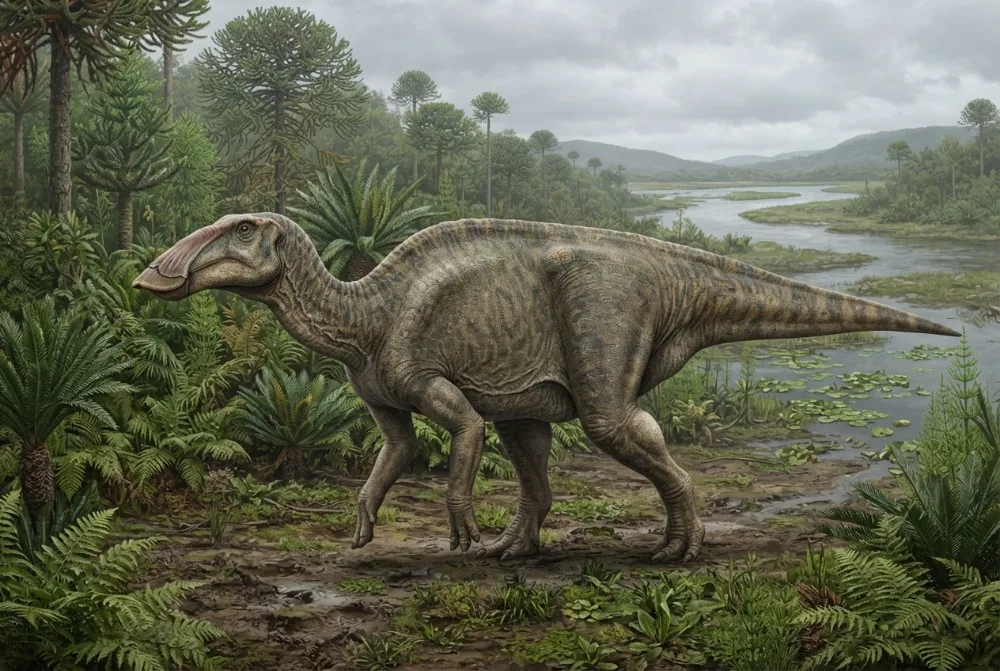
Latirhinus means 'broad nose' in Latin, because its nasal bone was wide and flat.1
The first skeleton of Latirhinus was found in the 1980s by a team from UNAM in Mexico.1
This dinosaur lived about 83 to 72 million years ago, during the Campanian age of the Late Cretaceous.13
The type species is named Latirhinus uitstlani, where 'uitstlani' means 'southern' in the Náhuatl language.1
Some scientists think Latirhinus was a lambeosaurine, a group of duck-billed dinosaurs with hollow head crests.1
The holotype skeleton includes parts of the nose, backbone, arms, legs, and feet.1
Ebibuuzo ebisinga okubuuzibwa ku Latirhinus
?How big was Latirhinus?
It was about 8.7 metres (29 feet) long and weighed around 3.75 metric tons (4.13 short tons). That is roughly as long as a school bus.1
?What did Latirhinus eat?
It was a plant-eater. It munched on plants with its many teeth, like other duck-billed dinosaurs.1
?Where was Latirhinus found?
Its fossils were found in Coahuila, Mexico, in the Cerro del Pueblo Formation. The first skeleton was discovered in the 1980s near the town of Presa de San Antonio.1
?Did Latirhinus have a crest?
Some scientists think it was a lambeosaurine, a group of duck-billed dinosaurs that often had hollow head crests. But its crest is not well known from the fossils.1
Eri abakugu mu dayinoso
- Erinnya lya ssaayansi
- Latirhinus
- Yatuumibwa
- Prieto-Márquez and Serrano Brañas 20124
- Ekibinja
- Ez'emimwa gy'embaata
- Ekika / ekibinja
- Hadrosauridae4
- Engabanya
- Ornithischia > Ornithopoda > Iguanodontia > Hadrosauridae4
- Emyaka gy'enjazi
- emyaka obukadde 84 okutuuka ku 72 (Campanian)4
- Ensengeka z'enjazi
- Cerro del Pueblo4
- Ensi
- Mekisiko4
- Ebisigalira ebyazuulibwa
- 1 mu The Paleobiology Database4
- Okuzuulibwa
- Latirhinus was named in 2012 by Albert Prieto-Márquez and Claudia Inés Serrano Brañas. The first fossils were found in the 1980s near Presa de San Antonio, Coahuila, Mexico, and were originally thought to be a different dinosaur called Kritosaurus.1
- Kikyakubaganyizibwako ebirowoozo
- Scientists still debate whether Latirhinus was a basal or a more advanced lambeosaurine within its family.1
Ebituufu gye biva
- Latirhinus (en.wikipedia.org)
- Latirhinus Prieto-Márquez & Serrano Brañas 2012 - Encyclopedia of Life (eol.org)
- PBDB Taxon (paleobiodb.org)
- Latirhinus in The Paleobiology Database (CC BY 4.0): emyaka, ebifo, ensengeka z'enjazi, engabanya.
Buli kituufu ku lupapula luno kirina ennamba eraga ensibuko yaakyo. Bwe tuba nga tukoze ensobi, tusonyiwe, ffe tuli bawagizi ba dayinoso, so si magazini ya ssaayansi. Tubuulire ku [email protected] tujja kugitereeza.
 Rex alumwa enjala! Dino Wiki pulojekiti ya taata eri mutabani we ayagala ennyo dayinoso, ya bwereere, tewali bulango era tewali bikulondoola. Abakulu basobola okuwa Rex akantu ak'okulya okuyamba okugikuuma ku mutimbagano.Liisa Rex
 Parasaurolophus
 Edmontosaurus
 Saurolophus
 Hypacrosaurus
 Corythosaurus
 Kritosaurus
 Tyrannosaurus
 Triceratops
 Velociraptor
 Spinosaurus
 Ankylosaurus
 Pteranodon