 Kwizi: Oli dayinoso ki?
 Olutalo lwa dayinoso
 Empaka z'emisinde gya dayinoso
 Emizannyo emitono egya dayinoso
 Alubaamu ya sitika
 Enkalala za dayinoso eza TOP
 Mpa ekyewuunyisa!
Longipteryx
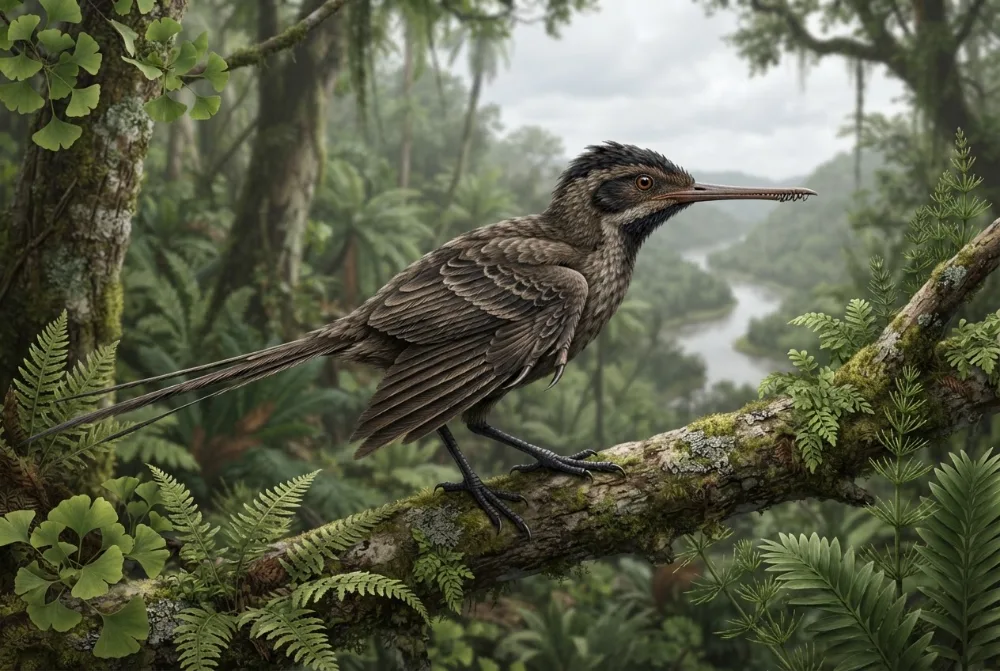
Longipteryx was a tiny bird that lived about 120 million years ago in what is now China. It had long, strong wings and a very long snout with hooked teeth at the tip. This little bird was a great flyer and could perch on branches like modern birds.12
Yabeerawo ddi?
Yali munene atya?
Ebiwaawaatiro bye byali bigazi kwenkana wa?
Yali muzito kwenkana wa?
Longipteryx yali munene atya bw'ogeraageranya ku GGWE?
Kubala kwokka mu browser yo. Tewali kiterekebwa wadde okusindikibwa wonna.
Yali wa mbiro kwenkana wa?


Ebyewuunyisa
Longipteryx had a very long snout that was longer than the rest of its head, with a few hooked teeth at the tip.1
Its wings were much longer than its legs, with the upper arm bone (humerus) being 1.56 times the length of the thigh bone (femur).1
Unlike most other early birds, Longipteryx had uncinate processes on its ribs, which helped strengthen its ribcage and improve breathing.12
Its feet were built for perching, with all four toe bones (metatarsals) ending at nearly the same level, just like modern perching birds.2
Scientists once thought Longipteryx ate fish or insects, but in 2024 a study found it actually ate seeds and fruits.1
Longipteryx had a big breastbone with a well-developed keel, which gave it powerful flight muscles.2
Ebibuuzo ebisinga okubuuzibwa ku Longipteryx
?How big was Longipteryx?
Longipteryx was very small, with a wingspan of about 46.3 cm (1.52 ft) and a body mass of about 193 g (6.8 oz).1
?What did Longipteryx eat?
Longipteryx ate fish. A 2024 study found fish remains in its stomach, showing it was a piscivore.13
?Did Longipteryx have feathers?
Yes, Longipteryx had feathers. The holotype preserves body feathers, wing coverts and down, but no long tail feathers.1
?Could Longipteryx fly?
Yes, Longipteryx was a good flyer. It had long, strong wings and a well-developed breastbone with a keel for powerful flight muscles.1
Omumenyi w'enfumo
Enfumo: Longipteryx was a fish-eater because of its long snout and teeth.
Amazima: Scientists now know from fossil evidence that Longipteryx ate seeds and fruits, not fish.1
Eri abakugu mu dayinoso
- Erinnya lya ssaayansi
- Longipteryx
- Yatuumibwa
- Zhang et al. 20004
- Ekibinja
- Ebinyonyi eby'olubereberye
- Ekika / ekibinja
- Longipterygidae4
- Engabanya
- Theropoda > Avialae4
- Emyaka gy'enjazi
- emyaka obukadde 121 okutuuka ku 113 (Aptian)4
- Ensengeka z'enjazi
- Jiufotang4
- Ensi
- Cayina4
- Ebisigalira ebyazuulibwa
- 3 mu The Paleobiology Database4
- Okuzuulibwa
- Longipteryx was named in 2000 by Zhang Fucheng and colleagues from a nearly complete skeleton found in the Jiufotang Formation in Chaoyang, China.42
- Kikyakubaganyizibwako ebirowoozo
- Scientists are not sure whether Longipteryx used its long snout and teeth to catch prey or for some other purpose.1
Ebituufu gye biva
- Longipteryx (en.wikipedia.org)
- Early diversification of birds: Evidence from a new opposite bird (ivpp.cas.cn)
- Direct evidence of frugivory in the Mesozoic bird Longipteryx contradicts morphological proxies for diet (cell.com)
- Longipteryx in The Paleobiology Database (CC BY 4.0): emyaka, ebifo, ensengeka z'enjazi, engabanya.
Buli kituufu ku lupapula luno kirina ennamba eraga ensibuko yaakyo. Bwe tuba nga tukoze ensobi, tusonyiwe, ffe tuli bawagizi ba dayinoso, so si magazini ya ssaayansi. Tubuulire ku [email protected] tujja kugitereeza.
 Rex alumwa enjala! Dino Wiki pulojekiti ya taata eri mutabani we ayagala ennyo dayinoso, ya bwereere, tewali bulango era tewali bikulondoola. Abakulu basobola okuwa Rex akantu ak'okulya okuyamba okugikuuma ku mutimbagano.Liisa Rex
 Archaeopteryx
 Hesperornis
 Ichthyornis
 Baptornis
 Jurapteryx
 Gobipteryx
 Stegosaurus
 Iguanodon
 Giganotosaurus
 Microraptor
 Deinonychus
 Baryonyx