 Kwizi: Oli dayinoso ki?
 Olutalo lwa dayinoso
 Empaka z'emisinde gya dayinoso
 Emizannyo emitono egya dayinoso
 Alubaamu ya sitika
 Enkalala za dayinoso eza TOP
 Mpa ekyewuunyisa!
Maiaspondylus
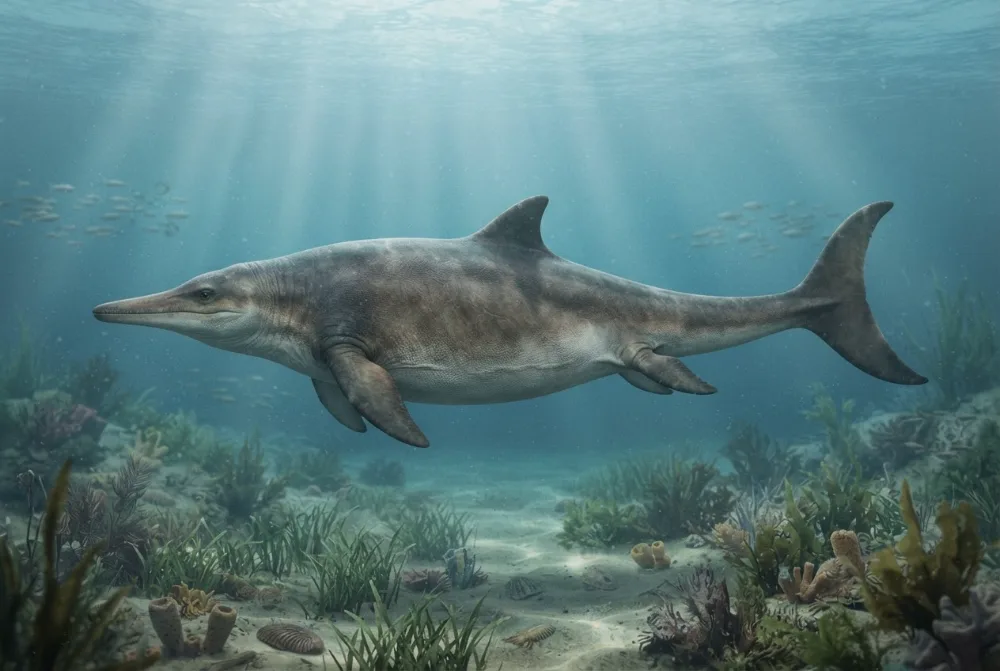
Maiaspondylus was a marine reptile that lived in the sea, not a dinosaur. It was an ichthyosaur, a fast-swimming predator with a long snout and sharp teeth. Fossils show that it gave birth to live babies, just like whales and dolphins do today.1
Yabeerawo ddi?
Yali munene atya?
Yali muwanvu kwenkana wa?
 obuwanvu ng'embwa 4, ennyindo ku mukira🍌obuwanvu ng'amenvu 22 nga gaddiriŋŋana🏊yandiwuze obuwanvu bw'ekidiba ekinene (50 m) mu sikonda 3.8
Maiaspondylus yali munene atya bw'ogeraageranya ku GGWE?
Kubala kwokka mu browser yo. Tewali kiterekebwa wadde okusindikibwa wonna.
Yali wa mbiro kwenkana wa?


Ebyewuunyisa
Maiaspondylus means 'caring mother vertebra' because a fossil was found with two embryos inside an adult, showing it gave live birth.1
The embryos found inside the adult are the smallest and youngest ichthyosaur embryos ever discovered.1
Maiaspondylus lived about 110 million years ago during the Early Cretaceous period.1
Its fossils were first found in the Loon River Formation in Canada's Northwest Territories.1
Maiaspondylus had a special skull bone arrangement: the jugal and maxilla overlapped a lot, which helped scientists tell it apart from other ichthyosaurs.2
Its teeth had smooth crowns and fluted cementum (the root covering), and they curved inward toward the tongue.2
The arm bone (humerus) of Maiaspondylus had three knobs at the end for muscles, with the middle knob smaller than the outer ones.2
Ebibuuzo ebisinga okubuuzibwa ku Maiaspondylus
?How big was Maiaspondylus?
No one knows for sure because no complete skeleton has been found. The known fossils include a nearly complete skeleton and vertebrae from adults, but scientists have not estimated its total length.1
?Did Maiaspondylus give live birth?
Yes. A fossil of an adult Maiaspondylus was found with two embryos inside, proving it gave birth to live babies, just like whales and dolphins.13
?Where was Maiaspondylus found?
Its fossils were first found in the Loon River Formation in Canada's Northwest Territories. Later, fossils were also found in England and Russia.1
Eri abakugu mu dayinoso
- Erinnya lya ssaayansi
- Maiaspondylus
- Yatuumibwa
- Maxwell and Caldwell 20064
- Ekibinja
- Ikisiyosawulu
- Ekika / ekibinja
- Ophthalmosauridae4
- Engabanya
- Ichthyosauria > Ichthyosauromorpha4
- Emyaka gy'enjazi
- emyaka obukadde 110 okutuuka ku 106 (Albian)4
- Ensengeka z'enjazi
- Loon River4
- Ensi
- Kanada4
- Ebisigalira ebyazuulibwa
- 1 mu The Paleobiology Database4
- Okuzuulibwa
- Maiaspondylus was named by scientists Erin Maxwell and Michael Caldwell in 2006. The fossils were found by technician Allan Lindoe, who collected and prepared them.1
- Kikyakubaganyizibwako ebirowoozo
- Scientists are still debating exactly how Maiaspondylus is related to other ichthyosaurs, especially the genus Platypterygius.1
Ebituufu gye biva
- Maiaspondylus (en.wikipedia.org)
- A NEW GENUS OF ICHTHYOSAUR FROM THE LOWER CRETACEOUS OF WESTERN CANADA (onlinelibrary.wiley.com)
- Pregnant prehistoric fossil offers clues to past | EurekAlert! (eurekalert.org)
- Maiaspondylus in The Paleobiology Database (CC BY 4.0): emyaka, ebifo, ensengeka z'enjazi, engabanya.
Buli kituufu ku lupapula luno kirina ennamba eraga ensibuko yaakyo. Bwe tuba nga tukoze ensobi, tusonyiwe, ffe tuli bawagizi ba dayinoso, so si magazini ya ssaayansi. Tubuulire ku [email protected] tujja kugitereeza.
 Rex alumwa enjala! Dino Wiki pulojekiti ya taata eri mutabani we ayagala ennyo dayinoso, ya bwereere, tewali bulango era tewali bikulondoola. Abakulu basobola okuwa Rex akantu ak'okulya okuyamba okugikuuma ku mutimbagano.Liisa Rex
 Ichthyosaurus
 Platypterygius
 Stenopterygius
 Khudiakovia
 Ophthalmosaurus
 Chonespondylus
 Stegosaurus
 Iguanodon
 Archaeopteryx
 Giganotosaurus
 Microraptor
 Deinonychus