 Kwizi: Oli dayinoso ki?
 Olutalo lwa dayinoso
 Empaka z'emisinde gya dayinoso
 Emizannyo emitono egya dayinoso
 Alubaamu ya sitika
 Enkalala za dayinoso eza TOP
 Mpa ekyewuunyisa!
Yabeerawo ddi?

Yali munene atya?
Yali muwanvu kwenkana wa?
Yali mugulumivu kwenkana wa?
kuteebereza
 obuwanvu ng'embwa 5, ennyindo ku mukira🍌obuwanvu ng'amenvu 28 nga gaddiriŋŋana🏃yandidduse mita 100 mu sikonda 21 (omuntu asinga embiro yeetaaga 9.6)
Nipponopelta yali munene atya bw'ogeraageranya ku GGWE?
Kubala kwokka mu browser yo. Tewali kiterekebwa wadde okusindikibwa wonna.
Yali wa mbiro kwenkana wa?


Ebyewuunyisa
Scientists used CT scans to see hidden bones inside the rock, like two complete teeth and part of the inner ear.12
Nipponopelta belonged to a group called nodosaurids, which had long spikes on their shoulders but no tail club.23
Its ancestors likely walked from North America to Asia across a land bridge called Beringia about 100 million years ago.32
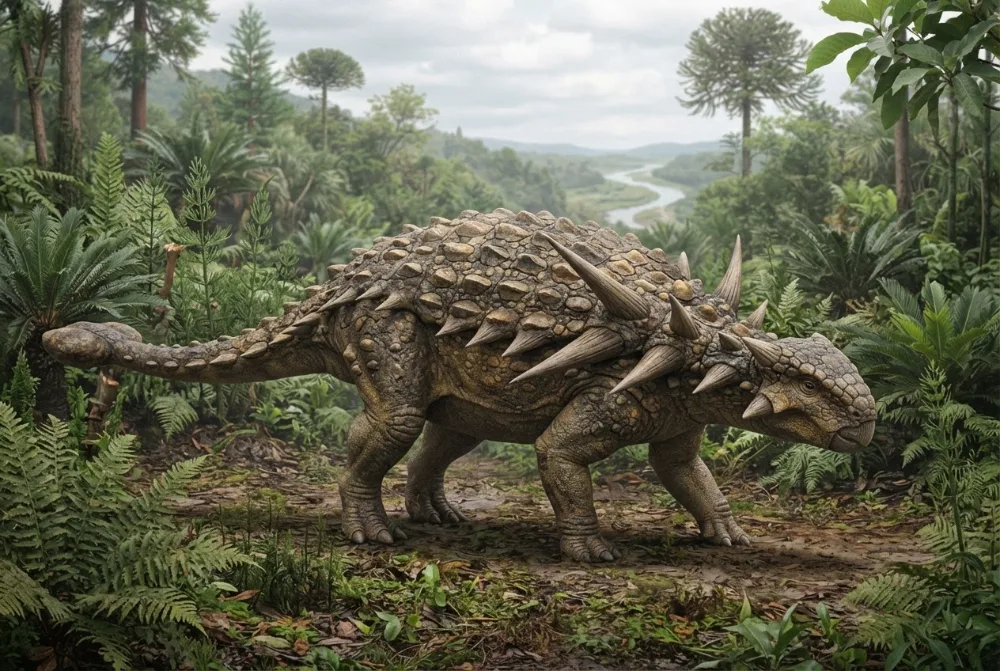
Ebibuuzo ebisinga okubuuzibwa ku Nipponopelta
?How big was Nipponopelta?
Scientists do not know its exact size because only a partial skull and a few bones have been found. It was probably similar in size to other nodosaurids, which were medium-sized, four-legged plant-eaters.1
?What did Nipponopelta eat?
It ate plants. Its teeth were small and leaf-shaped, good for cropping vegetation.3
?When did Nipponopelta live?
It lived during the Late Cretaceous period, about 96 to 94 million years ago.5
?Where was Nipponopelta found?
Its fossils were found in Hokkaido, Japan, along the bank of the Omakizawa River in Yūbari city.1
?Did Nipponopelta have a tail club?
No. Nipponopelta was a nodosaurid, and nodosaurids did not have a tail club. Instead, they had long spikes on their shoulders.3
?How did Nipponopelta get to Japan?
Its ancestors likely walked from North America to Asia across a land bridge called Beringia about 100 million years ago.3
?Is Nipponopelta a dinosaur?
Yes, Nipponopelta is a dinosaur. It is a type of armored dinosaur called a nodosaurid ankylosaur.1
?Why is it called Nipponopelta?
Its name means 'Japanese shield' in Greek and Japanese. 'Nippon' means Japan and 'pelta' means shield.1
Eri abakugu mu dayinoso
- Erinnya lya ssaayansi
- Nipponopelta
- Yatuumibwa
- Oyabu et al. 20276
- Ekibinja
- Dayinoso ez'engabo
- Ekika / ekibinja
- Nodosauridae6
- Engabanya
- Ornithischia > Ankylosauria > Nodosauridae > Thyreophora6
- Emyaka gy'enjazi
- emyaka obukadde 100 okutuuka ku 94 (Cenomanian)6
- Ensengeka z'enjazi
- Hikagenosawa6
- Ensi
- Japaani6
- Ebisigalira ebyazuulibwa
- 1 mu The Paleobiology Database6
- Okuzuulibwa
- The fossil was found by Eijiro Goto in 1995 in Yūbari, Hokkaido, Japan. In 2026, Shumpei Oyabu and colleagues named it Nipponopelta yezoensis after studying it with CT scans.12
- Kikyakubaganyizibwako ebirowoozo
- Scientists are not sure if Nipponopelta lived right on the coast or if its body was carried to the sea after death.13
Ebituufu gye biva
- Nipponopelta (en.wikipedia.org)
- 北海道産恐竜化石を「ニッポノペルタ・エゾエンシス」と命名 (hokudai.ac.jp)
- Rare armored dinosaur found in Japan may have ancestors that migrated across a land bridge 100 million years ago | Live Science (livescience.com)
- Nipponopelta yezoensis, Japan's First Definitive Ankylosaur (blog.everythingdinosaur.com)
- New Species of Armored Dinosaur Identified in Japan | Sci.News (sci.news)
- Nipponopelta in The Paleobiology Database (CC BY 4.0): emyaka, ebifo, ensengeka z'enjazi, engabanya.
Buli kituufu ku lupapula luno kirina ennamba eraga ensibuko yaakyo. Bwe tuba nga tukoze ensobi, tusonyiwe, ffe tuli bawagizi ba dayinoso, so si magazini ya ssaayansi. Tubuulire ku [email protected] tujja kugitereeza.
 Rex alumwa enjala! Dino Wiki pulojekiti ya taata eri mutabani we ayagala ennyo dayinoso, ya bwereere, tewali bulango era tewali bikulondoola. Abakulu basobola okuwa Rex akantu ak'okulya okuyamba okugikuuma ku mutimbagano.Liisa Rex
 Ankylosaurus
 Sauropelta
 Pinacosaurus
 Scutellosaurus
 Struthiosaurus
 Euoplocephalus
 Tyrannosaurus
 Triceratops
 Velociraptor
 Spinosaurus
 Parasaurolophus
 Pteranodon