 Kwizi: Oli dayinoso ki?
 Olutalo lwa dayinoso
 Empaka z'emisinde gya dayinoso
 Emizannyo emitono egya dayinoso
 Alubaamu ya sitika
 Enkalala za dayinoso eza TOP
 Mpa ekyewuunyisa!
Pararcus
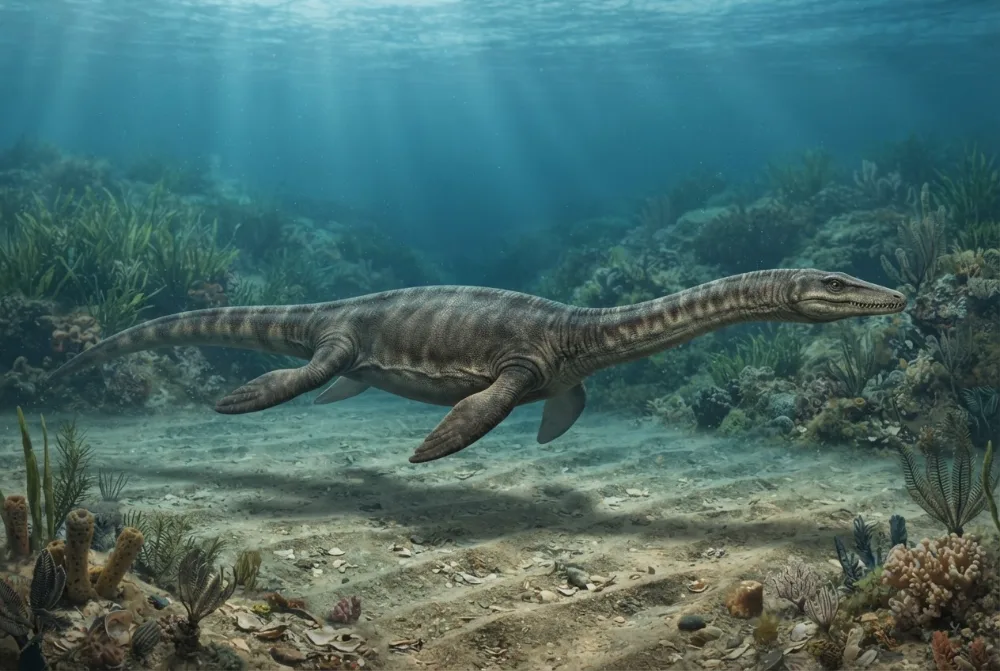
Pararcus was a marine reptile that lived in the shallow seas of the Netherlands about 245 million years ago. It had a flat body and strong, paddle-like limbs for swimming. Unlike many other placodonts, it did not have a heavy shell on its back.12
Yabeerawo ddi?
Yali munene atya?
Yali muwanvu kwenkana wa?
 obuwanvu nga kkapa 2.5 ab'awaka, ennyindo ku mukira🍌obuwanvu ng'amenvu 8 nga gaddiriŋŋana🏊yandiwuze obuwanvu bw'ekidiba ekinene (50 m) mu sikonda 16
Pararcus yali munene atya bw'ogeraageranya ku GGWE?
Kubala kwokka mu browser yo. Tewali kiterekebwa wadde okusindikibwa wonna.
Yali wa mbiro kwenkana wa?


Ebyewuunyisa
Pararcus had a special backbone where the neural arches (the parts that protect the spinal cord) were not fused together, even in adults. This is called paedomorphosis and is common in animals that live in the sea.1
Its hip bones (pubis and ischium) were flat and plate-like, which helped it swim efficiently.1
The only known fossil of Pararcus was found by a fossil collector named Gerben Diepenbroek, and the species is named after him.1
Pararcus lived during the Middle Triassic period, about 247 to 241 million years ago, when the Netherlands was covered by a shallow sea.2
Unlike some other placodonts that had heavy armour plates, Pararcus only had a few small, unfused armour plates scattered in its skin.1
The vertebrae of Pararcus were deeply hollowed out on both ends (amphicoelous) and still had a notochord, a flexible rod that runs through the spine.1
Eri abakugu mu dayinoso
- Erinnya lya ssaayansi
- Pararcus
- Yatuumibwa
- Klein and Scheyer 20142
- Ekibinja
- Ebyewalula eby'omu nnyanja
- Ekika / ekibinja
- Placodontia2
- Engabanya
- Placodontia > Sauropterygia2
- Emyaka gy'enjazi
- emyaka obukadde 247 okutuuka ku 241 ()2
- Ensengeka z'enjazi
- Vossenveld2
- Ensi
- Holandi2
- Ebisigalira ebyazuulibwa
- 1 mu The Paleobiology Database2
- Okuzuulibwa
- Pararcus was named in 2014 by Nicole Klein and Torsten Scheyer. The only fossil was found by Gerben Diepenbroek in a quarry near Winterswijk, the Netherlands.21
- Kikyakubaganyizibwako ebirowoozo
- Scientists are not sure exactly how Pararcus swam. Its flexible backbone and flat hip bones suggest it might have moved differently from other placodonts.1
Ebituufu gye biva
- Klein_20120147.indd (zora.uzh.ch)
- Pararcus in The Paleobiology Database (CC BY 4.0): emyaka, ebifo, ensengeka z'enjazi, engabanya.
Buli kituufu ku lupapula luno kirina ennamba eraga ensibuko yaakyo. Bwe tuba nga tukoze ensobi, tusonyiwe, ffe tuli bawagizi ba dayinoso, so si magazini ya ssaayansi. Tubuulire ku [email protected] tujja kugitereeza.
 Rex alumwa enjala! Dino Wiki pulojekiti ya taata eri mutabani we ayagala ennyo dayinoso, ya bwereere, tewali bulango era tewali bikulondoola. Abakulu basobola okuwa Rex akantu ak'okulya okuyamba okugikuuma ku mutimbagano.Liisa Rex
 Nothosaurus
 Placodus
 Lariosaurus
 Cyamodus
 Cymatosaurus
 Proneusticosaurus
 Chonespondylus
 Cymbospondylus
 Phalarodon
 Mixosaurus
 Chaohusaurus
 Chensaurus