 Kwizi: Oli dayinoso ki?
 Olutalo lwa dayinoso
 Empaka z'emisinde gya dayinoso
 Emizannyo emitono egya dayinoso
 Alubaamu ya sitika
 Enkalala za dayinoso eza TOP
 Mpa ekyewuunyisa!
Pervushovisaurus
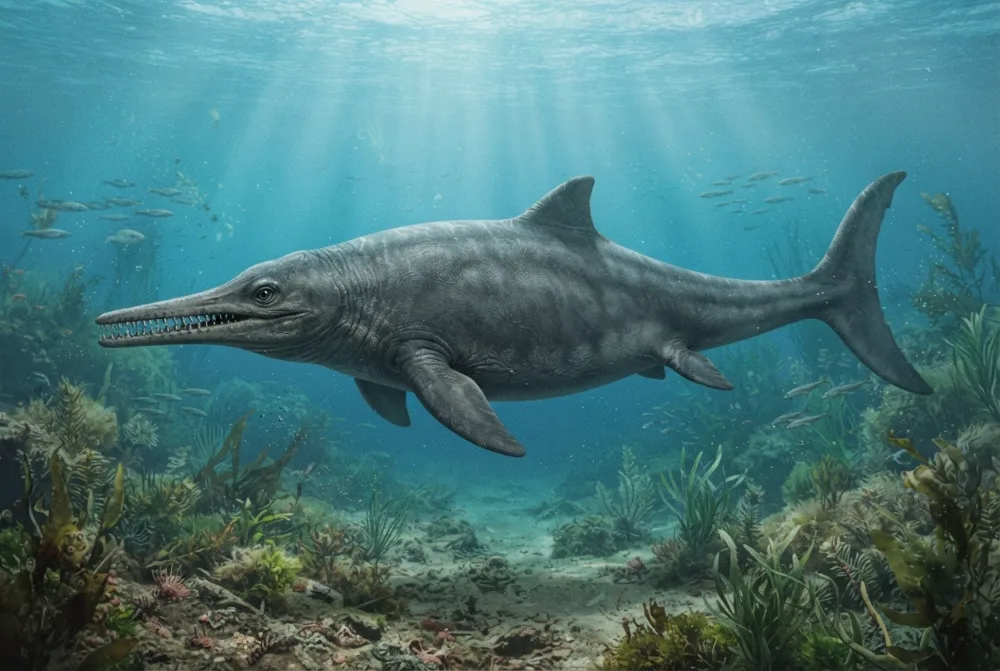
Pervushovisaurus was a fast-swimming marine reptile that looked like a dolphin with a long snout full of sharp teeth. It lived in the seas that covered Europe during the time of the dinosaurs, about 113 to 94 million years ago.31
Yabeerawo ddi?
Yali munene atya?
Yali muwanvu kwenkana wa?
 obuwanvu ng'embwa 6, ennyindo ku mukira🍌obuwanvu ng'amenvu 32 nga gaddiriŋŋana🏊yandiwuze obuwanvu bw'ekidiba ekinene (50 m) mu sikonda 4.1
Pervushovisaurus yali munene atya bw'ogeraageranya ku GGWE?
Kubala kwokka mu browser yo. Tewali kiterekebwa wadde okusindikibwa wonna.
Yali wa mbiro kwenkana wa?


Ebyewuunyisa
Pervushovisaurus was first thought to be a type of Platypterygius, but scientists later decided it was different enough to be its own genus.1
This ichthyosaur had a straight snout, unlike some of its relatives that had curved jaws.1
Its teeth had square roots with sharp 90-degree angles, which is unusual for an ichthyosaur.1
One species, Pervushovisaurus campylodon, was originally named Ichthyosaurus campylodon in 1846.1
Pervushovisaurus lived during the Cretaceous period, at the same time as dinosaurs like Tyrannosaurus and Triceratops, but in the ocean.3
Fossils of Pervushovisaurus have been found in the Melovatka Formation in Russia and the La Penthiève Beds in France.1
Like other ichthyosaurs, Pervushovisaurus gave birth to live young, not laying eggs on land.2
Ebibuuzo ebisinga okubuuzibwa ku Pervushovisaurus
?How big was Pervushovisaurus?
It was a medium-sized ichthyosaur, measuring about 5.8 metres (19 feet) long.1
?What did Pervushovisaurus eat?
It was a carnivore that ate fish and other sea creatures, using its long snout full of sharp teeth to catch prey.3
?Where did Pervushovisaurus live?
It lived in the seas that covered Europe during the Cretaceous period, and its fossils have been found in Russia, France, and the United Kingdom.1
?Is Pervushovisaurus a dinosaur?
No, it is not a dinosaur. It is an ichthyosaur, a marine reptile that lived in the ocean at the same time as dinosaurs.1
Eri abakugu mu dayinoso
- Erinnya lya ssaayansi
- Pervushovisaurus
- Yatuumibwa
- Arkhangelsky 19983
- Ekibinja
- Ikisiyosawulu
- Ekika / ekibinja
- Ophthalmosauridae3
- Engabanya
- Ichthyosauria > Ichthyosauromorpha3
- Emyaka gy'enjazi
- emyaka obukadde 113 okutuuka ku 94 (Albian / Cenomanian)3
- Ensengeka z'enjazi
- West Melbury Marly Chalk, Melovatskaya, La Penthiève Beds3
- Ensi
- Bufalansa, Bungereza, Rwasha, Bugirimaani3
- Ebisigalira ebyazuulibwa
- 14 mu The Paleobiology Database3
- Okuzuulibwa
- The genus Pervushovisaurus was named by Russian paleontologist M. S. Arkhangelsky in 1998, based on a partial skull from the Saratov region of Russia.13
- Kikyakubaganyizibwako ebirowoozo
- Scientists are still debating whether the two species Pervushovisaurus bannovkensis and Pervushovisaurus campylodon are truly distinct or if they represent the same animal.1
Ebituufu gye biva
- Pervushovisaurus (en.wikipedia.org)
- PBDB Taxon (paleobiodb.org)
- Pervushovisaurus in The Paleobiology Database (CC BY 4.0): emyaka, ebifo, ensengeka z'enjazi, engabanya.
Buli kituufu ku lupapula luno kirina ennamba eraga ensibuko yaakyo. Bwe tuba nga tukoze ensobi, tusonyiwe, ffe tuli bawagizi ba dayinoso, so si magazini ya ssaayansi. Tubuulire ku [email protected] tujja kugitereeza.
 Rex alumwa enjala! Dino Wiki pulojekiti ya taata eri mutabani we ayagala ennyo dayinoso, ya bwereere, tewali bulango era tewali bikulondoola. Abakulu basobola okuwa Rex akantu ak'okulya okuyamba okugikuuma ku mutimbagano.Liisa Rex
 Ichthyosaurus
 Platypterygius
 Stenopterygius
 Khudiakovia
 Ophthalmosaurus
 Chonespondylus
 Stegosaurus
 Iguanodon
 Archaeopteryx
 Giganotosaurus
 Microraptor
 Deinonychus