 Kwizi: Oli dayinoso ki?
 Olutalo lwa dayinoso
 Empaka z'emisinde gya dayinoso
 Emizannyo emitono egya dayinoso
 Alubaamu ya sitika
 Enkalala za dayinoso eza TOP
 Mpa ekyewuunyisa!
Psephoderma
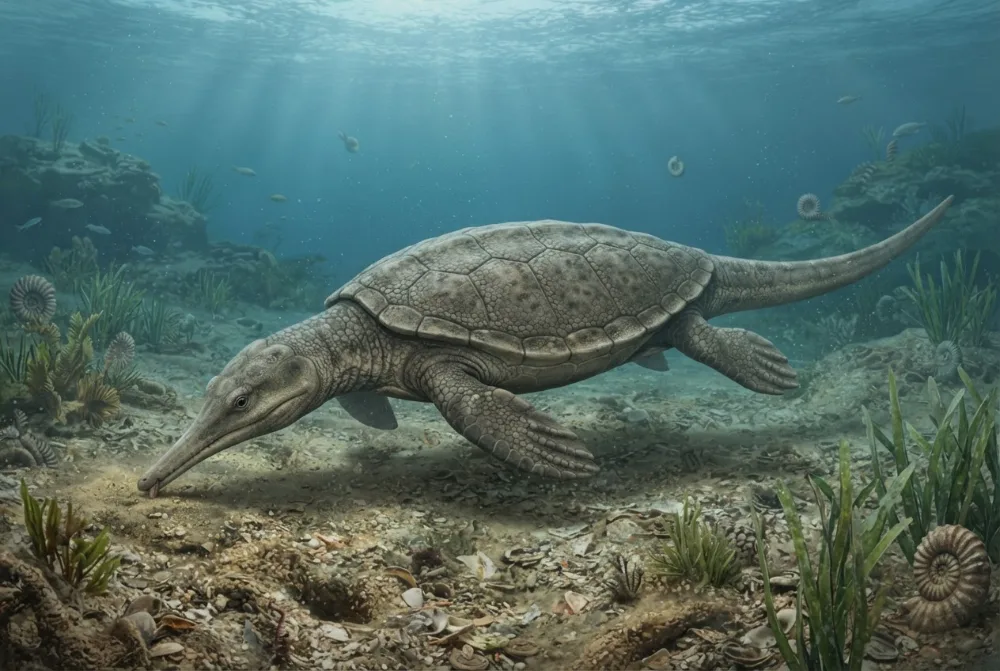
Psephoderma was a marine reptile that lived in the Late Triassic, about 210 million years ago. It had a flat skull and a shell made of two parts, like a turtle, and used its long snout to dig up shellfish from the seafloor.1
Yabeerawo ddi?
Yali munene atya?
Yali muwanvu kwenkana wa?
 obuwanvu nga kkapa 4 ab'awaka, ennyindo ku mukira🍌obuwanvu ng'amenvu 10 nga gaddiriŋŋana🏊yandiwuze obuwanvu bw'ekidiba ekinene (50 m) mu sikonda 16
Psephoderma yali munene atya bw'ogeraageranya ku GGWE?
Kubala kwokka mu browser yo. Tewali kiterekebwa wadde okusindikibwa wonna.
Yali wa mbiro kwenkana wa?


Ebyewuunyisa
Psephoderma had a long tail, up to about 80 cm (31 inches), covered in bony scutes.1
Its shell was split into two pieces: one over the ribs and another over the pelvis.1
The largest known Psephoderma fossil is 180 cm (5.9 feet) long.3
Its skull had a narrow, straight snout with grooves that led to the nostrils.1
Psephoderma had no teeth at the front of its mouth, only four large crushing teeth on each side of the palate.1
It lived in shallow, oxygen-rich waters near tidal channels, where it fed on shellfish like Modiolus and Isognomon.3
Ebibuuzo ebisinga okubuuzibwa ku Psephoderma
?Was Psephoderma a dinosaur?
No, Psephoderma was not a dinosaur. It was a marine reptile called a placodont, which is a type of sauropterygian.1
?How big was Psephoderma?
Psephoderma grew up to 180 centimetres (5.9 feet) long, which is about as long as a bathtub.1
?What did Psephoderma eat?
Psephoderma ate shellfish like Modiolus and Isognomon. It used its long snout to dig them up and crushed them with its large, flat teeth.3
?Could Psephoderma swim?
Yes, Psephoderma could swim. Its shell was streamlined for swimming, and it used its paddle-like limbs to move through the water.3
Eri abakugu mu dayinoso
- Erinnya lya ssaayansi
- Psephoderma
- Yatuumibwa
- von Meyer 18584
- Ekibinja
- Ebyewalula eby'omu nnyanja
- Ekika / ekibinja
- Placochelyida4
- Engabanya
- Placodontia > Sauropterygia4
- Emyaka gy'enjazi
- emyaka obukadde 243 okutuuka ku 201 ()4
- Ensengeka z'enjazi
- Calcare di Zu, Kössener Schichten, Zorzino Limestone4
- Ensi
- Yitale, Awusitiriya, Isirayeri, Bungereza4
- Ebisigalira ebyazuulibwa
- 10 mu The Paleobiology Database4
- Era emanyiddwa nga
- Placochelyanus (amannya ag'edda kati gabalibwa ng'ekisolo kye kimu)4
- Okuzuulibwa
- Psephoderma was named by German paleontologist Hermann von Meyer in 1858. Fossils have been found in the Alps and England.12
- Kikyakubaganyizibwako ebirowoozo
- Scientists are not sure if Psephoderma used its shell mainly for defense or for swimming, but some think it was shaped to help it glide through water.3
Ebituufu gye biva
- Psephoderma (en.wikipedia.org)
- PBDB Taxon (paleobiodb.org)
- FUNCTIONAL MORPHOLOGY AND MODE OF LIFE OF THE LATE TRIASSIC PLACODONT PSEPHODERMA ALPINUM MEYER FROM THE CALCARE DI ZORZINO (LOMBARDY, N ITALY) | RIVISTA ITALIANA DI PALEONTOLOGIA E STRATIGRAFIA (riviste.unimi.it)
- Psephoderma in The Paleobiology Database (CC BY 4.0): emyaka, ebifo, ensengeka z'enjazi, engabanya.
Buli kituufu ku lupapula luno kirina ennamba eraga ensibuko yaakyo. Bwe tuba nga tukoze ensobi, tusonyiwe, ffe tuli bawagizi ba dayinoso, so si magazini ya ssaayansi. Tubuulire ku [email protected] tujja kugitereeza.
 Rex alumwa enjala! Dino Wiki pulojekiti ya taata eri mutabani we ayagala ennyo dayinoso, ya bwereere, tewali bulango era tewali bikulondoola. Abakulu basobola okuwa Rex akantu ak'okulya okuyamba okugikuuma ku mutimbagano.Liisa Rex
 Nothosaurus
 Placodus
 Lariosaurus
 Cyamodus
 Cymatosaurus
 Proneusticosaurus
 Massospondylus
 Plateosaurus
 Coelophysis
 Podokesaurus
 Thecodontosaurus
 Eudimorphodon