 Kwizi: Oli dayinoso ki?
 Olutalo lwa dayinoso
 Empaka z'emisinde gya dayinoso
 Emizannyo emitono egya dayinoso
 Alubaamu ya sitika
 Enkalala za dayinoso eza TOP
 Mpa ekyewuunyisa!
Sclerocormus
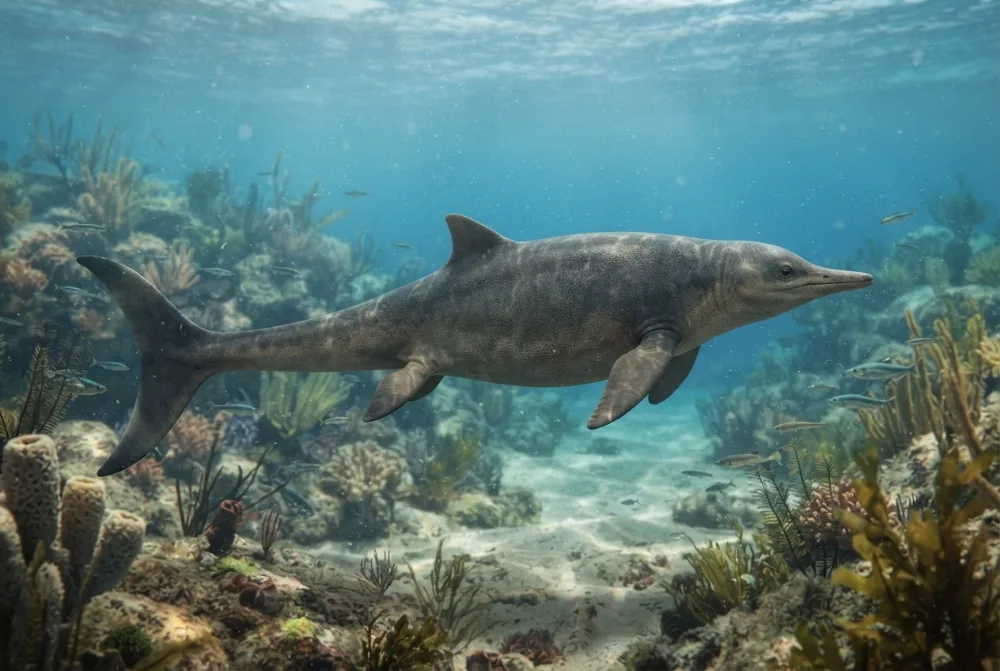
Sclerocormus was an early marine reptile that lived in the sea, not a dinosaur. It had a very tiny head and a long tail without a fluke, making it look different from later ichthyosaurs.1
Yabeerawo ddi?
Yali munene atya?
Yali muwanvu kwenkana wa?
Yali muzito kwenkana wa?
 obuwanvu nga kkapa 3 ab'awaka, ennyindo ku mukira🍌obuwanvu ng'amenvu 9 nga gaddiriŋŋana🍌obuzito ng'obw'amenvu 120🏊yandiwuze obuwanvu bw'ekidiba ekinene (50 m) mu sikonda 6.2
Sclerocormus yali munene atya bw'ogeraageranya ku GGWE?
Kubala kwokka mu browser yo. Tewali kiterekebwa wadde okusindikibwa wonna.
Yali wa mbiro kwenkana wa?


Ebyewuunyisa
Sclerocormus had an extremely small head that was only about 6.25% of its total body length, much smaller than other early marine reptiles like Chaohusaurus.1
Its tail was very long, making up about 58% of its total length, and it did not have a fluke like later ichthyosaurs.1
Sclerocormus had a heavily built body with flattened, overlapping belly ribs that formed a tight basket, similar to hupehsuchians.1
It lived during the Early Triassic period, about 248 to 247 million years ago, soon after the end-Permian mass extinction.41
Sclerocormus is one of the earliest known ichthyosauriforms, and its discovery shows that these marine reptiles evolved quickly within the first million years of their history.1
This reptile had large eyes with scleral plates, which are bony rings that help support the eye, like in many ichthyosaurs.1
Ebibuuzo ebisinga okubuuzibwa ku Sclerocormus
?How big was Sclerocormus?
Sclerocormus was about 1.6 metres (5.2 feet) long and weighed more than 15 kilograms (33 pounds).2
?What did Sclerocormus eat?
Sclerocormus was a suction feeder that used its narrow, toothless snout to suck in soft-bodied prey. Because its head and jaws were so small, it could only eat prey much smaller than itself.2
?Could Sclerocormus swim fast?
No, Sclerocormus was probably a slow swimmer. Its heavy build and body shape suggest it lived in shallow waters.2
?Is Sclerocormus a dinosaur?
No, Sclerocormus is not a dinosaur. It is an ichthyosauriform, a type of marine reptile that lived in the sea.2
Eri abakugu mu dayinoso
- Erinnya lya ssaayansi
- Sclerocormus
- Yatuumibwa
- Jiang et al. 20164
- Ekibinja
- Ikisiyosawulu
- Ekika / ekibinja
- Omphalosauridae4
- Engabanya
- Ichthyosauromorpha4
- Emyaka gy'enjazi
- emyaka obukadde 249 okutuuka ku 247 ()4
- Ensengeka z'enjazi
- Nanlinghu4
- Ensi
- Cayina4
- Ebisigalira ebyazuulibwa
- 1 mu The Paleobiology Database4
- Okuzuulibwa
- Sclerocormus was named by Jiang and colleagues in 2016 based on a single fossil skeleton found in the Nanlinghu Formation in Anhui, China.41
- Kikyakubaganyizibwako ebirowoozo
- Scientists are not sure exactly what Sclerocormus ate, because it had no teeth, but they think it may have been a suction feeder.1
Ebituufu gye biva
- A large aberrant stem ichthyosauriform indicating early rise and demise of ichthyosauromorphs in the wake of the end-Permian extinction | Scientific Reports (nature.com)
- Sclerocormus (en.wikipedia.org)
- A large aberrant stem ichthyosauriform indicating early rise and demise of ichthyosauromorphs in the wake of the end-Permian extinction | Scientific Reports (preview-www.nature.com)
- Sclerocormus in The Paleobiology Database (CC BY 4.0): emyaka, ebifo, ensengeka z'enjazi, engabanya.
Buli kituufu ku lupapula luno kirina ennamba eraga ensibuko yaakyo. Bwe tuba nga tukoze ensobi, tusonyiwe, ffe tuli bawagizi ba dayinoso, so si magazini ya ssaayansi. Tubuulire ku [email protected] tujja kugitereeza.
 Rex alumwa enjala! Dino Wiki pulojekiti ya taata eri mutabani we ayagala ennyo dayinoso, ya bwereere, tewali bulango era tewali bikulondoola. Abakulu basobola okuwa Rex akantu ak'okulya okuyamba okugikuuma ku mutimbagano.Liisa Rex
 Ichthyosaurus
 Platypterygius
 Stenopterygius
 Khudiakovia
 Ophthalmosaurus
 Chonespondylus
 Corosaurus