 Kwizi: Oli dayinoso ki?
 Olutalo lwa dayinoso
 Empaka z'emisinde gya dayinoso
 Emizannyo emitono egya dayinoso
 Alubaamu ya sitika
 Enkalala za dayinoso eza TOP
 Mpa ekyewuunyisa!
Yabeerawo ddi?

Yali munene atya?
Yali muwanvu kwenkana wa?
Yali mugulumivu kwenkana wa?
kuteebereza
Yali muzito kwenkana wa?
 obuwanvu ng'embwa 4, ennyindo ku mukira🍌obuwanvu ng'amenvu 25 nga gaddiriŋŋana🍉obuzito ng'obwa wotamerooni 260🧸obuzito ng'obw'abaana 68 ab'omu nnasale🎒obuzito ng'obw'abaana b'essomero 41🐻❄️obuzito ng'obwa ddubu enjeru 3🏃yandidduse mita 100 mu sikonda 9.7 (omuntu asinga embiro yeetaaga 9.6)
Spinops yali munene atya bw'ogeraageranya ku GGWE?
Kubala kwokka mu browser yo. Tewali kiterekebwa wadde okusindikibwa wonna.
Yali wa mbiro kwenkana wa?


Ebyewuunyisa
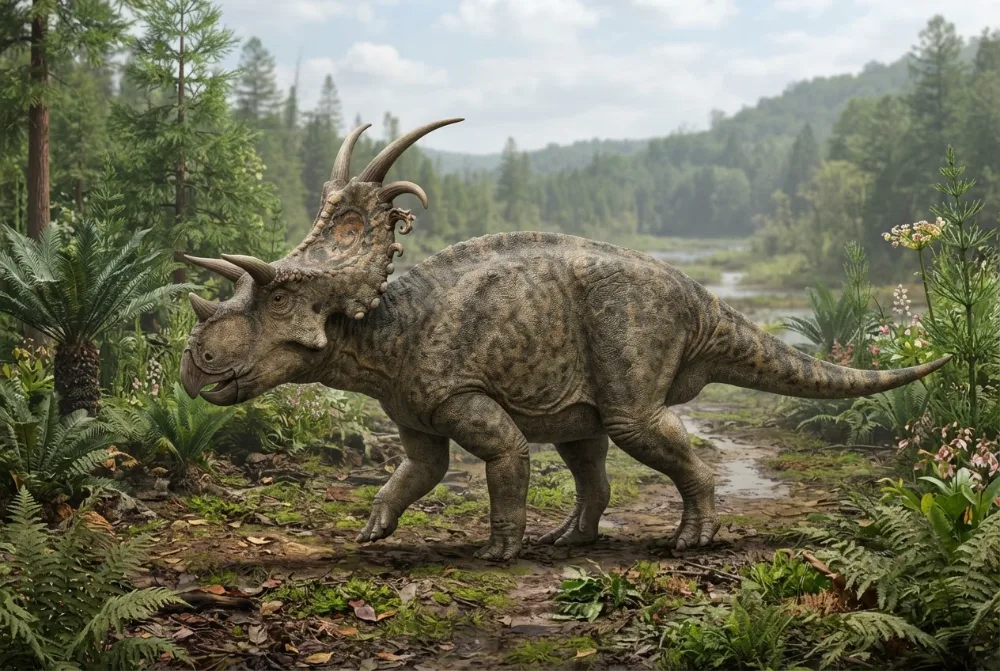
Spinops had a pair of forward-curving hooks on the middle of its frill, and just next to them were extremely long, backward-pointing spikes.1
The fossils of Spinops were first collected in 1916 by Charles H. Sternberg and his son Levi, but they sat in a museum in London for almost 100 years before scientists studied them.21
Spinops was named in 2011, making it a relatively new dinosaur even though its bones were found long ago.24
Scientists think Spinops lived about 76.5 million years ago, during the Late Cretaceous period.2
Ebibuuzo ebisinga okubuuzibwa ku Spinops
?How big was Spinops?
Spinops was about 4.5 metres long and weighed around 1.3 metric tons. That is roughly the size of a small car.23
?What did Spinops eat?
Spinops was a plant-eater. It used its beak to clip leaves and other plants.3
?When did Spinops live?
Spinops lived about 76 million years ago, during the Late Cretaceous period. That's long before humans existed.32
?Why did Spinops have spikes on its frill?
Scientists think the spikes and hooks on Spinops's frill were for showing off, maybe to attract mates or scare rivals. The exact reason is not known for sure.1
Eri abakugu mu dayinoso
- Erinnya lya ssaayansi
- Spinops
- Yatuumibwa
- Farke et al. 20114
- Ekibinja
- Dayinoso ez'amayembe
- Ekika / ekibinja
- Ceratopsidae4
- Engabanya
- Ornithischia > Ceratopsia > Ceratopsidae4
- Emyaka gy'enjazi
- emyaka obukadde 84 okutuuka ku 72 (Campanian)4
- Ensengeka z'enjazi
- Oldman4
- Ensi
- Kanada4
- Ebisigalira ebyazuulibwa
- 1 mu The Paleobiology Database4
- Okuzuulibwa
- Spinops was named in 2011 by Andrew A. Farke and colleagues. The fossils were collected in 1916 by Charles H. and Levi Sternberg in Dinosaur Provincial Park, Alberta, Canada, and were later studied at the Natural History Museum in London.21
- Kikyakubaganyizibwako ebirowoozo
- Scientists are not sure whether Spinops was a rare dinosaur or if more of its bones will be found in the future.1
Ebituufu gye biva
- A New Centrosaurine from the Late Cretaceous of Alberta, Canada, and the Evolution of Parietal Ornamentation in Horned Dinosaurs (bioone.org)
- Spinops (en.wikipedia.org)
- New horned dinosaur announced nearly 100 years after discovery (phys.org)
- Spinops in The Paleobiology Database (CC BY 4.0): emyaka, ebifo, ensengeka z'enjazi, engabanya.
Buli kituufu ku lupapula luno kirina ennamba eraga ensibuko yaakyo. Bwe tuba nga tukoze ensobi, tusonyiwe, ffe tuli bawagizi ba dayinoso, so si magazini ya ssaayansi. Tubuulire ku [email protected] tujja kugitereeza.
 Rex alumwa enjala! Dino Wiki pulojekiti ya taata eri mutabani we ayagala ennyo dayinoso, ya bwereere, tewali bulango era tewali bikulondoola. Abakulu basobola okuwa Rex akantu ak'okulya okuyamba okugikuuma ku mutimbagano.Liisa Rex
 Triceratops
 Protoceratops
 Ojoceratops
 Tatankaceratops
 Psittacosaurus
 Centrosaurus
 Tyrannosaurus
 Velociraptor
 Spinosaurus
 Ankylosaurus
 Parasaurolophus
 Pteranodon