 Kwizi: Oli dayinoso ki?
 Olutalo lwa dayinoso
 Empaka z'emisinde gya dayinoso
 Emizannyo emitono egya dayinoso
 Alubaamu ya sitika
 Enkalala za dayinoso eza TOP
 Mpa ekyewuunyisa!
Yabeerawo ddi?

Yali munene atya?
Yali muwanvu kwenkana wa?
Yali mugulumivu kwenkana wa?
Yali muzito kwenkana wa?

 obuwanvu ng'embwa 6, ennyindo ku mukira🍌obuwanvu ng'amenvu 31 nga gaddiriŋŋanaobuzito ng'obw'embwa 140🍉obuzito ng'obwa wotamerooni 540🎒obuzito ng'obw'ebibiina 3 ebijjuvu eby'abaana b'essomero🐻❄️obuzito ng'obwa ddubu enjeru 6🏃yandidduse mita 100 mu sikonda 11 (omuntu asinga embiro yeetaaga 9.6)
Styracosaurus yali munene atya bw'ogeraageranya ku GGWE?
Kubala kwokka mu browser yo. Tewali kiterekebwa wadde okusindikibwa wonna.
Yali wa mbiro kwenkana wa?


Ebyewuunyisa
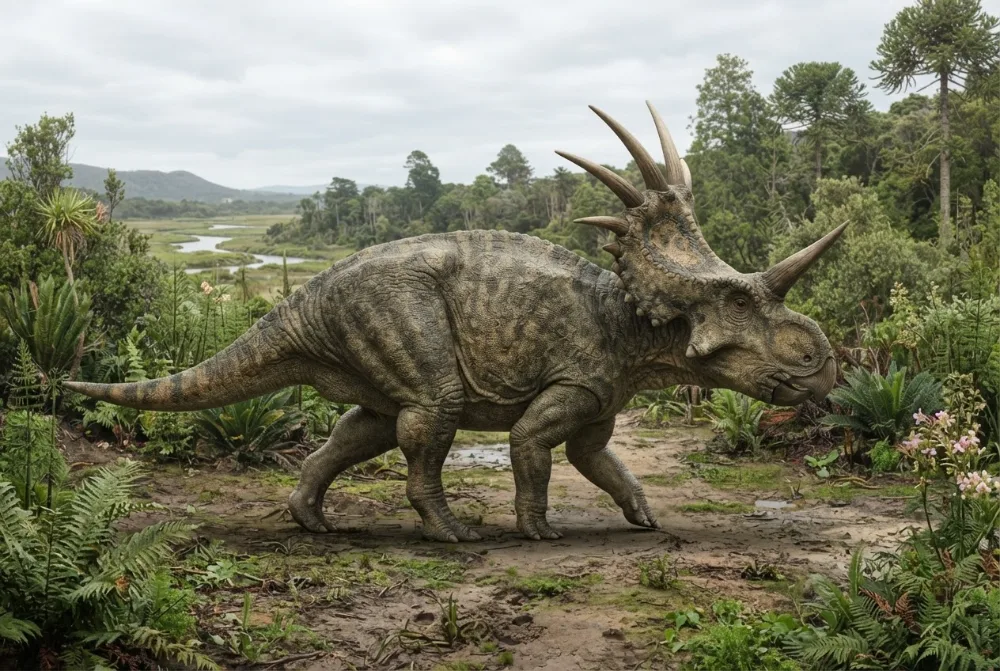
The nose horn of Styracosaurus could be up to 60 centimeters (2 feet) long and 15 centimeters (6 inches) wide.1
Its frill had four to six long spikes sticking out, which is why its name means 'spiked lizard'.1
Scientists have found a bone bed with many Styracosaurus skeletons together, which suggests they may have lived in herds.1
Styracosaurus lived alongside other famous dinosaurs like the horned Centrosaurus, the duck-billed Parasaurolophus, and the tyrannosaur Gorgosaurus.1
The first Styracosaurus fossil was a nearly complete skull found in 1913 by Charles H. Sternberg in what is now Dinosaur Provincial Park in Alberta, Canada.1
A nearly complete skeleton of the same individual was collected later, in 1935, and is now on display in Ottawa, Canada.1
Ebibuuzo ebisinga okubuuzibwa ku Styracosaurus
?How big was Styracosaurus?
About 5 to 5.5 metres long and weighed 1.8 to 2.7 metric tons. It stood about 1.8 metres tall.12
?What did Styracosaurus eat?
It was a plant-eater (herbivore) that ate low-growing plants. It had a parrot-like beak and rows of teeth for slicing tough vegetation.21
?How many horns did Styracosaurus have?
It had one big nose horn and four to six long spikes on its frill. The number of frill spikes varied between individuals.21
?Did Styracosaurus live in herds?
Yes, scientists think so. A bone bed with many Styracosaurus skeletons together suggests they may have lived and died in groups.21
?What predators did Styracosaurus have?
Large meat-eaters like Daspletosaurus, a relative of Tyrannosaurus, lived alongside it and probably hunted it.21
?How fast could Styracosaurus run?
It was very slow. It walked on four short legs and probably could not outrun predators.2
Omumenyi w'enfumo
Enfumo: Some people think Styracosaurus used its frill spikes mainly for fighting predators.
Amazima: Scientists debate the function of the horns and frill, but they may have been used for display to attract mates, for species recognition, or for defense, not just for fighting.1
Eri abakugu mu dayinoso
- Erinnya lya ssaayansi
- Styracosaurus
- Yatuumibwa
- Lambe 19134
- Ekibinja
- Dayinoso ez'amayembe
- Ekika / ekibinja
- Ceratopsidae4
- Engabanya
- Ornithischia > Ceratopsia > Ceratopsidae4
- Emyaka gy'enjazi
- emyaka obukadde 84 okutuuka ku 72 (Campanian)4
- Ensengeka z'enjazi
- Dinosaur Park4
- Ensi
- Kanada4
- Ebisigalira ebyazuulibwa
- 10 mu The Paleobiology Database4
- Okuzuulibwa
- Styracosaurus was named by Canadian paleontologist Lawrence Lambe in 1913, based on a skull found by Charles H. Sternberg in Alberta, Canada.13
- Kikyakubaganyizibwako ebirowoozo
- Scientists still debate whether another species, Styracosaurus ovatus, should be its own genus (Rubeosaurus) or just a different specimen of Styracosaurus albertensis.1
Ebituufu gye biva
- Styracosaurus (en.wikipedia.org)
- Styracosaurus | Natural History Museum (nhm.ac.uk)
- PBDB Taxon (paleobiodb.org)
- Styracosaurus in The Paleobiology Database (CC BY 4.0): emyaka, ebifo, ensengeka z'enjazi, engabanya.
Buli kituufu ku lupapula luno kirina ennamba eraga ensibuko yaakyo. Bwe tuba nga tukoze ensobi, tusonyiwe, ffe tuli bawagizi ba dayinoso, so si magazini ya ssaayansi. Tubuulire ku [email protected] tujja kugitereeza.
 Rex alumwa enjala! Dino Wiki pulojekiti ya taata eri mutabani we ayagala ennyo dayinoso, ya bwereere, tewali bulango era tewali bikulondoola. Abakulu basobola okuwa Rex akantu ak'okulya okuyamba okugikuuma ku mutimbagano.Liisa Rex
 Triceratops
 Protoceratops
 Ojoceratops
 Tatankaceratops
 Psittacosaurus
 Centrosaurus
 Tyrannosaurus
 Velociraptor
 Spinosaurus
 Ankylosaurus
 Parasaurolophus
 Pteranodon