 Kwizi: Oli dayinoso ki?
 Olutalo lwa dayinoso
 Empaka z'emisinde gya dayinoso
 Emizannyo emitono egya dayinoso
 Alubaamu ya sitika
 Enkalala za dayinoso eza TOP
 Mpa ekyewuunyisa!
Udanoceratops
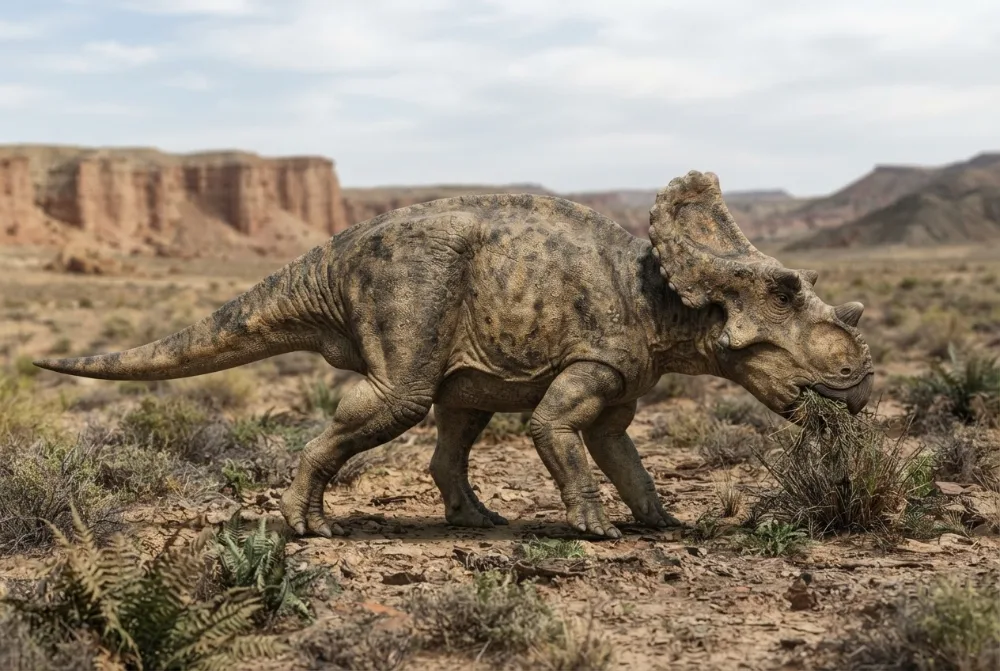
Udanoceratops was a big, plant-eating dinosaur that lived in the Gobi Desert of Mongolia. It had a powerful beak and strong jaws that could bite through tough plants, maybe even bone! This dinosaur was one of the largest of its family, the leptoceratopsids.12
Yabeerawo ddi?
Yali munene atya?
Yali muwanvu kwenkana wa?
Yali mugulumivu kwenkana wa?
kuteebereza
Yali muzito kwenkana wa?
 obuwanvu ng'embwa 4, ennyindo ku mukira🍌obuwanvu ng'amenvu 22 nga gaddiriŋŋana🍉obuzito ng'obwa wotamerooni 140🧸obuzito ng'obw'abaana 37 ab'omu nnasale🎒obuzito ng'obw'abaana b'essomero 22🏃yandidduse mita 100 mu sikonda 12 (omuntu asinga embiro yeetaaga 9.6)
Udanoceratops yali munene atya bw'ogeraageranya ku GGWE?
Kubala kwokka mu browser yo. Tewali kiterekebwa wadde okusindikibwa wonna.
Yali wa mbiro kwenkana wa?


Ebyewuunyisa
Udanoceratops is the largest known leptoceratopsid, reaching about 4 meters (13 feet) long and weighing around 700 kilograms (1,500 pounds).1
Its skull was deep and robust, with a smooth snout that had no horns or bumps, unlike many other horned dinosaurs.1
The lower jaw of Udanoceratops was very strong, and scientists think it could bite with enough force to possibly break bone.1
Its tail was tall and flattened from side to side, which some scientists once thought meant it lived in water, but now they think it helped the dinosaur walk on soft sand.1
Udanoceratops lived in the Gobi Desert during the Late Cretaceous, about 75 to 71 million years ago, alongside dinosaurs like Protoceratops and Velociraptor.1
The only known fossil of Udanoceratops was discovered by a joint Soviet-Mongolian expedition in the 1980s, and its bones were found inside hard calcium carbonate rocks.1
The species name, Udanoceratops tschizhovi, honors D. O. Tschizhov, a colleague of the scientist who first described it.1
Ebibuuzo ebisinga okubuuzibwa ku Udanoceratops
?How big was Udanoceratops?
About 4 metres (13 feet) long and 700 kilograms (1,500 pounds). It was the largest known leptoceratopsid.12
?Did Udanoceratops have horns?
No, its snout was completely smooth with no horns or bumps, unlike many other horned dinosaurs.1
?What did Udanoceratops eat?
It was a herbivore, eating tough plants. Its powerful beak and strong jaws were used for shearing vegetation.12
?Could Udanoceratops swim?
Probably not. Scientists once thought it might be semi-aquatic because of its tall tail, but now they think that shape helped it walk on soft sand.1
?When did Udanoceratops live?
It lived during the Late Cretaceous period, about 81 to 71 million years ago.2
Omumenyi w'enfumo
Enfumo: Some people think Udanoceratops was a small dinosaur like other leptoceratopsids.
Amazima: Udanoceratops was actually the largest known leptoceratopsid, reaching about 4 meters long.1
Eri abakugu mu dayinoso
- Erinnya lya ssaayansi
- Udanoceratops
- Yatuumibwa
- Kurzanov 19923
- Ekibinja
- Dayinoso ez'amayembe
- Ekika / ekibinja
- Leptoceratopsidae3
- Engabanya
- Ornithischia > Ceratopsia3
- Emyaka gy'enjazi
- emyaka obukadde 84 okutuuka ku 72 (Campanian)3
- Ensengeka z'enjazi
- Djadokhta3
- Ensi
- Mongoliya3
- Ebisigalira ebyazuulibwa
- 1 mu The Paleobiology Database3
- Okuzuulibwa
- Udanoceratops was named by Russian paleontologist Sergei Kurzanov in 1992. The fossils were found in the 1980s during a joint Soviet-Mongolian expedition at the Udan-Sayr locality in Mongolia.12
- Kikyakubaganyizibwako ebirowoozo
- Scientists are still debating whether Udanoceratops could walk on two legs or only on all fours, and whether it lived partly in water.1
Ebituufu gye biva
- Udanoceratops (en.wikipedia.org)
- Udanoceratops | Natural History Museum (nhm.ac.uk)
- Udanoceratops in The Paleobiology Database (CC BY 4.0): emyaka, ebifo, ensengeka z'enjazi, engabanya.
Buli kituufu ku lupapula luno kirina ennamba eraga ensibuko yaakyo. Bwe tuba nga tukoze ensobi, tusonyiwe, ffe tuli bawagizi ba dayinoso, so si magazini ya ssaayansi. Tubuulire ku [email protected] tujja kugitereeza.
 Rex alumwa enjala! Dino Wiki pulojekiti ya taata eri mutabani we ayagala ennyo dayinoso, ya bwereere, tewali bulango era tewali bikulondoola. Abakulu basobola okuwa Rex akantu ak'okulya okuyamba okugikuuma ku mutimbagano.Liisa Rex
 Triceratops
 Protoceratops
 Ojoceratops
 Tatankaceratops
 Psittacosaurus
 Centrosaurus
 Tyrannosaurus
 Velociraptor
 Spinosaurus
 Ankylosaurus
 Parasaurolophus
 Pteranodon