 Kwizi: Oli dayinoso ki?
 Olutalo lwa dayinoso
 Empaka z'emisinde gya dayinoso
 Emizannyo emitono egya dayinoso
 Alubaamu ya sitika
 Enkalala za dayinoso eza TOP
 Mpa ekyewuunyisa!
Umoonasaurus
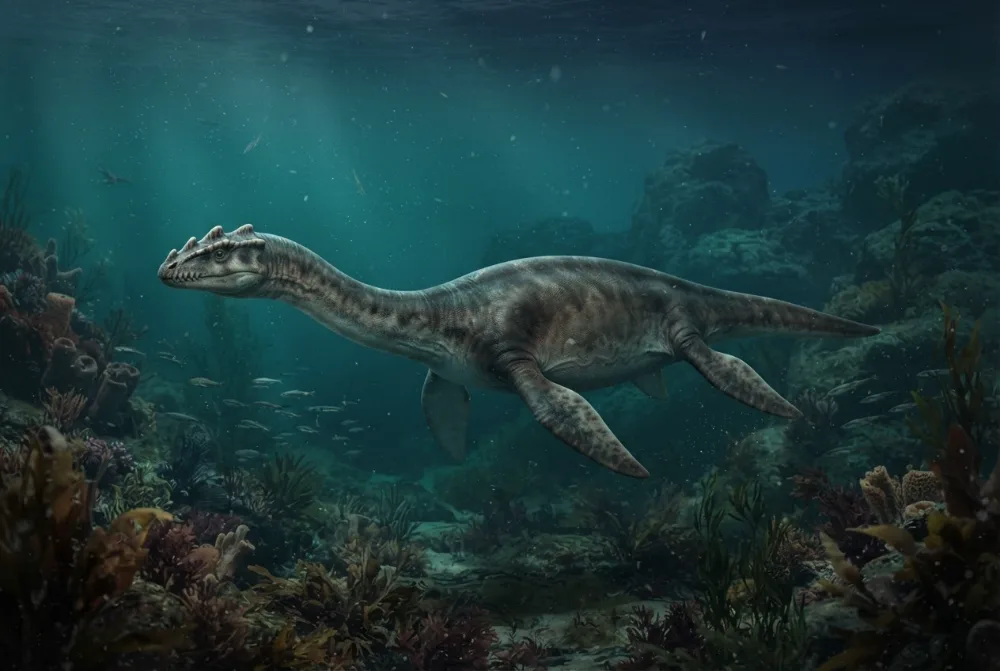
Umoonasaurus was a small, crested marine reptile that swam in cold seas near Antarctica about 115 million years ago. It had three bony crests on its head, like a tiny underwater dinosaur, but it was actually a plesiosaur, not a dinosaur. Its fossils are famous because they are preserved in beautiful blue opal.12
Yabeerawo ddi?
Yali munene atya?
Yali muwanvu kwenkana wa?
 obuwanvu ng'embwa 2.5, ennyindo ku mukira🍌obuwanvu ng'amenvu 14 nga gaddiriŋŋana🏊yandiwuze obuwanvu bw'ekidiba ekinene (50 m) mu sikonda 6.9
Umoonasaurus yali munene atya bw'ogeraageranya ku GGWE?
Kubala kwokka mu browser yo. Tewali kiterekebwa wadde okusindikibwa wonna.
Yali wa mbiro kwenkana wa?


Ebyewuunyisa
Umoonasaurus is known from several partial skeletons, and one of them is the most complete opalized vertebrate fossil ever found.1
It had three thin, blade-like crests on its skull: one along the top of its snout and a pair above its eyes. These crests may have been used for display, like a peacock's tail.1
Umoonasaurus lived in a cold, high-latitude inland sea near the South Pole, where water temperatures were near freezing.12
It was a small plesiosaur, only about 2.5 metres (8 feet) long as an adult. A juvenile specimen was less than 1 metre long.1
Umoonasaurus is the most primitive and also the last surviving member of its group, the rhomaleosaurids. It lived about 115 million years ago.12
Its tail ended in a 'pygostyle-like' structure made of fused vertebrae, similar to the tail tip of some modern birds.1
Ebibuuzo ebisinga okubuuzibwa ku Umoonasaurus
?What did Umoonasaurus eat?
Umoonasaurus ate small fish. Preserved gut contents show it ate small teleost fish.1
?Why did Umoonasaurus have crests?
Scientists think the three crests on its skull were used for display, like a peacock's tail, to help recognise each other or attract mates. They were too fragile for fighting.1
Eri abakugu mu dayinoso
- Erinnya lya ssaayansi
- Umoonasaurus
- Yatuumibwa
- Kear et al. 20065
- Ekibinja
- Pulesiyosawulu
- Ekika / ekibinja
- Leptocleididae5
- Engabanya
- Plesiosauria > Sauropterygia5
- Emyaka gy'enjazi
- emyaka obukadde 121 okutuuka ku 100 (Aptian / Albian)5
- Ensengeka z'enjazi
- Bulldog Shale5
- Ensi
- Awusitureeliya5
- Ebisigalira ebyazuulibwa
- 4 mu The Paleobiology Database5
- Okuzuulibwa
- Umoonasaurus was named in 2006 by Benjamin Kear and colleagues. The holotype skeleton, nicknamed 'Eric', was bought by public donations and is preserved in opal from the Zorba Extension Opal Field near Coober Pedy, Australia.1
- Kikyakubaganyizibwako ebirowoozo
- Scientists are not sure what the three crests on its head were used for. They were too fragile for fighting, so they might have been for display or recognizing other Umoonasaurus.1
Ebituufu gye biva
- An archaic crested plesiosaur in opal from the Lower Cretaceous high-latitude deposits of Australia (pmc.ncbi.nlm.nih.gov)
- An archaic crested plesiosaur in opal from the Lower Cretaceous high-latitude deposits of Australia (royalsocietypublishing.org)
- Umoonasaurus (en.wikipedia.org)
- Umoonasaurus demoscyllus - The Australian Museum (australian.museum)
- Umoonasaurus in The Paleobiology Database (CC BY 4.0): emyaka, ebifo, ensengeka z'enjazi, engabanya.
Buli kituufu ku lupapula luno kirina ennamba eraga ensibuko yaakyo. Bwe tuba nga tukoze ensobi, tusonyiwe, ffe tuli bawagizi ba dayinoso, so si magazini ya ssaayansi. Tubuulire ku [email protected] tujja kugitereeza.
 Rex alumwa enjala! Dino Wiki pulojekiti ya taata eri mutabani we ayagala ennyo dayinoso, ya bwereere, tewali bulango era tewali bikulondoola. Abakulu basobola okuwa Rex akantu ak'okulya okuyamba okugikuuma ku mutimbagano.Liisa Rex
 Elasmosaurus
 Pliosaurus
 Plesiosaurus
 Cimoliasaurus
 Colymbosaurus
 Trinacromerum
 Stegosaurus
 Iguanodon
 Archaeopteryx
 Giganotosaurus
 Microraptor
 Deinonychus