 Kwizi: Oli dayinoso ki?
 Olutalo lwa dayinoso
 Empaka z'emisinde gya dayinoso
 Emizannyo emitono egya dayinoso
 Alubaamu ya sitika
 Enkalala za dayinoso eza TOP
 Mpa ekyewuunyisa!
Yabeerawo ddi?

Yali munene atya?
Yali muwanvu kwenkana wa?
Yali mugulumivu kwenkana wa?
kuteebereza
Yali muzito kwenkana wa?
 obuwanvu ng'embwa 6, ennyindo ku mukira🍌obuwanvu ng'amenvu 31 nga gaddiriŋŋana🍉obuzito ng'obwa wotamerooni 140🧸obuzito ng'obw'abaana 37 ab'omu nnasale🎒obuzito ng'obw'abaana b'essomero 22🏃yandidduse mita 100 mu sikonda 9.2 (omuntu asinga embiro yeetaaga 9.6)
Viavenator yali munene atya bw'ogeraageranya ku GGWE?
Kubala kwokka mu browser yo. Tewali kiterekebwa wadde okusindikibwa wonna.
Yali wa mbiro kwenkana wa?


Ebyewuunyisa
Viavenator belongs to a group called Furileusauria, which means 'stiff back lizard' in the Mapudungun language, because their backbones were very rigid.2
It lived during the Santonian age, about 85.7 to 83.6 million years ago, filling a gap in the fossil record between earlier and later abelisaurids.32
The only known species is Viavenator exxoni, named after ExxonMobil for helping preserve fossils in the La Invernada area.12
Its skeleton shows special features like a deep notch in the skull bones and a downturned crest on the shin bone, which helped scientists identify it as a new species.2
Viavenator had a very stiff backbone with extra connections between the vertebrae, making its spine almost like a single rod.2
It was a medium to big sized theropod, part of the abelisaurid family that lived in the southern continents during the Cretaceous.2
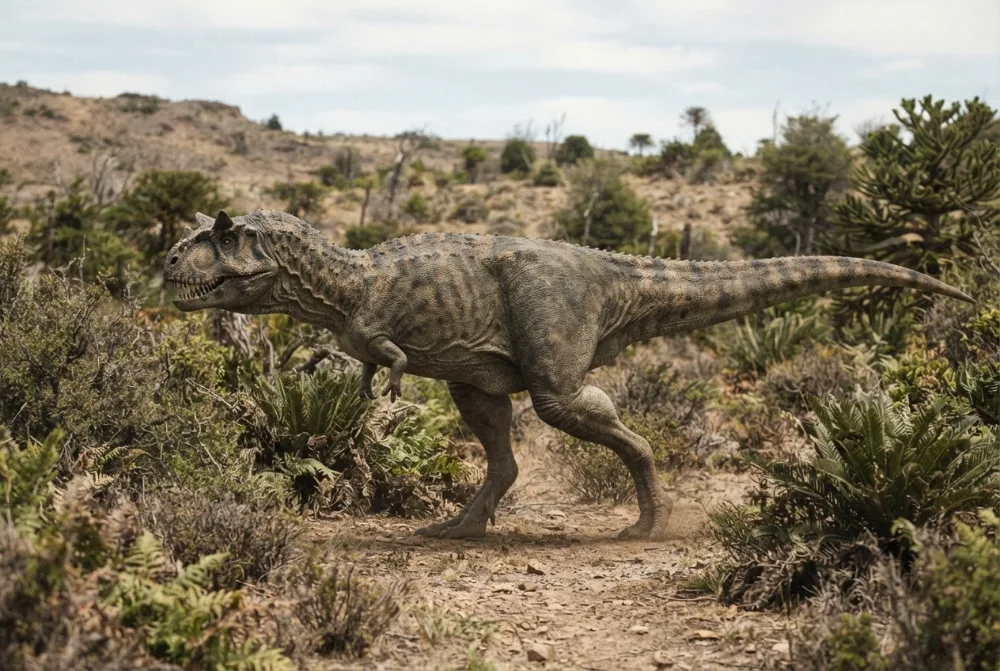
Ebibuuzo ebisinga okubuuzibwa ku Viavenator
?How big was Viavenator?
About 5.6 metres (18 feet) long.1
?What did Viavenator eat?
It was a carnivore, so it ate meat.1
?Why did Viavenator have a stiff back?
Its backbone was very rigid, with extra connections between vertebrae, which helped it move like a seesaw pivoting on its hips.2
?When did Viavenator live?
It lived during the Santonian age of the Late Cretaceous, about 85.7 to 83.6 million years ago.1
Eri abakugu mu dayinoso
- Erinnya lya ssaayansi
- Viavenator
- Yatuumibwa
- Filippi et al. 20165
- Ekibinja
- Dayinoso ezirya ennyama
- Ekika / ekibinja
- Abelisauridae5
- Engabanya
- Theropoda > Ceratosauria > Abelisauridae5
- Emyaka gy'enjazi
- emyaka obukadde 86 okutuuka ku 84 (Santonian)5
- Ensengeka z'enjazi
- Bajo de la Carpa5
- Ensi
- Arigentina5
- Ebisigalira ebyazuulibwa
- 1 mu The Paleobiology Database5
- Okuzuulibwa
- Viavenator was named and described in 2016 by Filippi and colleagues based on a partial skeleton found in the Bajo de la Carpa Formation of Argentina.13
- Kikyakubaganyizibwako ebirowoozo
- Scientists are still debating exactly how Viavenator is related to other abelisaurids, as it seems to be a transitional form between earlier and later species.2
Ebituufu gye biva
- Viavenator (en.wikipedia.org)
- A new brachyrostran with hypertrophied axial structures reveals an unexpected radiation of latest Cretaceous abelisaurids (corporate.exxonmobil.com)
- PBDB Taxon (paleobiodb.org)
- Viavenator exxoni | Dinosaur Database by DinoAnimals.com (dinoanimals.com)
- Viavenator in The Paleobiology Database (CC BY 4.0): emyaka, ebifo, ensengeka z'enjazi, engabanya.
Buli kituufu ku lupapula luno kirina ennamba eraga ensibuko yaakyo. Bwe tuba nga tukoze ensobi, tusonyiwe, ffe tuli bawagizi ba dayinoso, so si magazini ya ssaayansi. Tubuulire ku [email protected] tujja kugitereeza.
 Rex alumwa enjala! Dino Wiki pulojekiti ya taata eri mutabani we ayagala ennyo dayinoso, ya bwereere, tewali bulango era tewali bikulondoola. Abakulu basobola okuwa Rex akantu ak'okulya okuyamba okugikuuma ku mutimbagano.Liisa Rex
 Allosaurus
 Carnotaurus
 Dilophosaurus
 Giganotosaurus
 Compsognathus
 Paronychodon
 Tyrannosaurus
 Triceratops
 Velociraptor
 Spinosaurus
 Ankylosaurus
 Parasaurolophus