 Kwizi: Oli dayinoso ki?
 Olutalo lwa dayinoso
 Empaka z'emisinde gya dayinoso
 Emizannyo emitono egya dayinoso
 Alubaamu ya sitika
 Enkalala za dayinoso eza TOP
 Mpa ekyewuunyisa!
Yabeerawo ddi?

Yali munene atya?
Yali muwanvu kwenkana wa?
Yali mugulumivu kwenkana wa?
kuteebereza
Yali muzito kwenkana wa?
 obuwanvu nga kkapa 3 ab'awaka, ennyindo ku mukira🍌obuwanvu ng'amenvu 9 nga gaddiriŋŋanaobuzito ng'obwa kkapa ow'awaka🍌obuzito ng'obw'amenvu 46🏃yandidduse mita 100 mu sikonda 11 (omuntu asinga embiro yeetaaga 9.6)
Vitakrisaurus yali munene atya bw'ogeraageranya ku GGWE?
Kubala kwokka mu browser yo. Tewali kiterekebwa wadde okusindikibwa wonna.
Yali wa mbiro kwenkana wa?


Ebyewuunyisa
Vitakrisaurus was named by scientist Muhammad Sadiq Malkani in 2010.2
Its fossils include hand bones like carpals, metacarpals, and claws, which are rare for theropods from this region.1
This dinosaur lived during the very end of the Cretaceous Period, about 67 to 66 million years ago.1
Vitakrisaurus is known from the Vitakri Lameta Formation in central Pakistan.1
It belongs to a group of theropods called abelisauroids, which were common in the southern continents.1
The species name saraiki honors the Saraiki language spoken by people living near where the fossils were found.1
Ebibuuzo ebisinga okubuuzibwa ku Vitakrisaurus
?How big was Vitakrisaurus?
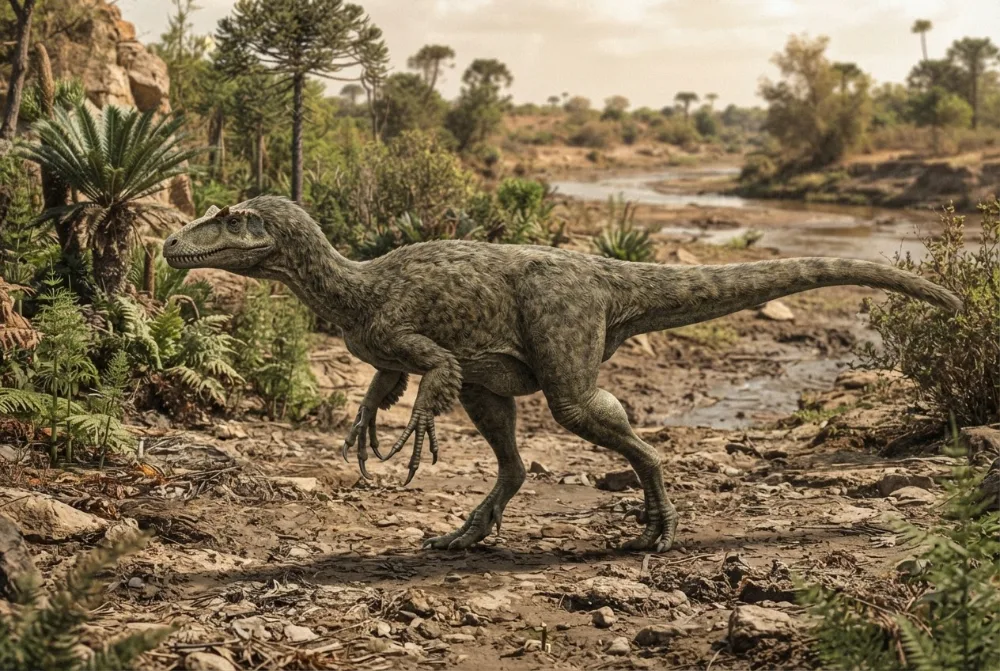
It was a medium sized theropod, about 10 metres long. That is roughly the length of a school bus.4
?What did Vitakrisaurus eat?
It was a carnivore, meaning it ate meat. It used its strong hands and claws to catch prey.4
?When did Vitakrisaurus live?
It lived at the very end of the Cretaceous Period, about 67 to 66 million years ago.4
?Where was Vitakrisaurus found?
Its fossils were found in the Vitakri Lameta Formation in Balochistan, central Pakistan.14
?Is Vitakrisaurus a dinosaur?
Yes, it is a dinosaur. It belongs to the group Theropoda, which includes meat-eating dinosaurs like T. rex.4
?Did Vitakrisaurus have feathers?
Scientists do not know for sure. No feathers have been found with its fossils, but many theropods related to it may have had feathers.1
?How fast could Vitakrisaurus run?
Nobody knows for sure. As a medium-sized theropod, it was probably a fast runner, but no speed estimates have been published.4
?Why is it called Vitakrisaurus?
Its name honors the Vitakri locality where it was found, and 'saurus' means lizard. The species name saraiki honors the Saraiki language of Pakistan.1
Eri abakugu mu dayinoso
- Erinnya lya ssaayansi
- Vitakrisaurus
- Yatuumibwa
- Malkani 20104
- Ekibinja
- Dayinoso ezirya ennyama
- Ekika / ekibinja
- Vitakrisauridae4
- Engabanya
- Theropoda > Ceratosauria4
- Emyaka gy'enjazi
- emyaka obukadde 72 okutuuka ku 66 (Maastrichtian)4
- Ensengeka z'enjazi
- Vitakri4
- Ensi
- Pakisitaani4
- Ebisigalira ebyazuulibwa
- 3 mu The Paleobiology Database4
- Okuzuulibwa
- Vitakrisaurus was named by Muhammad Sadiq Malkani in 2010 based on fossils from the mid Bor 2 locality in the Barkhan district of Balochistan, Pakistan.21
- Kikyakubaganyizibwako ebirowoozo
- Scientists are not sure exactly how big Vitakrisaurus grew, because only a few bones have been found.1
Ebituufu gye biva
- Vitakrisaurus saraiki Theropod from South Asia (scirp.org)
- PBDB Taxon (paleobiodb.org)
- Vitakrisaurus saraiki | Dinosaur Database by DinoAnimals.com (dinoanimals.com)
- Vitakrisaurus in The Paleobiology Database (CC BY 4.0): emyaka, ebifo, ensengeka z'enjazi, engabanya.
Buli kituufu ku lupapula luno kirina ennamba eraga ensibuko yaakyo. Bwe tuba nga tukoze ensobi, tusonyiwe, ffe tuli bawagizi ba dayinoso, so si magazini ya ssaayansi. Tubuulire ku [email protected] tujja kugitereeza.
 Rex alumwa enjala! Dino Wiki pulojekiti ya taata eri mutabani we ayagala ennyo dayinoso, ya bwereere, tewali bulango era tewali bikulondoola. Abakulu basobola okuwa Rex akantu ak'okulya okuyamba okugikuuma ku mutimbagano.Liisa Rex
 Allosaurus
 Carnotaurus
 Dilophosaurus
 Giganotosaurus
 Compsognathus
 Paronychodon
 Tyrannosaurus
 Triceratops
 Velociraptor
 Spinosaurus
 Ankylosaurus
 Parasaurolophus