 Kwizi: Oli dayinoso ki?
 Olutalo lwa dayinoso
 Empaka z'emisinde gya dayinoso
 Emizannyo emitono egya dayinoso
 Alubaamu ya sitika
 Enkalala za dayinoso eza TOP
 Mpa ekyewuunyisa!
Xenoceratops
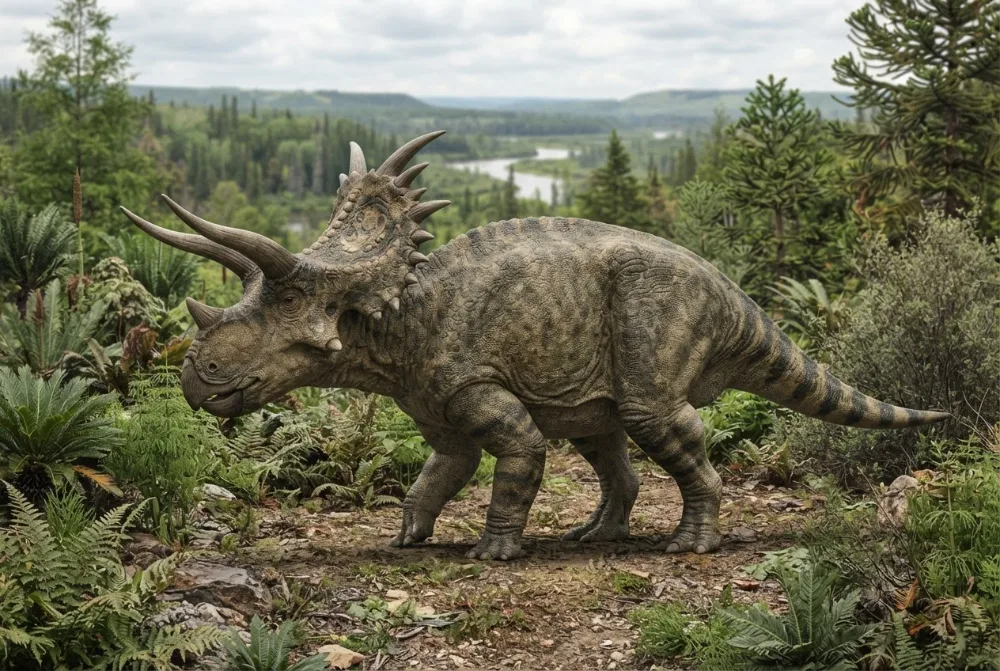
Xenoceratops was an early horned dinosaur that lived in Canada about 78 million years ago. It had a big frill on its head with spikes and two long horns above its eyes, making it look a bit like an alien. It was one of the oldest large horned dinosaurs ever found in North America.1
Yabeerawo ddi?
Yali munene atya?
Yali muwanvu kwenkana wa?
Yali mugulumivu kwenkana wa?
kuteebereza
Yali muzito kwenkana wa?

 obuwanvu ng'embwa 6, ennyindo ku mukira🍌obuwanvu ng'amenvu 33 nga gaddiriŋŋanaobuzito ng'obw'embwa 90🍉obuzito ng'obwa wotamerooni 360🧸obuzito ng'obw'abaana 95 ab'omu nnasale🎒obuzito ng'obw'abaana b'essomero 56🐻❄️obuzito ng'obwa ddubu enjeru 4🏃yandidduse mita 100 mu sikonda 11 (omuntu asinga embiro yeetaaga 9.6)
Xenoceratops yali munene atya bw'ogeraageranya ku GGWE?
Kubala kwokka mu browser yo. Tewali kiterekebwa wadde okusindikibwa wonna.
Yali wa mbiro kwenkana wa?


Ebyewuunyisa
Xenoceratops is the oldest known ceratopsid dinosaur from Canada, living about 78 million years ago.2
Its name means 'alien horned face' because it was found in rocks that had not yielded horned dinosaur fossils before.2
The fossils were collected in 1958 by paleontologist Wann Langston Jr., but they sat in a museum for decades before scientists realized they belonged to a new species.1
Unlike Triceratops, Xenoceratops had spikes on its frill in addition to the two long brow horns.1
Xenoceratops was about 6 metres long and weighed more than 2 tons, about as heavy as a large rhinoceros.1
It lived in a subtropical environment in Alberta, which at that time had no snow or frost.1
Scientists think Xenoceratops is the most primitive centrosaurine, meaning it branched off early in the evolution of this group of horned dinosaurs.2
Omumenyi w'enfumo
Enfumo: Xenoceratops is just a small, unimportant dinosaur.
Amazima: Xenoceratops is important because it is the oldest known large horned dinosaur from Canada, and it shows that horned dinosaurs evolved their fancy frills and horns very early.1
Eri abakugu mu dayinoso
- Erinnya lya ssaayansi
- Xenoceratops
- Yatuumibwa
- Ryan et al. 20123
- Ekibinja
- Dayinoso ez'amayembe
- Ekika / ekibinja
- Ceratopsidae3
- Engabanya
- Ornithischia > Ceratopsia > Ceratopsidae3
- Emyaka gy'enjazi
- emyaka obukadde 84 okutuuka ku 72 (Campanian)3
- Ensengeka z'enjazi
- Foremost3
- Ensi
- Kanada3
- Ebisigalira ebyazuulibwa
- 1 mu The Paleobiology Database3
- Okuzuulibwa
- Xenoceratops was named in 2012 by Michael Ryan and colleagues. The fossils were originally collected in 1958 by Wann Langston Jr. from a bone bed in the Foremost Formation of Alberta, Canada, and later rediscovered in the Canadian Museum of Nature.2
- Kikyakubaganyizibwako ebirowoozo
- Scientists are not sure exactly what the complete skull of Xenoceratops looked like, because only parts of the frill and horns have been found.2
Ebituufu gye biva
- Two-Ton "Alien" Horned Dinosaur Found, "Different From Every Other" | National Geographic (nationalgeographic.com)
- cdnsciencepub.com (cdnsciencepub.com)
- Xenoceratops in The Paleobiology Database (CC BY 4.0): emyaka, ebifo, ensengeka z'enjazi, engabanya.
Buli kituufu ku lupapula luno kirina ennamba eraga ensibuko yaakyo. Bwe tuba nga tukoze ensobi, tusonyiwe, ffe tuli bawagizi ba dayinoso, so si magazini ya ssaayansi. Tubuulire ku [email protected] tujja kugitereeza.
 Rex alumwa enjala! Dino Wiki pulojekiti ya taata eri mutabani we ayagala ennyo dayinoso, ya bwereere, tewali bulango era tewali bikulondoola. Abakulu basobola okuwa Rex akantu ak'okulya okuyamba okugikuuma ku mutimbagano.Liisa Rex
 Triceratops
 Protoceratops
 Ojoceratops
 Tatankaceratops
 Psittacosaurus
 Centrosaurus
 Tyrannosaurus
 Velociraptor
 Spinosaurus
 Ankylosaurus
 Parasaurolophus
 Pteranodon