 Ozali dino nini? Kwizi
 Etumba ya badino
 Mbangu ya badino
 Masano mike ya badino
 Albumu ya bastika
 Bilisti TOP ya badino
 Kamwisa ngai!
Azalaki na bomoi ntango nini?

Azalaki monene boni?
Azalaki molai boni?
Azalaki molai boni na likolo?
kokanisa
 molai lokola bambwa 4 zolo kino mokila🍌molai lokola matoko 23 oyo balandani🏃akokaki kopota metele 100 na sekonde 5,8 (moto oyo aleki mbangu asalelaka 9,6)
Afromimus azalaki monene boni soki tokokanisi na YO?
Kaka matematiki na navigatere na yo. Eloko moko te ebombami to etindami esika moko.
Azalaki na mbangu boni?


Makambo ya kosepelisa
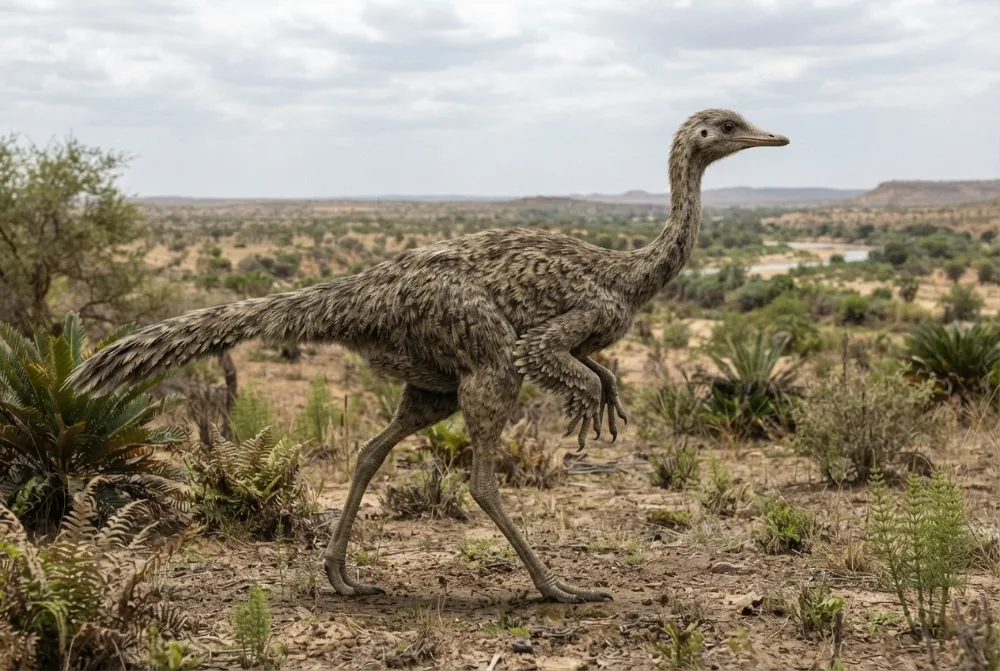
Afromimus is one of the oldest ornithomimosaurs found in Africa, showing that these ostrich-like dinosaurs lived on southern continents early in their evolution.2
The only known skeleton of Afromimus includes tail bones, chevrons, and parts of the right hind leg.2
Its tail vertebrae have broad, peanut-shaped joints that helped the tail bend and flex.2
Afromimus lived about 113 to 100 million years ago, during the Albian age of the Early Cretaceous.1
The name Afromimus means 'African mimic', because it looks like other ornithomimosaurs but comes from Africa.1
Scientists think Afromimus was a ground-dwelling dinosaur that laid eggs.1
Mituna oyo batunaka mingi na ntina na Afromimus
?How big was Afromimus?
About 4.14 metres long, based on its tibia length and its classification as a noasaurid. It was half the size of Gallimimus and twice the size of Shenzhousaurus.4
?What did Afromimus eat?
Scientists are not sure, but its toothless beak suggests it may have eaten plants, small animals, or eggs. No direct evidence of its diet has been found.4
?Is Afromimus a dinosaur?
Yes, Afromimus is a theropod dinosaur. It was originally thought to be an ornithomimosaur, but later studies suggest it was a ceratosaurian related to abelisauroids.4
?When did Afromimus live?
Afromimus lived during the Early Cretaceous, about 113 to 100 million years ago. That is the Albian age.4
?Could Afromimus run fast?
Probably yes. It had long legs and a light body, like modern ostriches, so it was likely a fast runner. No exact speed has been calculated.4
?Where was Afromimus found?
Its only skeleton was found in the Ténéré Desert of Niger, Africa. It was discovered in 1997 at a place called Gadoufaoua.4
Mpo na bayebi ya badino
- Nkombo ya siansi
- Afromimus
- Nkombo epesamaki na
- Sereno 20175
- Lisanga
- Badino-otrushe
- Libota / klade
- Ornithomimosauria5
- Klasifikasio
- Theropoda > Ornithomimosauria5
- Mbula ya mabanga
- mbula milio 113 kino 100 (Albian)5
- Milongo ya mabanga
- Elrhaz5
- Bikolo
- Nijere5
- Bafosile oyo ekomami
- 1 na The Paleobiology Database5
- Ntango bamonaki yango
- Afromimus was named by paleontologist Paul Sereno in 2017, based on a fragmentary skeleton found in the El Rhaz Formation of Niger.12
- Naino bazali kowelana
- Scientists are not sure exactly how big Afromimus was, because only a partial skeleton has been found.2
Esika makambo euti
- PBDB Taxon (paleobiodb.org)
- Early Cretaceous Ornithomimosaurs (Dinosauria: Coelurosauria) from Africa (exa.ai)
- Afromimus (Wikipedia) (Wikipedia)
- Afromimus - Wikipedia (en-wp.org)
- Afromimus in The Paleobiology Database (CC BY 4.0): mbula, bisika, milongo ya mabanga, klasifikasio.
Likambo nyonso na lokasa oyo ezali na nimero oyo elakisi liziba na yango. Soki tosali libunga, limbisa biso, tozali bato balingaka badino, zulunalo ya siansi te. Yebisa biso na [email protected] mpe tokobongisa yango.
 Rex azali na nzala! Dino Wiki ezali mosala ya tata moko mpo na mwana na ye ya mobali oyo alingaka badino, ofele, piblisite te mpe batrakere te. Bato bakolo bakoki kopesa Rex biskwi mpo na kosalisa ete etikala na internet.Leisa Rex
 Gallimimus
 Ornithomimus
 Struthiomimus
 Deinocheirus
 Dromiceiomimus
 Archaeornithomimus
 Stegosaurus
 Iguanodon
 Archaeopteryx
 Giganotosaurus
 Microraptor
 Deinonychus