 Ozali dino nini? Kwizi
 Etumba ya badino
 Mbangu ya badino
 Masano mike ya badino
 Albumu ya bastika
 Bilisti TOP ya badino
 Kamwisa ngai!
Azalaki na bomoi ntango nini?

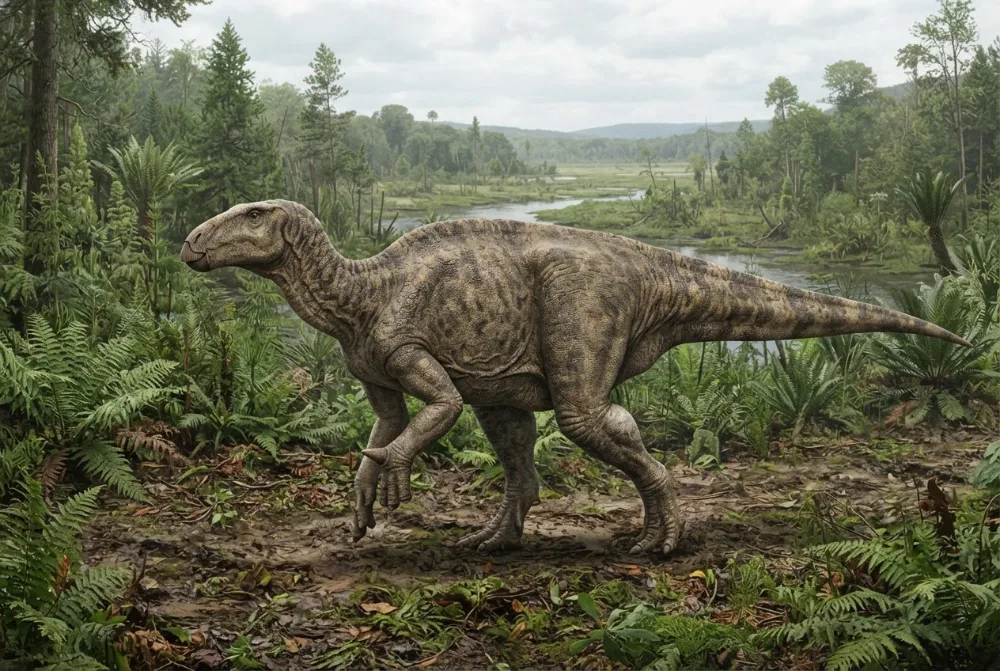
Azalaki monene boni?
Azalaki molai boni?
Azalaki molai boni na likolo?
Azalaki kilo boni?
 molai lokola bamotuka 2,5 oyo batelemi na molongo🍌molai lokola matoko 61 oyo balandani
 pene kilo lokola nzoku🍉kilo lokola bapasteke 1000🎒kilo lokola bakelasi 6 mobimba ya bana🐻❄️kilo lokola ba-urs ya pembe 11🏃akokaki kopota metele 100 na sekonde 15 (moto oyo aleki mbangu asalelaka 9,6)
Iguanodon azalaki monene boni soki tokokanisi na YO?
Kaka matematiki na navigatere na yo. Eloko moko te ebombami to etindami esika moko.
Azalaki na mbangu boni?


Makambo ya kosepelisa
Iguanodon was named in 1825 by Gideon Mantell after he found teeth that looked like iguana teeth.1
Its thumb had a big, sharp spike that scientists think was used for defense against predators.1
Iguanodon had a flexible little finger that could grasp objects, unlike its other fingers which were more like hooves.1
When Iguanodon closed its mouth, the bones in its upper jaw would bow out, making the teeth grind against each other like a chewing motion.1
The front of Iguanodon's mouth had no teeth, just a bony beak covered with a hard material for cropping plants.1
Iguanodon could reach food from ground level up to 4 to 5 metres (13 to 16 feet) high, so it ate both low plants and tree leaves.1
In 1878, many complete Iguanodon skeletons were found in a coal mine in Bernissart, Belgium, which helped scientists understand the dinosaur much better.1
Mituna oyo batunaka mingi na ntina na Iguanodon
?How big was Iguanodon?
Iguanodon was about 9 to 11 metres (30 to 36 feet) long and weighed around 4.5 metric tons (5 short tons).1
?What did Iguanodon eat?
Iguanodon was a plant-eater. It used its beak to snip leaves and its cheek teeth to grind tough plants like cycads.34
?Did Iguanodon have a thumb spike?
Yes, Iguanodon had a large, sharp spike on each thumb. It may have been used for defense or for breaking into fruits and seeds.35
?Could Iguanodon walk on two legs?
Yes, Iguanodon could walk on two legs or on all fours. It was one of the few dinosaurs that could do both.34
?When did Iguanodon live?
Iguanodon lived during the Early Cretaceous period, about 126 to 122 million years ago.1
?Who discovered Iguanodon?
Iguanodon was named by Gideon Mantell in 1825 after teeth were found in Sussex, England. His wife Mary Ann Mantell is often credited with finding the first teeth.51
?Was Iguanodon a dinosaur?
Yes, Iguanodon was a dinosaur. It was one of the first dinosaurs ever named, after Megalosaurus.1
?How fast could Iguanodon run?
Up to about 24 km/h (15 mph) on two legs, about as fast as a grown-up riding a bike. Most of the time it walked much slower.4
Mobuki masapo
Lisapo: Iguanodon was a slow, clumsy dinosaur that always walked on four legs.
Solo: Iguanodon could walk on two legs or all fours, and it was probably quite agile for its size.2
Mpo na bayebi ya badino
- Nkombo ya siansi
- Iguanodon
- Nkombo epesamaki na
- Mantell 18256
- Lisanga
- Badino ya monoko ya ndeke
- Libota / klade
- Ankylopollexia6
- Klasifikasio
- Ornithischia > Ornithopoda > Iguanodontia6
- Mbula ya mabanga
- mbula milio 155 kino 66 (Kimmeridgian / Maastrichtian)6
- Milongo ya mabanga
- Arcillas de Morella, Weald Clay, Wessex6
- Bikolo
- Angeletere, Espanye, Alemani, Falansa, Portigale, Belezi6
- Bafosile oyo ekomami
- 133 na The Paleobiology Database6
- Bayebi ye mpe na nkombo
- Heterosaurus, Iguanosaurus, Struthopus, Therosaurus (bankombo ya kala oyo sikoyo batangaka lokola nyama moko)6
- Ntango bamonaki yango
- Iguanodon was first named by Gideon Mantell in 1825 based on fossil teeth found in Sussex, England. Later, in 1878, many complete skeletons were discovered in a Belgian coal mine and studied by Louis Dollo.1
- Naino bazali kowelana
- Scientists still debate exactly what plants Iguanodon ate. Some think it ate horsetails, cycads, and conifers, while others link it to the spread of flowering plants.1
Esika makambo euti
- Iguanodon (en.wikipedia.org)
- Iguanodon | Diet, Habitat & Extinction (britannica.com)
- Iguanodon | National Geographic Kids (kids.nationalgeographic.com)
- enchantedlearning.com (enchantedlearning.com)
- Iguanodon: the teeth that led to a dinosaur discovery | Natural History Museum (nhm.ac.uk)
- Iguanodon in The Paleobiology Database (CC BY 4.0): mbula, bisika, milongo ya mabanga, klasifikasio.
Likambo nyonso na lokasa oyo ezali na nimero oyo elakisi liziba na yango. Soki tosali libunga, limbisa biso, tozali bato balingaka badino, zulunalo ya siansi te. Yebisa biso na [email protected] mpe tokobongisa yango.
 Rex azali na nzala! Dino Wiki ezali mosala ya tata moko mpo na mwana na ye ya mobali oyo alingaka badino, ofele, piblisite te mpe batrakere te. Bato bakolo bakoki kopesa Rex biskwi mpo na kosalisa ete etikala na internet.Leisa Rex
 Tenontosaurus
 Thescelosaurus
 Zalmoxes
 Camptosaurus
 Rhabdodon
 Nanosaurus
 Stegosaurus
 Archaeopteryx
 Giganotosaurus
 Microraptor
 Deinonychus
 Baryonyx