 Ozali dino nini? Kwizi
 Etumba ya badino
 Mbangu ya badino
 Masano mike ya badino
 Albumu ya bastika
 Bilisti TOP ya badino
 Kamwisa ngai!
Amargatitanis
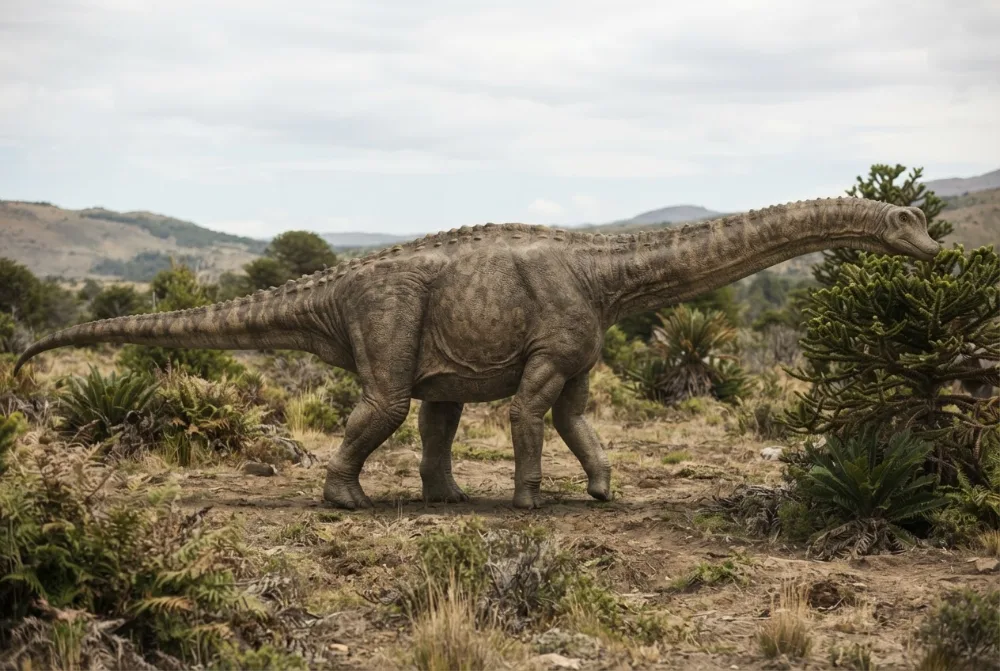
Amargatitanis was a long-necked plant-eater that lived in what is now Argentina. It was a sauropod, but not one of the biggest, it was about as long as a school bus. Its fossils were found near a place called La Amarga, which means 'the bitter one' in Spanish.1
Azalaki na bomoi ntango nini?
Azalaki monene boni?
Azalaki molai boni?
Azalaki molai boni na likolo?
kokanisa
Azalaki kilo boni?
 molai lokola bamotuka 2,5 oyo batelemi na molongo🍌molai lokola matoko 67 oyo balandani
 kilo lokola bambwa 180🍉kilo lokola bapasteke 700🎒kilo lokola bakelasi 4 mobimba ya bana🐻❄️kilo lokola ba-urs ya pembe 8🏃akokaki kopota metele 100 na sekonde 17 (moto oyo aleki mbangu asalelaka 9,6)
Amargatitanis azalaki monene boni soki tokokanisi na YO?
Kaka matematiki na navigatere na yo. Eloko moko te ebombami to etindami esika moko.
Azalaki na mbangu boni?


Makambo ya kosepelisa
Amargatitanis was first thought to be a titanosaur, but later scientists realized it was a dicraeosaurid, a group of sauropods with short necks and tall spines on their vertebrae.1
The only known skeleton of Amargatitanis is incomplete: just a partial hind leg, a hip bone, and two vertebrae. That makes it hard for scientists to know exactly what it looked like.1
Amargatitanis lived about 129 to 123 million years ago, during the Early Cretaceous period.1
The fossils were collected by famous paleontologist José Bonaparte in 1983, but the dinosaur wasn't named until 2007 by Sebastián Apesteguía.1
Amargatitanis shared its home with other sauropods like Amargasaurus and Zapalasaurus. They probably ate different plants to avoid competing for food.1
Like other dicraeosaurids, Amargatitanis had a long tail and strong legs. Its neck was shorter than many other sauropods, so it probably fed at heights up to about 2.7 metres (8.9 feet).1
Mituna oyo batunaka mingi na ntina na Amargatitanis
?How big was Amargatitanis?
About 12 metres (39.7 feet) long and weighed around 3.5 metric tons (3.9 short tons), according to one estimate. Another study gave a higher weight of about 11.4 metric tons (12.6 short tons).1
?What did Amargatitanis eat?
It was a plant-eater, or herbivore. It probably ate low-growing plants because its neck was shorter than many other sauropods.13
?When did Amargatitanis live?
It lived about 129 to 123 million years ago, during the Early Cretaceous period.1
Mpo na bayebi ya badino
- Nkombo ya siansi
- Amargatitanis
- Nkombo epesamaki na
- Apesteguía 20073
- Lisanga
- Nkingo milai
- Libota / klade
- Dicraeosauridae3
- Klasifikasio
- Sauropodomorpha > Sauropoda > Diplodocoidea3
- Mbula ya mabanga
- mbula milio 126 kino 121 (Barremian)3
- Milongo ya mabanga
- La Amarga3
- Bikolo
- Arzantine3
- Bafosile oyo ekomami
- 1 na The Paleobiology Database3
- Ntango bamonaki yango
- Amargatitanis was named by Argentine paleontologist Sebastián Apesteguía in 2007. The fossils were found in 1983 by a team led by José Bonaparte in the La Amarga Formation of Argentina.1
- Naino bazali kowelana
- Scientists are not sure whether Amargatitanis is a valid genus or a nomen dubium (doubtful name), because the fossils are so few and fragmentary.2
Esika makambo euti
- Amargatitanis (en.wikipedia.org)
- PBDB Taxon (paleobiodb.org)
- Amargatitanis in The Paleobiology Database (CC BY 4.0): mbula, bisika, milongo ya mabanga, klasifikasio.
Likambo nyonso na lokasa oyo ezali na nimero oyo elakisi liziba na yango. Soki tosali libunga, limbisa biso, tozali bato balingaka badino, zulunalo ya siansi te. Yebisa biso na [email protected] mpe tokobongisa yango.
 Rex azali na nzala! Dino Wiki ezali mosala ya tata moko mpo na mwana na ye ya mobali oyo alingaka badino, ofele, piblisite te mpe batrakere te. Bato bakolo bakoki kopesa Rex biskwi mpo na kosalisa ete etikala na internet.Leisa Rex
 Brachiosaurus
 Diplodocus
 Brontosaurus
 Argentinosaurus
 Camarasaurus
 Morosaurus
 Stegosaurus
 Iguanodon
 Archaeopteryx
 Giganotosaurus
 Microraptor
 Deinonychus