 Ozali dino nini? Kwizi
 Etumba ya badino
 Mbangu ya badino
 Masano mike ya badino
 Albumu ya bastika
 Bilisti TOP ya badino
 Kamwisa ngai!
Balaenognathus
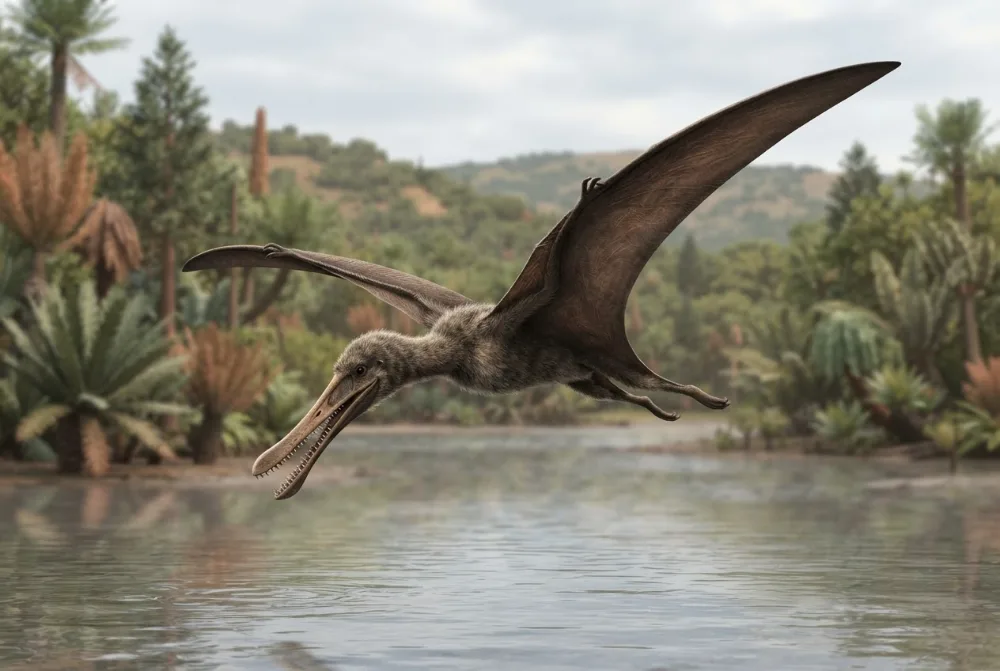
Balaenognathus was a flying reptile that lived about 150 million years ago. It had a strange, spoon-shaped snout with hundreds of tiny hooked teeth. It used its beak like a strainer to scoop up tiny shrimp from the water, just like a modern flamingo.12
Azalaki na bomoi ntango nini?
Azalaki monene boni?
Azalaki molai boni?
 molai lokola bapusu 2 ya ndako zolo kino mokila🍌molai lokola matoko 6 oyo balandani⚽akokaki kopumbwa kokatisa esika mobimba ya ndembo na sekonde 9,9
Balaenognathus azalaki monene boni soki tokokanisi na YO?
Kaka matematiki na navigatere na yo. Eloko moko te ebombami to etindami esika moko.
Azalaki na mbangu boni?


Makambo ya kosepelisa
Balaenognathus had at least 480 teeth, more than most other pterosaurs.1
The tips of its teeth had tiny hooks, which have never been seen in any other pterosaur. These hooks helped trap shrimp so they couldn't escape.12
The front of its snout was shaped like a spatula and had no teeth, so water could flow in easily.1
Its upper jaw was more curved than its lower jaw, so its mouth stayed slightly open at the front even when closed.1
The fossil was found by accident in a quarry in Germany, inside a block of stone that also contained bones of a crocodile-like animal.12
Balaenognathus lived during the Late Jurassic period, about 152 to 149 million years ago.3
It had long legs, which helped it wade through shallow seas while feeding.2
Mituna oyo batunaka mingi na ntina na Balaenognathus
?What did Balaenognathus eat?
It ate tiny shrimp and other small plankton. It used its spoon-shaped beak and hundreds of tiny hooked teeth to strain them out of the water.12
?How big was Balaenognathus?
It was a medium-sized pterosaur with a wingspan of 1.17 metres (3.8 feet). Its body was about 1 metre long.5
Mpo na bayebi ya badino
- Nkombo ya siansi
- Balaenognathus
- Nkombo epesamaki na
- Martill et al. 20236
- Lisanga
- Bareptile oyo bapumbwaka
- Libota / klade
- Ctenochasmatidae6
- Klasifikasio
- Pterosauria > Pterodactyloidea6
- Mbula ya mabanga
- mbula milio 152 kino 149 (Kimmeridgian)6
- Bikolo
- Alemani6
- Bafosile oyo ekomami
- 1 na The Paleobiology Database6
- Ntango bamonaki yango
- Balaenognathus was named by David Martill and colleagues in 2023. The only known fossil was found in September 2011 in a quarry near Wattendorf, Bavaria, Germany, by workers collecting a block of limestone.1
- Naino bazali kowelana
- Scientists are not sure exactly how Balaenognathus used its hooked teeth and spatula-like snout to filter food, but they think it may have pumped water in and out by moving its long neck.1
Esika makambo euti
- A new pterodactyloid pterosaur with a unique filter-feeding apparatus from the Late Jurassic of Germany | PalZ | Springer Nature Link (link.springer.com)
- Bizarre filter-feeding pterosaur described from Germany | Natural History Museum (nhm.ac.uk)
- PBDB Taxon (paleobiodb.org)
- Balaenognathus (en.m.wikipedia.org)
- Balaenognathus (Wikipedia) (Wikipedia)
- Balaenognathus in The Paleobiology Database (CC BY 4.0): mbula, bisika, milongo ya mabanga, klasifikasio.
Likambo nyonso na lokasa oyo ezali na nimero oyo elakisi liziba na yango. Soki tosali libunga, limbisa biso, tozali bato balingaka badino, zulunalo ya siansi te. Yebisa biso na [email protected] mpe tokobongisa yango.
 Rex azali na nzala! Dino Wiki ezali mosala ya tata moko mpo na mwana na ye ya mobali oyo alingaka badino, ofele, piblisite te mpe batrakere te. Bato bakolo bakoki kopesa Rex biskwi mpo na kosalisa ete etikala na internet.Leisa Rex
 Pteranodon
 Quetzalcoatlus
 Dorygnathus
 Rhamphorhynchus
 Anhanguera
 Pterodactylus
 Brachiosaurus
 Diplodocus
 Allosaurus
 Brontosaurus
 Compsognathus
 Camarasaurus