 Ozali dino nini? Kwizi
 Etumba ya badino
 Mbangu ya badino
 Masano mike ya badino
 Albumu ya bastika
 Bilisti TOP ya badino
 Kamwisa ngai!
Baryonyx
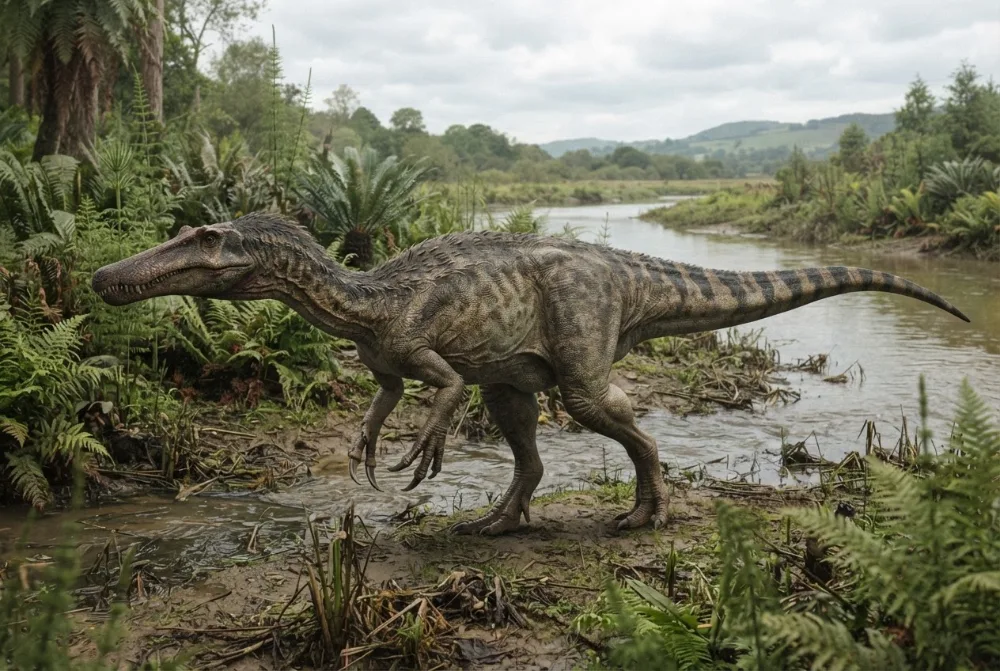
Baryonyx was a big, fish-eating dinosaur with a long snout like a crocodile and a huge claw on each hand. It lived about 130 to 125 million years ago in what is now England and other parts of Europe. It was one of the first dinosaurs shown to eat fish!1
Azalaki na bomoi ntango nini?
Azalaki monene boni?
Azalaki molai boni?
Azalaki molai boni na likolo?
Azalaki kilo boni?
 molai lokola bamotuka 2 oyo batelemi na molongo🍌molai lokola matoko 56 oyo balandani
 kilo lokola bambwa 100🍉kilo lokola bapasteke 400🎒kilo lokola bakelasi 2,5 mobimba ya bana🐻❄️kilo lokola ba-urs ya pembe 4🏃akokaki kopota metele 100 na sekonde 14 (moto oyo aleki mbangu asalelaka 9,6)
Baryonyx azalaki monene boni soki tokokanisi na YO?
Kaka matematiki na navigatere na yo. Eloko moko te ebombami to etindami esika moko.
Azalaki na mbangu boni?


Makambo ya kosepelisa
Baryonyx had a huge claw on its first finger, about 30 centimeters (12 inches) long, which it may have used to catch fish.1
Its snout was long and narrow, like a crocodile's, with many small, serrated teeth, perfect for gripping slippery fish.1
The first Baryonyx skeleton was found in 1983 in a clay pit in Surrey, England, by an amateur fossil collector named William Walker.1
Baryonyx was the first theropod dinosaur proven to eat fish, because fish scales were found in its stomach area.1
It lived in a warm, swampy environment with rivers and lakes, alongside other dinosaurs like Iguanodon and small sauropods.1
Some scientists think Baryonyx may have waded in water like a heron, using its long snout to snap up fish.1
Baryonyx also had a notch in its upper jaw, similar to a gharial, which helped it hold onto wriggling prey.1
Mituna oyo batunaka mingi na ntina na Baryonyx
?How big was Baryonyx?
About 7.5 to 10 metres (25 to 33 feet) long and weighed 1.2 to 2 metric tons (1.3 to 2.2 short tons).12
?What did Baryonyx eat?
It mainly ate fish, but also scavenged and ate young Iguanodon. Fish scales and bones were found in its stomach.12
?Did Baryonyx have feathers?
Nobody knows for sure. No feathers have been found with Baryonyx fossils, but some related dinosaurs may have had simple feathers.1
?Could Baryonyx swim?
It may have waded in shallow water and was probably a good swimmer, like a crocodile. It lived in a swampy environment.12
?Was Baryonyx bigger than T. rex?
No, Baryonyx was smaller. T. rex was about 12 metres (40 feet) long and weighed over 8 metric tons, while Baryonyx was up to 10 metres (33 feet) and 2 metric tons.1
?Why did Baryonyx have a big claw?
It used its 31-centimetre (12-inch) claw to catch fish and tear apart prey. The claw was on its thumb.12
?When did Baryonyx live?
It lived during the Early Cretaceous period, about 130 to 125 million years ago.12
?Where was Baryonyx found?
The first skeleton was found in 1983 in a clay pit in Surrey, England. Fossils have also been found in Spain.12
?Is Baryonyx a dinosaur?
Yes, Baryonyx is a theropod dinosaur. It is not a marine reptile or pterosaur.12
?How fast could Baryonyx run?
Scientists do not know its exact speed, but as a large theropod it probably ran at a moderate pace, maybe 25 to 40 km/h (15 to 25 mph).1
Mobuki masapo
Lisapo: Baryonyx was a slow, clumsy dinosaur that only ate fish.
Solo: While it ate fish, Baryonyx was also an active predator and scavenger, and it could probably move well on land.1
Mpo na bayebi ya badino
- Nkombo ya siansi
- Baryonyx
- Nkombo epesamaki na
- Charig and Milner 19863
- Lisanga
- Baspinozore
- Libota / klade
- Spinosauridae3
- Klasifikasio
- Theropoda > Spinosauridae3
- Mbula ya mabanga
- mbula milio 139 kino 110 (Berriasian / Albian)3
- Milongo ya mabanga
- Pinilla de los Moros, Weald Clay, Wessex3
- Bikolo
- Espanye, Angeletere, Portigale, Tinizi3
- Bafosile oyo ekomami
- 12 na The Paleobiology Database3
- Ntango bamonaki yango
- The first Baryonyx skeleton was discovered in 1983 by amateur fossil collector William J. Walker in a clay pit in Surrey, England. It was named by Alan J. Charig and Angela C. Milner in 1986.1
- Naino bazali kowelana
- Scientists still debate whether Baryonyx mainly hunted fish or also scavenged on land, and whether some fossils from other places really belong to this genus.1
Esika makambo euti
- Baryonyx (en.wikipedia.org)
- Baryonyx | Natural History Museum (nhm.ac.uk)
- Baryonyx in The Paleobiology Database (CC BY 4.0): mbula, bisika, milongo ya mabanga, klasifikasio.
Likambo nyonso na lokasa oyo ezali na nimero oyo elakisi liziba na yango. Soki tosali libunga, limbisa biso, tozali bato balingaka badino, zulunalo ya siansi te. Yebisa biso na [email protected] mpe tokobongisa yango.
 Rex azali na nzala! Dino Wiki ezali mosala ya tata moko mpo na mwana na ye ya mobali oyo alingaka badino, ofele, piblisite te mpe batrakere te. Bato bakolo bakoki kopesa Rex biskwi mpo na kosalisa ete etikala na internet.Leisa Rex
 Spinosaurus
 Suchomimus
 Angaturama
 Camarillasaurus
 Ceratosuchops
 Iberospinus
 Stegosaurus
 Iguanodon
 Archaeopteryx
 Giganotosaurus
 Microraptor
 Deinonychus