 Ozali dino nini? Kwizi
 Etumba ya badino
 Mbangu ya badino
 Masano mike ya badino
 Albumu ya bastika
 Bilisti TOP ya badino
 Kamwisa ngai!
Ceratocaudia
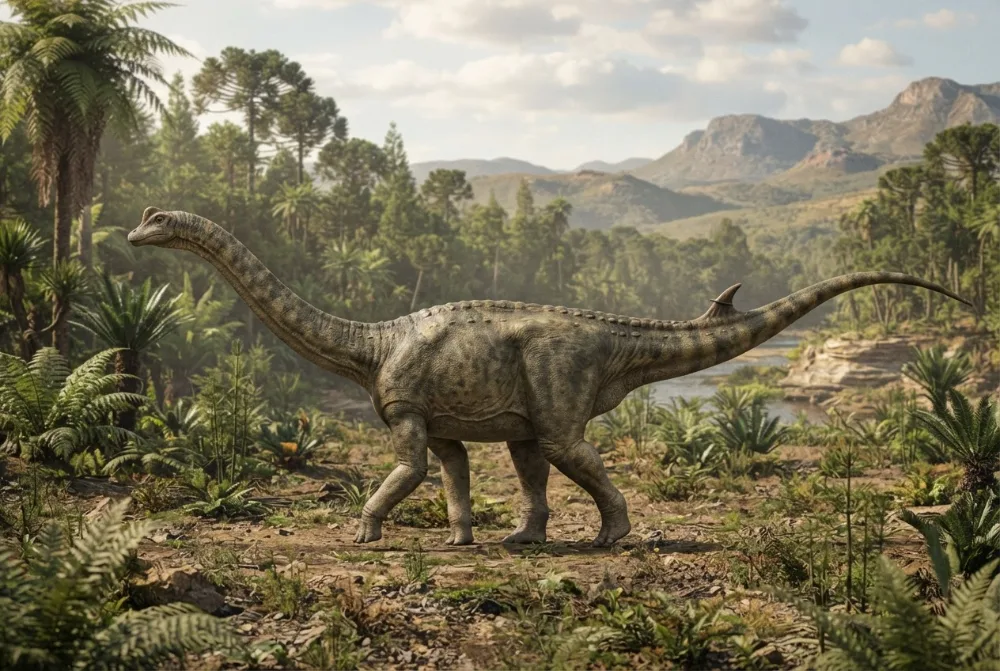
Ceratocaudia was a small, plant-eating sauropod dinosaur that lived in what is now India during the Jurassic Period. It had a horn-like crest on its tail bones, and scientists think it might have used its tail to scare away predators.1
Azalaki na bomoi ntango nini?
Azalaki monene boni?
Azalaki molai boni?
Azalaki molai boni na likolo?
kokanisa
 molai lokola bambwa 7 zolo kino mokila🍌molai lokola matoko 39 oyo balandani🏃akokaki kopota metele 100 na sekonde 12 (moto oyo aleki mbangu asalelaka 9,6)
Ceratocaudia azalaki monene boni soki tokokanisi na YO?
Kaka matematiki na navigatere na yo. Eloko moko te ebombami to etindami esika moko.
Azalaki na mbangu boni?


Makambo ya kosepelisa
Ceratocaudia is one of the smallest known macronarian sauropods, measuring only about 7 metres (23 feet) long.1
The horn-like crest on its tail vertebrae gave the dinosaur its name, meaning 'horned tail'.1
Scientists think Ceratocaudia might have been a dwarf species because the only known skeleton is from an old individual but is still very small.13
The holotype skeleton includes neck bones, tail bones, an ulna, thighbones, shinbones, and even finger and toe bones.1
Ceratocaudia lived in an estuary environment alongside petrified wood, clams, and a much larger sauropod that was about 20 metres long.1
Mituna oyo batunaka mingi na ntina na Ceratocaudia
?How big was Ceratocaudia?
Ceratocaudia was about 7 metres (23 feet) long, making it one of the smallest known macronarian sauropods.1
?Did Ceratocaudia have a horn on its tail?
Yes, it had a horn-like crest on its tail bones, which is why its name means 'horned tail'.1
?What did Ceratocaudia eat?
Ceratocaudia was a plant-eater, or herbivore.4
?When did Ceratocaudia live?
Ceratocaudia lived during the Jurassic Period, from about 201 to 168 million years ago.4
?Where was Ceratocaudia found?
Its fossils were found in Gujarat, India, in rocks that were once a low-energy estuary.1
?Could Ceratocaudia use its tail to fight?
Scientists think it could swing its tail as a mild deterrent to scare away predators.1
Mpo na bayebi ya badino
- Nkombo ya siansi
- Ceratocaudia
- Nkombo epesamaki na
- Natarajan et al. 20264
- Lisanga
- Nkingo milai
- Libota / klade
- Macronaria4
- Klasifikasio
- Sauropodomorpha > Sauropoda > Macronaria4
- Mbula ya mabanga
- mbula milio 201 kino 168 (Hettangian / Bajocian)4
- Milongo ya mabanga
- Kaladongar4
- Bikolo
- Indi4
- Bafosile oyo ekomami
- 1 na The Paleobiology Database4
- Ntango bamonaki yango
- Ceratocaudia antiqua was named by Abhishek Natarajan and colleagues in 2026 based on a partial skeleton found in the Kaladongar Formation of Gujarat, India.12
- Naino bazali kowelana
- Scientists are not sure if Ceratocaudia was a true dwarf species or just a small adult, and they debate its exact place on the sauropod family tree.13
Esika makambo euti
- Ceratocaudia (en.wikipedia.org)
- PBDB Taxon (paleobiodb.org)
- A new diminutive Jurassic neosauropod from the Kaladongar Formation (Khadir Uplift) of the Kachchh Basin, western India (exa.ai)
- Ceratocaudia in The Paleobiology Database (CC BY 4.0): mbula, bisika, milongo ya mabanga, klasifikasio.
Likambo nyonso na lokasa oyo ezali na nimero oyo elakisi liziba na yango. Soki tosali libunga, limbisa biso, tozali bato balingaka badino, zulunalo ya siansi te. Yebisa biso na [email protected] mpe tokobongisa yango.
 Rex azali na nzala! Dino Wiki ezali mosala ya tata moko mpo na mwana na ye ya mobali oyo alingaka badino, ofele, piblisite te mpe batrakere te. Bato bakolo bakoki kopesa Rex biskwi mpo na kosalisa ete etikala na internet.Leisa Rex
 Brachiosaurus
 Diplodocus
 Brontosaurus
 Argentinosaurus
 Camarasaurus
 Morosaurus
 Dilophosaurus
 Stenopterygius
 Dorygnathus
 Scutellosaurus
 Sinosaurus
 Temnodontosaurus