 Ozali dino nini? Kwizi
 Etumba ya badino
 Mbangu ya badino
 Masano mike ya badino
 Albumu ya bastika
 Bilisti TOP ya badino
 Kamwisa ngai!
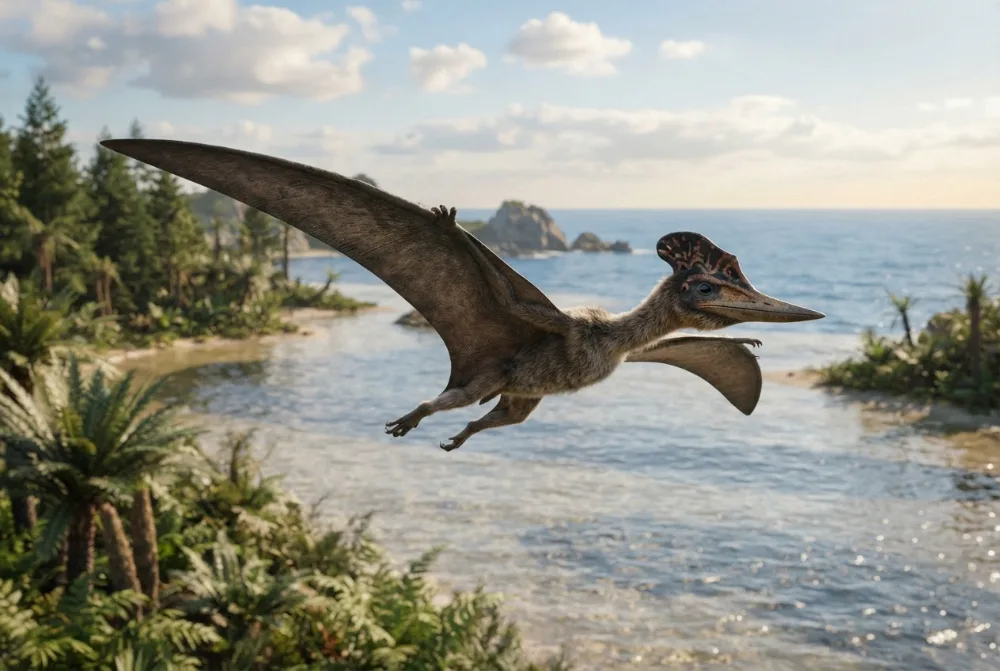
Germanodactylus
Germanodactylus was a small pterosaur that flew over warm lagoons during the Late Jurassic. It had a pointed beak and a fancy crest on its head, which may have been used to attract mates.1
Azalaki na bomoi ntango nini?
Azalaki monene boni?
Mapapu na ye ezalaki monene boni?
 molai lokola bapusu 2 ya ndako zolo kino mokila⚽akokaki kopumbwa kokatisa esika mobimba ya ndembo na sekonde 10
Germanodactylus azalaki monene boni soki tokokanisi na YO?
Kaka matematiki na navigatere na yo. Eloko moko te ebombami to etindami esika moko.
Azalaki na mbangu boni?


Makambo ya kosepelisa
Germanodactylus had a head crest with a bony part and a soft-tissue part that more than doubled its height. The soft part was probably made of skin-like material.1
Its skull was about 13 centimeters (5.1 inches) long for G. cristatus, and 21 centimeters (8.3 inches) for G. rhamphastinus.1
Germanodactylus had sharp teeth, with about 13 teeth in each side of the upper jaw for G. cristatus, and 16 for G. rhamphastinus.1
For a long time, scientists thought Germanodactylus was just a species of Pterodactylus, but it got its own genus in 1964.1
Some scientists think the two species of Germanodactylus might not be closely related, and one might belong to a different group.1
Germanodactylus lived about 150 to 148 million years ago, during the Late Jurassic period.1
Mituna oyo batunaka mingi na ntina na Germanodactylus
?Was Germanodactylus a dinosaur?
No, Germanodactylus was a pterosaur, a flying reptile that lived during the time of dinosaurs, but it is not a dinosaur.1
?How big was Germanodactylus?
Germanodactylus was about the size of a raven. G. cristatus had a wingspan of about 0.98 meters (3.2 feet), and G. rhamphastinus was a bit larger with a wingspan of 1.08 meters (3.5 feet).1
?What did Germanodactylus eat?
Scientists are not sure exactly what it ate, but its sharp teeth suggest it may have eaten fish or other small animals.1
?Why did Germanodactylus have a crest?
The crest may have been used to attract mates, like a peacock's tail. It had a bony part and a soft part that more than doubled its height.1
Mobuki masapo
Lisapo: Germanodactylus was a dinosaur.
Solo: Germanodactylus was a pterosaur, a flying reptile that is not a dinosaur.1
Mpo na bayebi ya badino
- Nkombo ya siansi
- Germanodactylus
- Nkombo epesamaki na
- Young 19642
- Lisanga
- Bareptile oyo bapumbwaka
- Libota / klade
- Lophocratia2
- Klasifikasio
- Pterosauria > Pterodactyloidea2
- Mbula ya mabanga
- mbula milio 155 kino 145 (Kimmeridgian / Tithonian)2
- Milongo ya mabanga
- Solnhofen, Kimmeridge Clay, Altmühltal2
- Bikolo
- Alemani, Angeletere2
- Bafosile oyo ekomami
- 5 na The Paleobiology Database2
- Ntango bamonaki yango
- The first specimen was found in the Solnhofen Limestone of Germany and was named Pterodactylus cristatus by Carl Wiman in 1925. Yang Zhongjian gave it its own genus, Germanodactylus, in 1964.1
- Naino bazali kowelana
- Scientists still debate whether the two species of Germanodactylus belong in the same genus, or if one should be moved to a new genus.1
Esika makambo euti
- Germanodactylus (en.wikipedia.org)
- Germanodactylus in The Paleobiology Database (CC BY 4.0): mbula, bisika, milongo ya mabanga, klasifikasio.
Likambo nyonso na lokasa oyo ezali na nimero oyo elakisi liziba na yango. Soki tosali libunga, limbisa biso, tozali bato balingaka badino, zulunalo ya siansi te. Yebisa biso na [email protected] mpe tokobongisa yango.
 Rex azali na nzala! Dino Wiki ezali mosala ya tata moko mpo na mwana na ye ya mobali oyo alingaka badino, ofele, piblisite te mpe batrakere te. Bato bakolo bakoki kopesa Rex biskwi mpo na kosalisa ete etikala na internet.Leisa Rex
 Pteranodon
 Quetzalcoatlus
 Dorygnathus
 Rhamphorhynchus
 Anhanguera
 Pterodactylus
 Brachiosaurus
 Diplodocus
 Allosaurus
 Brontosaurus
 Compsognathus
 Camarasaurus