 Ozali dino nini? Kwizi
 Etumba ya badino
 Mbangu ya badino
 Masano mike ya badino
 Albumu ya bastika
 Bilisti TOP ya badino
 Kamwisa ngai!
Giraffatitan
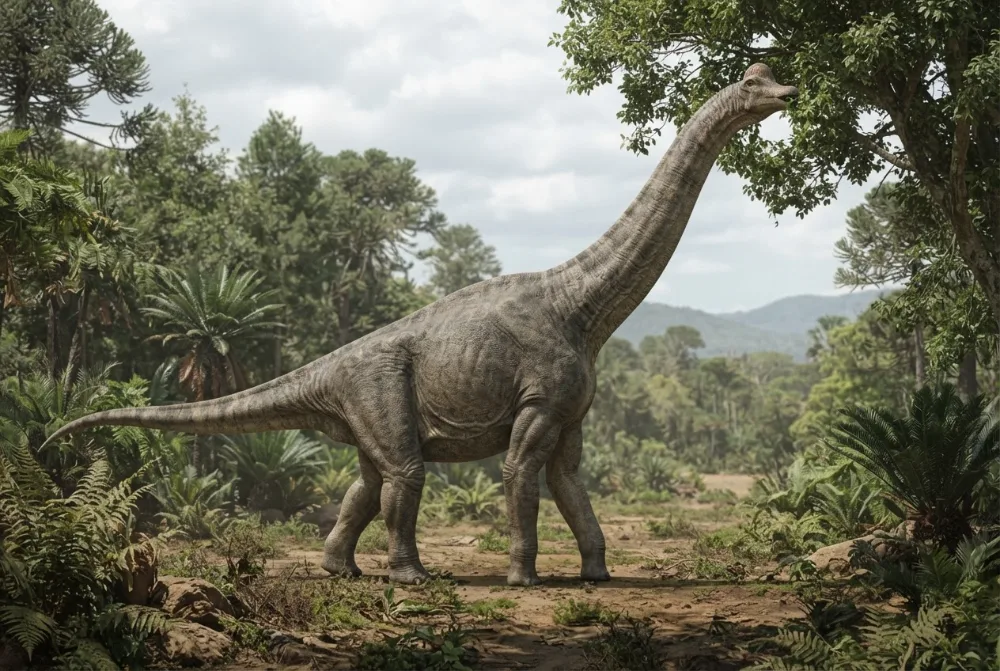
Giraffatitan was a giant, long-necked plant-eater that lived in what is now Tanzania. It had a giraffe-like shape with very long front legs and a tall skull. This dinosaur could reach high into the trees to munch on leaves that other dinosaurs couldn't reach.1
Azalaki na bomoi ntango nini?
Azalaki monene boni?
Azalaki molai boni?
Azalaki molai boni na likolo?
Azalaki kilo boni?

 molai lokola bamotuka 6 oyo batelemi na molongo🍌molai lokola matoko 140 oyo balandani🍉kilo lokola bapasteke 9600🦒molai na likolo lokola bazirafe 3 oyo batelemi moko likolo ya mosusu🎒kilo lokola bakelasi 60 mobimba ya bana🐻❄️kilo lokola ba-urs ya pembe 110🏢molai ete akoka kotala na lininisa ya etaje 6🏃akokaki kopota metele 100 na sekonde 40 (moto oyo aleki mbangu asalelaka 9,6)
Giraffatitan azalaki monene boni soki tokokanisi na YO?
Kaka matematiki na navigatere na yo. Eloko moko te ebombami to etindami esika moko.
Azalaki na mbangu boni?


Makambo ya kosepelisa
Giraffatitan was first thought to be an African species of Brachiosaurus, but scientists now think it is a separate genus because of many differences in its bones.1
The name Giraffatitan means 'titanic giraffe' because its long neck and sloping body reminded scientists of a giraffe.1
Most size estimates come from a subadult skeleton called HMN SII, but a larger leg bone suggests some Giraffatitan grew even bigger, up to 26 metres long.1
Its nostrils were once thought to be on top of its head, like a snorkel, but modern studies show they were near the tip of the snout.1
Giraffatitan lived about 150 to 145 million years ago, during the Late Jurassic period, in a warm, seasonal climate with forests and coastal lagoons.1
It had a very long neck that could only move up and down a little, so it probably fed on treetop leaves without swinging its head sideways much.1
Mituna oyo batunaka mingi na ntina na Giraffatitan
?How big was Giraffatitan?
About 23 metres (75 feet) long and 12 metres (39 feet) tall. The largest individuals may have reached 26 metres (85 feet) and weighed up to 48 tonnes (53 tons).12
?What did Giraffatitan eat?
It was a plant-eater (herbivore) that ate leaves from the tops of trees. Its long neck and chisel-like teeth helped it reach and bite off foliage that other dinosaurs couldn't.12
?When did Giraffatitan live?
It lived during the Late Jurassic Period, about 154 to 142 million years ago.2
?Where was Giraffatitan found?
Its fossils were discovered in Tanzania, Africa, at a place called Tendaguru.12
?Was Giraffatitan bigger than T. rex?
Yes, much bigger. Giraffatitan was about 23 metres long and weighed up to 48 tonnes, while T. rex was only about 12 metres long and weighed around 8 tonnes.1
?Is Giraffatitan a dinosaur?
Yes, it is a dinosaur. It is a sauropod, a group of four-legged, long-necked plant-eating dinosaurs.12
?Why did Giraffatitan have a long neck?
Its long neck helped it reach high into trees to eat leaves that other dinosaurs could not reach. Its neck could only move up and down a little, so it probably fed on treetop leaves without swinging its head sideways much.1
?Could Giraffatitan swim?
No, scientists now think it was a fully land animal. Water pressure would have made it hard to breathe if it was submerged, and its feet were too narrow for swimming.1
Mobuki masapo
Lisapo: Some people think Giraffatitan spent most of its time in water to support its heavy body.
Solo: Scientists now believe it was fully land-living, because water pressure would have made breathing difficult and its feet were not good for swimming.1
Mpo na bayebi ya badino
- Nkombo ya siansi
- Giraffatitan
- Nkombo epesamaki na
- (Paul 1988)3
- Lisanga
- Nkingo milai
- Libota / klade
- Brachiosauridae3
- Klasifikasio
- Sauropodomorpha > Sauropoda > Macronaria3
- Mbula ya mabanga
- mbula milio 162 kino 143 (Oxfordian / Tithonian)3
- Milongo ya mabanga
- Tendaguru3
- Bikolo
- Tanzani3
- Bafosile oyo ekomami
- 42 na The Paleobiology Database3
- Ntango bamonaki yango
- Giraffatitan was discovered in Tanzania by a German expedition led by Werner Janensch, who first named it Brachiosaurus brancai in 1914. It was later given its own genus name Giraffatitan by Gregory S. Paul in 1988.1
- Naino bazali kowelana
- Scientists still debate whether Giraffatitan should be a separate genus from Brachiosaurus or just a close relative.1
Esika makambo euti
- Giraffatitan (en.wikipedia.org)
- Giraffatitan | Natural History Museum (nhm.ac.uk)
- Giraffatitan in The Paleobiology Database (CC BY 4.0): mbula, bisika, milongo ya mabanga, klasifikasio.
Likambo nyonso na lokasa oyo ezali na nimero oyo elakisi liziba na yango. Soki tosali libunga, limbisa biso, tozali bato balingaka badino, zulunalo ya siansi te. Yebisa biso na [email protected] mpe tokobongisa yango.
 Rex azali na nzala! Dino Wiki ezali mosala ya tata moko mpo na mwana na ye ya mobali oyo alingaka badino, ofele, piblisite te mpe batrakere te. Bato bakolo bakoki kopesa Rex biskwi mpo na kosalisa ete etikala na internet.Leisa Rex
 Brachiosaurus
 Diplodocus
 Brontosaurus
 Argentinosaurus
 Camarasaurus
 Morosaurus
 Allosaurus
 Compsognathus
 Camptosaurus
 Nanosaurus
 Rhamphorhynchus
 Ceratosaurus