 Ozali dino nini? Kwizi
 Etumba ya badino
 Mbangu ya badino
 Masano mike ya badino
 Albumu ya bastika
 Bilisti TOP ya badino
 Kamwisa ngai!
Keichousaurus
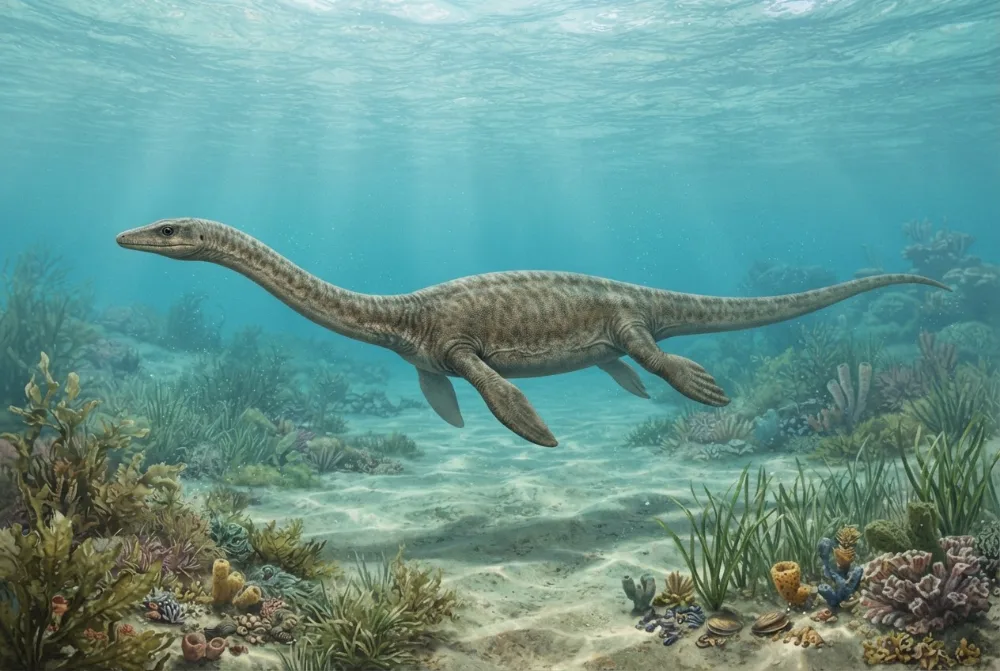
Keichousaurus was a small marine reptile that swam in warm seas during the Triassic Period. It had a long neck, a long tail, and paddle-like limbs to row through the water.1
Azalaki na bomoi ntango nini?
Azalaki monene boni?
Azalaki molai boni?
Keichousaurus azalaki monene boni soki tokokanisi na YO?
Kaka matematiki na navigatere na yo. Eloko moko te ebombami to etindami esika moko.
Azalaki na mbangu boni?


Makambo ya kosepelisa
Keichousaurus gave birth to live young instead of laying eggs. Baby fossils have been found inside adult females.1
This reptile had very broad ulna bones in its forelimbs, which helped make its paddles more effective for swimming.1
Males grew slightly larger than females. Mature males reached about 16 cm snout-vent length, while females reached about 15 cm.1
Keichousaurus is one of the most common sauropterygian fossils found in China. Many complete skeletons have been collected.1
It had a long, serpentine neck and a small head, similar to other pachypleurosaurs.1
Keichousaurus probably used a rowing motion with its paddle-like limbs to move through the water.1
Mituna oyo batunaka mingi na ntina na Keichousaurus
?Is Keichousaurus a dinosaur?
No, Keichousaurus is not a dinosaur. It is a marine reptile called a sauropterygian.1
?How big was Keichousaurus?
Keichousaurus was very small. Mature males reached about 16 cm snout-vent length, and females about 15 cm.1
?What did Keichousaurus eat?
It ate fish. It had pointed teeth and backward-curved teeth at the front of its mouth to catch and swallow prey whole.1
?Did Keichousaurus lay eggs?
No. Fossil evidence shows that Keichousaurus gave birth to live young, not eggs. Babies have been found inside adult females.143
?Could Keichousaurus swim?
Yes, it was a good swimmer. It used its paddle-like limbs to row through the water, similar to underwater flight.1
?When did Keichousaurus live?
Keichousaurus lived during the Triassic Period, from about 251 to 227 million years ago.1
Mpo na bayebi ya badino
- Nkombo ya siansi
- Keichousaurus
- Nkombo epesamaki na
- Young 19585
- Lisanga
- Bareptile ya mbu
- Libota / klade
- Keichousauridae5
- Klasifikasio
- Sauropterygia5
- Mbula ya mabanga
- mbula milio 251 kino 237 ()5
- Milongo ya mabanga
- Falang, Jialingjiang, Gejiu5
- Bikolo
- Sina5
- Bafosile oyo ekomami
- 7 na The Paleobiology Database5
- Ntango bamonaki yango
- The first fossil of Keichousaurus was found in 1957 in Guizhou Province, China, by Hu Chengzhi. It was named by Chinese paleontologist Young Chung-chien in 1958.1
- Naino bazali kowelana
- Scientists are not sure whether Keichousaurus was viviparous (giving birth to live young) or ovoviviparous (eggs hatching inside the mother).3
Esika makambo euti
- Keichousaurus (en.wikipedia.org)
- PBDB Taxon (paleobiodb.org)
- Morphology of Keichousaurus hui from the Middle Triassic of Xingyi, Guizhou Province with Comments on Its Reproduction Mode (xbna.pku.edu.cn)
- Triassic marine reptiles gave birth to live young | Nature (nature.com)
- Keichousaurus in The Paleobiology Database (CC BY 4.0): mbula, bisika, milongo ya mabanga, klasifikasio.
Likambo nyonso na lokasa oyo ezali na nimero oyo elakisi liziba na yango. Soki tosali libunga, limbisa biso, tozali bato balingaka badino, zulunalo ya siansi te. Yebisa biso na [email protected] mpe tokobongisa yango.
 Rex azali na nzala! Dino Wiki ezali mosala ya tata moko mpo na mwana na ye ya mobali oyo alingaka badino, ofele, piblisite te mpe batrakere te. Bato bakolo bakoki kopesa Rex biskwi mpo na kosalisa ete etikala na internet.Leisa Rex
 Nothosaurus
 Placodus
 Lariosaurus
 Cyamodus
 Cymatosaurus
 Proneusticosaurus
 Chonespondylus
 Cymbospondylus
 Phalarodon
 Mixosaurus
 Chaohusaurus
 Chensaurus