 Ozali dino nini? Kwizi
 Etumba ya badino
 Mbangu ya badino
 Masano mike ya badino
 Albumu ya bastika
 Bilisti TOP ya badino
 Kamwisa ngai!
Kunpengopterus
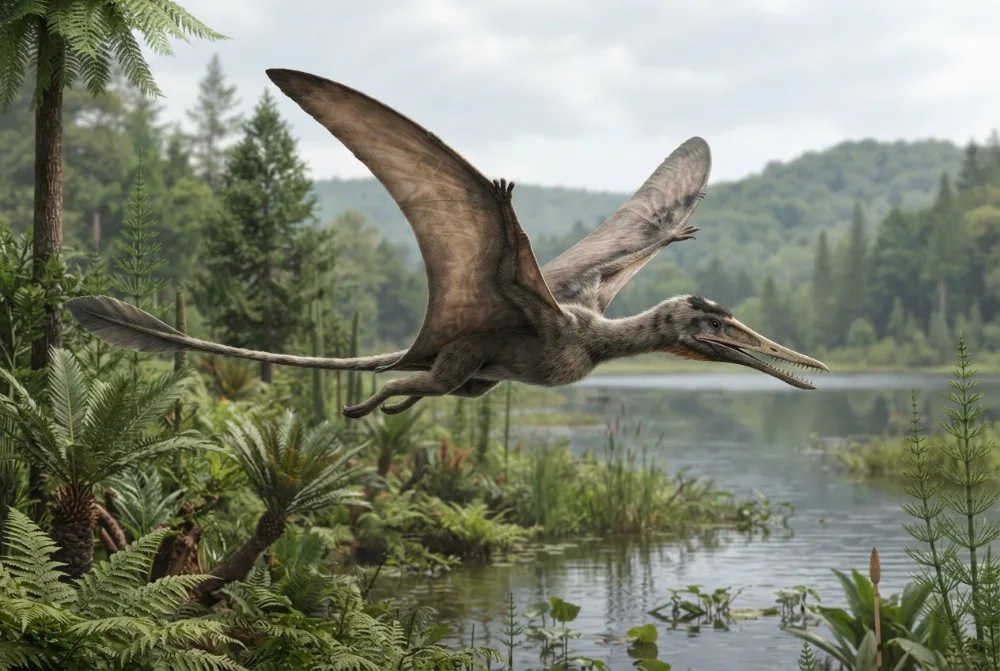
Kunpengopterus was a flying reptile that lived in what is now China during the Jurassic Period. It had a long tail and a head like a bird, and it ate fish.23
Azalaki na bomoi ntango nini?
Azalaki monene boni?
Azalaki kilo boni?
Kunpengopterus azalaki monene boni soki tokokanisi na YO?
Kaka matematiki na navigatere na yo. Eloko moko te ebombami to etindami esika moko.
Azalaki na mbangu boni?


Makambo ya kosepelisa
Kunpengopterus sinensis is known from two nearly complete skeletons, one adult and one juvenile, found with fossilized vomit pellets nearby.3
The vomit pellets contain scales of palaeonisciform fish, proving that Kunpengopterus ate fish and could vomit indigestible parts.3
Both the adult and juvenile Kunpengopterus had similar teeth and could fly soon after hatching, like some other pterosaurs.3
The name Kunpengopterus comes from Chinese mythology: the Kun was a giant fish that could turn into the Peng, a huge bird.1
Kunpengopterus lived between about 168 and 152 million years ago, during the Late Jurassic Period.2
The type specimen of Kunpengopterus sinensis is an almost complete skeleton with a full skull and lower jaws.1
Mituna oyo batunaka mingi na ntina na Kunpengopterus
?How big was Kunpengopterus?
Its head was about 10.7 centimetres (4.2 inches) long. The whole body was small, like a modern bird.1
?Did Kunpengopterus have feathers?
No, it did not have feathers. It had pycnofibers, which are thin, hair-like fibers, on its body.4
?What did Kunpengopterus eat?
It ate fish, especially palaeonisciform fish. Scientists know this because fossilized vomit pellets containing fish scales were found with its skeletons.5
?Could Kunpengopterus fly?
Yes, it could fly. Even young Kunpengopterus could fly soon after hatching, just like adults.5
Mpo na bayebi ya badino
- Nkombo ya siansi
- Kunpengopterus
- Nkombo epesamaki na
- Wang et al. 20106
- Lisanga
- Bareptile oyo bapumbwaka
- Libota / klade
- Wukongopteridae6
- Klasifikasio
- Pterosauria6
- Mbula ya mabanga
- mbula milio 168 kino 152 (Bathonian / Kimmeridgian)6
- Milongo ya mabanga
- Tiaojishan6
- Bikolo
- Sina6
- Bafosile oyo ekomami
- 2 na The Paleobiology Database6
- Ntango bamonaki yango
- Kunpengopterus sinensis was named by Wang Xiaolin and colleagues in 2010, based on a fossil found in the Tiaojishan Formation of Liaoning, China.12
- Naino bazali kowelana
- Scientists are not sure about the exact age of the rocks that contain Kunpengopterus fossils, which may be from the Middle or Late Jurassic.1
Esika makambo euti
- Kunpengopterus (en.wikipedia.org)
- PBDB Taxon (paleobiodb.org)
- Two emetolite-pterosaur associations from the Late Jurassic of China: showing the first evidence for antiperistalsis in (royalsocietypublishing.org)
- New long-tailed pterosaurs (Wukongopteridae) from western Liaoning, China (dinodata.de)
- Two emetolite-pterosaur associations from the Late Jurassic of China: showing the first evidence for antiperistalsis in pterosaurs (pmc.ncbi.nlm.nih.gov)
- Kunpengopterus in The Paleobiology Database (CC BY 4.0): mbula, bisika, milongo ya mabanga, klasifikasio.
Likambo nyonso na lokasa oyo ezali na nimero oyo elakisi liziba na yango. Soki tosali libunga, limbisa biso, tozali bato balingaka badino, zulunalo ya siansi te. Yebisa biso na [email protected] mpe tokobongisa yango.
 Rex azali na nzala! Dino Wiki ezali mosala ya tata moko mpo na mwana na ye ya mobali oyo alingaka badino, ofele, piblisite te mpe batrakere te. Bato bakolo bakoki kopesa Rex biskwi mpo na kosalisa ete etikala na internet.Leisa Rex
 Pteranodon
 Quetzalcoatlus
 Dorygnathus
 Rhamphorhynchus
 Anhanguera
 Pterodactylus
 Brachiosaurus
 Diplodocus
 Allosaurus
 Brontosaurus
 Compsognathus
 Camarasaurus