 Ozali dino nini? Kwizi
 Etumba ya badino
 Mbangu ya badino
 Masano mike ya badino
 Albumu ya bastika
 Bilisti TOP ya badino
 Kamwisa ngai!
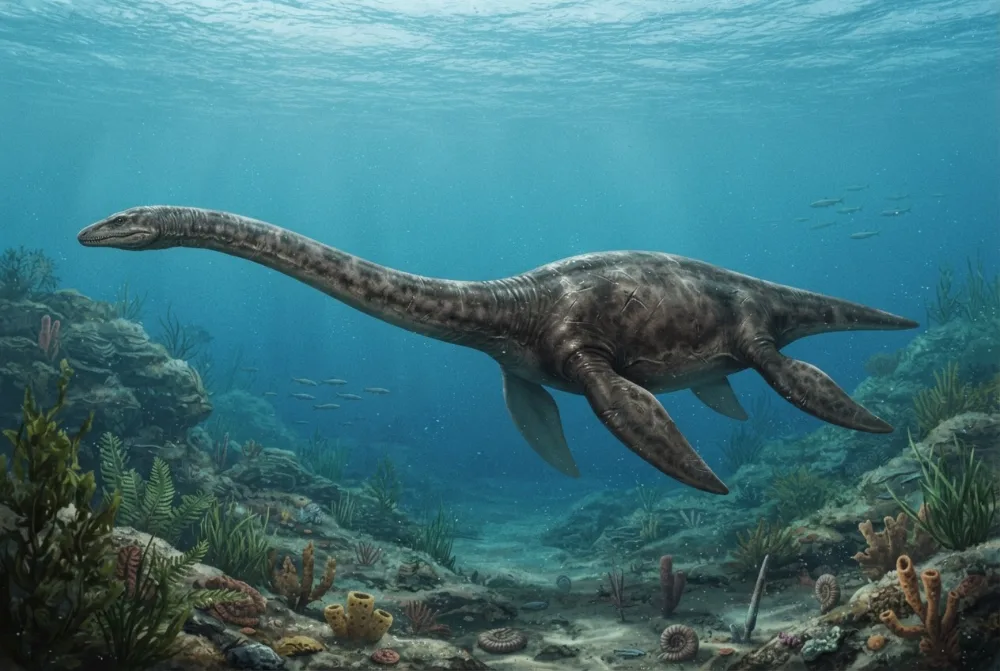
Lagenanectes
Lagenanectes was a long-necked marine reptile that swam in the seas of what is now Germany. It was not a dinosaur, but a plesiosaur, and it used its four flippers to paddle through the water. This ancient creature grew to about 8 meters long, as long as a school bus!21
Azalaki na bomoi ntango nini?
Azalaki monene boni?
Azalaki molai boni?
 molai lokola bambwa 8 zolo kino mokila🍌molai lokola matoko 44 oyo balandani🏊akokaki kobeta mai bolai ya pisine monene (50 m) na sekonde 7,5
Lagenanectes azalaki monene boni soki tokokanisi na YO?
Kaka matematiki na navigatere na yo. Eloko moko te ebombami to etindami esika moko.
Azalaki na mbangu boni?


Makambo ya kosepelisa
Lagenanectes is one of the earliest known elasmosaurids, a group of plesiosaurs with very long necks. It lived about 130 million years ago during the Early Cretaceous.21
The front part of its lower jaw had a unique platform with dents, and the tooth sockets pointed sideways. This is different from most other plesiosaurs.1
Grooves on the top of its skull may have held electroreceptors, which helped Lagenanectes detect prey hidden in the dark water.1
The only known fossil of Lagenanectes shows signs of bone disease. The back of the skull and first neck vertebra had bony outgrowths, possibly from a bacterial infection.21
The fossil was discovered in 1964 by a private collector named Kurt Wiedenroth in a clay pit near Sarstedt, Germany. The pit no longer exists.21
Lagenanectes was named in 2017, more than 50 years after its discovery. Scientists finally studied the bones and realized it was a new genus.1
Mpo na bayebi ya badino
- Nkombo ya siansi
- Lagenanectes
- Nkombo epesamaki na
- Sachs et al. 20174
- Lisanga
- Baplezozore
- Libota / klade
- Elasmosauridae4
- Klasifikasio
- Plesiosauria > Elasmosauridae > Sauropterygia4
- Mbula ya mabanga
- mbula milio 133 kino 126 (Hauterivian)4
- Milongo ya mabanga
- Stadthagen4
- Bikolo
- Alemani4
- Bafosile oyo ekomami
- 1 na The Paleobiology Database4
- Ntango bamonaki yango
- Lagenanectes was discovered in 1964 by fossil collector Kurt Wiedenroth in a clay pit near Sarstedt, Germany. It was named and described as a new genus and species by Sven Sachs, Jahn J. Hornung and Benjamin P. Kear in 2017.21
- Naino bazali kowelana
- The exact age of the Lagenanectes fossil is uncertain. It could be from the lower Hauterivian to lower Barremian stages, but scientists think it is most likely upper Hauterivian.21
Esika makambo euti
- Lagenanectes (en.wikipedia.org)
- Lagenanectes richterae, an early elasmosaurid from Germany (sachspal.de)
- PBDB Taxon (paleobiodb.org)
- Lagenanectes in The Paleobiology Database (CC BY 4.0): mbula, bisika, milongo ya mabanga, klasifikasio.
Likambo nyonso na lokasa oyo ezali na nimero oyo elakisi liziba na yango. Soki tosali libunga, limbisa biso, tozali bato balingaka badino, zulunalo ya siansi te. Yebisa biso na [email protected] mpe tokobongisa yango.
 Rex azali na nzala! Dino Wiki ezali mosala ya tata moko mpo na mwana na ye ya mobali oyo alingaka badino, ofele, piblisite te mpe batrakere te. Bato bakolo bakoki kopesa Rex biskwi mpo na kosalisa ete etikala na internet.Leisa Rex
 Elasmosaurus
 Pliosaurus
 Plesiosaurus
 Cimoliasaurus
 Colymbosaurus
 Trinacromerum
 Stegosaurus
 Iguanodon
 Archaeopteryx
 Giganotosaurus
 Microraptor
 Deinonychus