 Ozali dino nini? Kwizi
 Etumba ya badino
 Mbangu ya badino
 Masano mike ya badino
 Albumu ya bastika
 Bilisti TOP ya badino
 Kamwisa ngai!
Azalaki na bomoi ntango nini?

Azalaki monene boni?
Azalaki molai boni?
Azalaki molai boni na likolo?
kokanisa
Azalaki kilo boni?

 molai lokola bamotuka 6 oyo batelemi na molongo🍌molai lokola matoko 140 oyo balandani🍉kilo lokola bapasteke 9400🎒kilo lokola bakelasi 59 mobimba ya bana🐻❄️kilo lokola ba-urs ya pembe 100🏢molai ete akoka kotala na lininisa ya etaje 2🏃akokaki kopota metele 100 na sekonde 33 (moto oyo aleki mbangu asalelaka 9,6)
Losillasaurus azalaki monene boni soki tokokanisi na YO?
Kaka matematiki na navigatere na yo. Eloko moko te ebombami to etindami esika moko.
Azalaki na mbangu boni?


Makambo ya kosepelisa
Losillasaurus had a very long humerus (upper arm bone) that measured 143 centimetres (56 inches) long, even though the specimen was not fully grown.1
The neural spines on its tail vertebrae were shaped like cutlasses, a unique feature that helps scientists identify this dinosaur.2
Losillasaurus lived during the Late Jurassic and possibly into the Early Cretaceous, about 157 to 145 million years ago.1
The largest Losillasaurus individuals may have weighed as much as 47 tonnes (52 short tons), similar to several elephants combined.1
Losillasaurus belongs to a group of sauropods called Turiasauria, which includes other giants like Turiasaurus.3
The first fossils of Losillasaurus were discovered near the village of Losilla in Valencia, Spain, by a local teacher who was also an amateur archaeologist.2
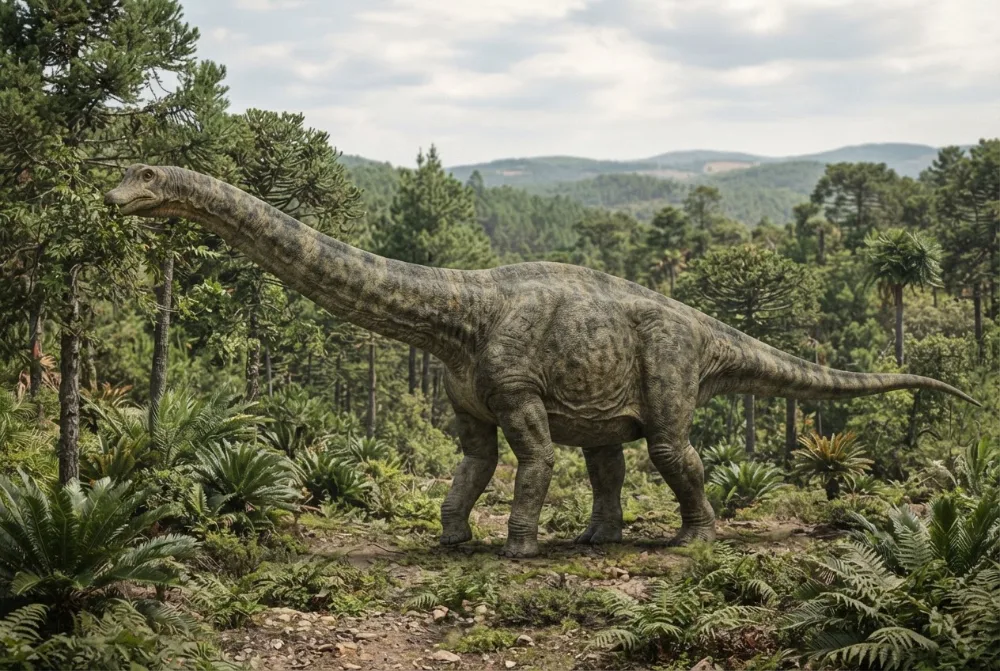
Mituna oyo batunaka mingi na ntina na Losillasaurus
?How big was Losillasaurus?
Estimates vary. One study suggests 15 to 18 metres (49 to 59 ft) long and 12 to 15 tonnes (13 to 17 short tons). But the largest adults may have reached 25 metres (82 ft) and weighed about 47 tonnes (52 short tons).1
?What did Losillasaurus eat?
It was a plant-eater. Its heart-shaped teeth helped it eat tough plants.1
?When did Losillasaurus live?
It lived during the Late Jurassic and possibly into the Early Cretaceous, about 157 to 145 million years ago.1
?Where was Losillasaurus found?
Its fossils were discovered near the village of Losilla in Valencia, Spain, and also in the Lourinhã Formation of Portugal.1
Mpo na bayebi ya badino
- Nkombo ya siansi
- Losillasaurus
- Nkombo epesamaki na
- Casanovas et al. 20013
- Lisanga
- Nkingo milai
- Libota / klade
- Turiasauria3
- Klasifikasio
- Sauropodomorpha > Sauropoda3
- Mbula ya mabanga
- mbula milio 155 kino 143 (Kimmeridgian / Tithonian)3
- Milongo ya mabanga
- Villar del Arzobispo, Praia da Amoreira-Porto Novo3
- Bikolo
- Espanye, Portigale3
- Bafosile oyo ekomami
- 3 na The Paleobiology Database3
- Ntango bamonaki yango
- Losillasaurus was named in 2001 by Casanovas, Santafé, and Sanz based on fossils found near Losilla, Spain. The fossils were excavated between 1989 and 1995.12
- Naino bazali kowelana
- Scientists are not sure exactly how big adult Losillasaurus could grow, because the best-known specimen is a subadult.1
Esika makambo euti
- Losillasaurus (en.wikipedia.org)
- Losillasaurus giganteus, a new sauropod from the transitional Jurassic Cretaceous of the Los Serranos basin (Valencia, Spain) (naturalhistory.si.edu)
- Losillasaurus in The Paleobiology Database (CC BY 4.0): mbula, bisika, milongo ya mabanga, klasifikasio.
Likambo nyonso na lokasa oyo ezali na nimero oyo elakisi liziba na yango. Soki tosali libunga, limbisa biso, tozali bato balingaka badino, zulunalo ya siansi te. Yebisa biso na [email protected] mpe tokobongisa yango.
 Rex azali na nzala! Dino Wiki ezali mosala ya tata moko mpo na mwana na ye ya mobali oyo alingaka badino, ofele, piblisite te mpe batrakere te. Bato bakolo bakoki kopesa Rex biskwi mpo na kosalisa ete etikala na internet.Leisa Rex
 Brachiosaurus
 Diplodocus
 Brontosaurus
 Argentinosaurus
 Camarasaurus
 Morosaurus
 Allosaurus
 Compsognathus
 Camptosaurus
 Nanosaurus
 Rhamphorhynchus
 Ceratosaurus