 Ozali dino nini? Kwizi
 Etumba ya badino
 Mbangu ya badino
 Masano mike ya badino
 Albumu ya bastika
 Bilisti TOP ya badino
 Kamwisa ngai!
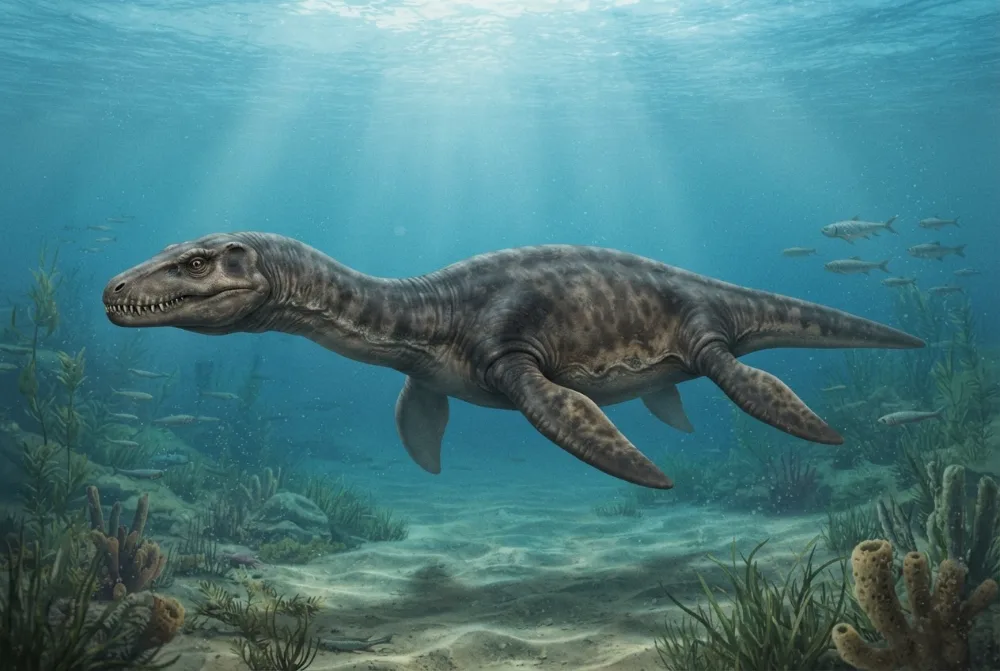
Polycotylus
Polycotylus was a short-necked plesiosaur that swam in the warm seas of North America and Europe during the Cretaceous. It had a big head, strong flippers, and gave birth to live babies in the water, just like whales do today.1
Azalaki na bomoi ntango nini?
Azalaki monene boni?
Azalaki molai boni?
Azalaki kilo boni?
 molai lokola bambwa 5 zolo kino mokila🍌molai lokola matoko 30 oyo balandani🍉kilo lokola bapasteke 200🧸kilo lokola bana 53 ya eteyelo ya bana mike🎒kilo lokola bana 31 ya kelasi🐻❄️kilo lokola ba-urs ya pembe 2🏊akokaki kobeta mai bolai ya pisine monene (50 m) na sekonde 6,7
Polycotylus azalaki monene boni soki tokokanisi na YO?
Kaka matematiki na navigatere na yo. Eloko moko te ebombami to etindami esika moko.
Azalaki na mbangu boni?


Makambo ya kosepelisa
Polycotylus was named by famous paleontologist Edward Drinker Cope in 1869 from fossils found in Kansas.1
A fossil of Polycotylus found in Kansas contains a single large fetus inside the mother, proving that these plesiosaurs gave live birth.1
The baby Polycotylus was about 1.5 metres (4.9 feet) long, which is about 32 percent of the mother's length.1
Polycotylus had a short neck and a long head, making it look a bit like a pliosaur, but it is actually a type of plesiosaur called a polycotylid.1
Its name means 'much-cupped vertebrae' because the bones in its spine have deep cup-like hollows.1
Polycotylus lived in the Western Interior Seaway, a shallow sea that split North America in two during the Cretaceous.1
Scientists think Polycotylus gave birth to just one large baby at a time, a strategy called K-selection.1
Mituna oyo batunaka mingi na ntina na Polycotylus
?How big was Polycotylus?
Polycotylus was a medium-sized plesiosaur, measuring about 4.7 to 5.4 metres (15 to 18 feet) long and weighing over 1 metric ton (1.1 short tons).1
?Did Polycotylus have a short neck?
Yes, Polycotylus had a short neck and a long head, unlike the long-necked plesiosaurs like Elasmosaurus.1
?What did Polycotylus eat?
Polycotylus had thick teeth with striations on their surfaces, which suggests it ate fish and other marine animals, but the sources do not give a specific diet.1
?When did Polycotylus live?
Polycotylus lived toward the end of the Cretaceous period, about 84 to 66 million years ago.1
Mobuki masapo
Lisapo: Many people think all plesiosaurs had long necks like the Loch Ness Monster.
Solo: Polycotylus had a short neck and a large head, very different from long-necked plesiosaurs like Elasmosaurus.1
Mpo na bayebi ya badino
- Nkombo ya siansi
- Polycotylus
- Nkombo epesamaki na
- Cope 18693
- Lisanga
- Baplezozore
- Libota / klade
- Polycotylidae3
- Klasifikasio
- Plesiosauria > Sauropterygia3
- Mbula ya mabanga
- mbula milio 152 kino 72 (Kimmeridgian / Campanian)3
- Milongo ya mabanga
- Niobrara, Frontier, Mooreville Chalk3
- Bikolo
- Amerika, Falansa, Rusi3
- Bafosile oyo ekomami
- 10 na The Paleobiology Database3
- Ntango bamonaki yango
- Edward Drinker Cope named Polycotylus in 1869 from fragmentary bones found in the Niobrara Formation of Kansas. A nearly complete skeleton was later found in Alabama in 1949 but not described until 2002.1
- Naino bazali kowelana
- Scientists are not sure exactly how many species of Polycotylus existed, and some species may be the same as others.1
Esika makambo euti
- Polycotylus (en.wikipedia.org)
- PBDB Taxon (paleobiodb.org)
- Polycotylus in The Paleobiology Database (CC BY 4.0): mbula, bisika, milongo ya mabanga, klasifikasio.
Likambo nyonso na lokasa oyo ezali na nimero oyo elakisi liziba na yango. Soki tosali libunga, limbisa biso, tozali bato balingaka badino, zulunalo ya siansi te. Yebisa biso na [email protected] mpe tokobongisa yango.
 Rex azali na nzala! Dino Wiki ezali mosala ya tata moko mpo na mwana na ye ya mobali oyo alingaka badino, ofele, piblisite te mpe batrakere te. Bato bakolo bakoki kopesa Rex biskwi mpo na kosalisa ete etikala na internet.Leisa Rex
 Elasmosaurus
 Pliosaurus
 Plesiosaurus
 Cimoliasaurus
 Colymbosaurus
 Trinacromerum
 Stegosaurus
 Iguanodon
 Archaeopteryx
 Giganotosaurus
 Microraptor
 Deinonychus