 Ozali dino nini? Kwizi
 Etumba ya badino
 Mbangu ya badino
 Masano mike ya badino
 Albumu ya bastika
 Bilisti TOP ya badino
 Kamwisa ngai!
Sclerocormus
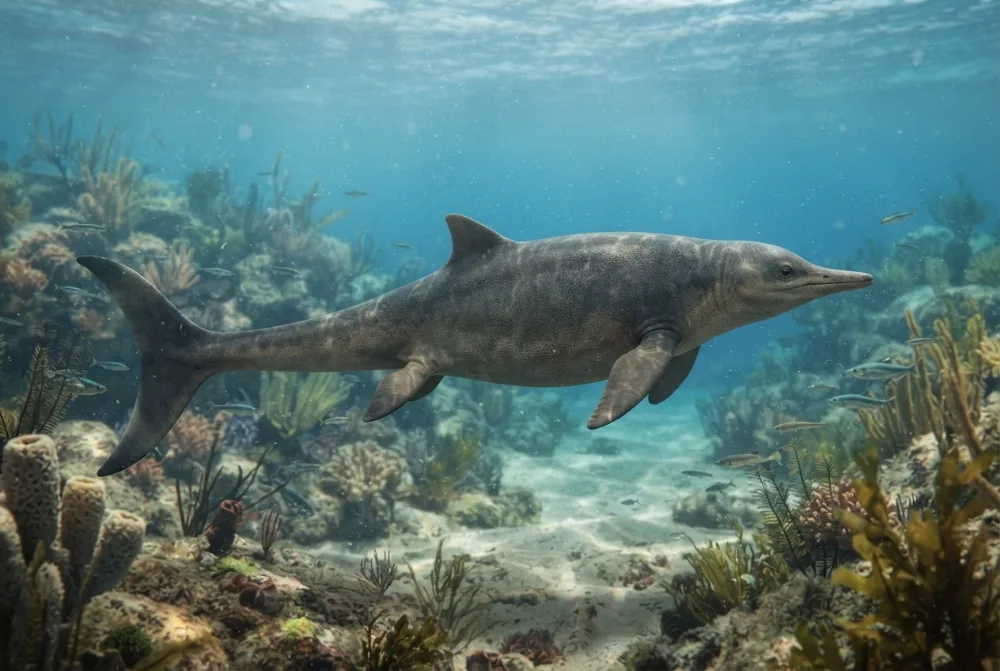
Sclerocormus was an early marine reptile that lived in the sea, not a dinosaur. It had a very tiny head and a long tail without a fluke, making it look different from later ichthyosaurs.1
Azalaki na bomoi ntango nini?
Azalaki monene boni?
Azalaki molai boni?
Azalaki kilo boni?
 molai lokola bapusu 3 ya ndako zolo kino mokila🍌molai lokola matoko 9 oyo balandani🍌kilo lokola matoko 120🏊akokaki kobeta mai bolai ya pisine monene (50 m) na sekonde 6,2
Sclerocormus azalaki monene boni soki tokokanisi na YO?
Kaka matematiki na navigatere na yo. Eloko moko te ebombami to etindami esika moko.
Azalaki na mbangu boni?


Makambo ya kosepelisa
Sclerocormus had an extremely small head that was only about 6.25% of its total body length, much smaller than other early marine reptiles like Chaohusaurus.1
Its tail was very long, making up about 58% of its total length, and it did not have a fluke like later ichthyosaurs.1
Sclerocormus had a heavily built body with flattened, overlapping belly ribs that formed a tight basket, similar to hupehsuchians.1
It lived during the Early Triassic period, about 248 to 247 million years ago, soon after the end-Permian mass extinction.41
Sclerocormus is one of the earliest known ichthyosauriforms, and its discovery shows that these marine reptiles evolved quickly within the first million years of their history.1
This reptile had large eyes with scleral plates, which are bony rings that help support the eye, like in many ichthyosaurs.1
Mituna oyo batunaka mingi na ntina na Sclerocormus
?How big was Sclerocormus?
Sclerocormus was about 1.6 metres (5.2 feet) long and weighed more than 15 kilograms (33 pounds).2
?What did Sclerocormus eat?
Sclerocormus was a suction feeder that used its narrow, toothless snout to suck in soft-bodied prey. Because its head and jaws were so small, it could only eat prey much smaller than itself.2
?Could Sclerocormus swim fast?
No, Sclerocormus was probably a slow swimmer. Its heavy build and body shape suggest it lived in shallow waters.2
?Is Sclerocormus a dinosaur?
No, Sclerocormus is not a dinosaur. It is an ichthyosauriform, a type of marine reptile that lived in the sea.2
Mpo na bayebi ya badino
- Nkombo ya siansi
- Sclerocormus
- Nkombo epesamaki na
- Jiang et al. 20164
- Lisanga
- Baiktiozore
- Libota / klade
- Omphalosauridae4
- Klasifikasio
- Ichthyosauromorpha4
- Mbula ya mabanga
- mbula milio 249 kino 247 ()4
- Milongo ya mabanga
- Nanlinghu4
- Bikolo
- Sina4
- Bafosile oyo ekomami
- 1 na The Paleobiology Database4
- Ntango bamonaki yango
- Sclerocormus was named by Jiang and colleagues in 2016 based on a single fossil skeleton found in the Nanlinghu Formation in Anhui, China.41
- Naino bazali kowelana
- Scientists are not sure exactly what Sclerocormus ate, because it had no teeth, but they think it may have been a suction feeder.1
Esika makambo euti
- A large aberrant stem ichthyosauriform indicating early rise and demise of ichthyosauromorphs in the wake of the end-Permian extinction | Scientific Reports (nature.com)
- Sclerocormus (en.wikipedia.org)
- A large aberrant stem ichthyosauriform indicating early rise and demise of ichthyosauromorphs in the wake of the end-Permian extinction | Scientific Reports (preview-www.nature.com)
- Sclerocormus in The Paleobiology Database (CC BY 4.0): mbula, bisika, milongo ya mabanga, klasifikasio.
Likambo nyonso na lokasa oyo ezali na nimero oyo elakisi liziba na yango. Soki tosali libunga, limbisa biso, tozali bato balingaka badino, zulunalo ya siansi te. Yebisa biso na [email protected] mpe tokobongisa yango.
 Rex azali na nzala! Dino Wiki ezali mosala ya tata moko mpo na mwana na ye ya mobali oyo alingaka badino, ofele, piblisite te mpe batrakere te. Bato bakolo bakoki kopesa Rex biskwi mpo na kosalisa ete etikala na internet.Leisa Rex
 Ichthyosaurus
 Platypterygius
 Stenopterygius
 Khudiakovia
 Ophthalmosaurus
 Chonespondylus
 Corosaurus