 Ozali dino nini? Kwizi
 Etumba ya badino
 Mbangu ya badino
 Masano mike ya badino
 Albumu ya bastika
 Bilisti TOP ya badino
 Kamwisa ngai!
Seitaad
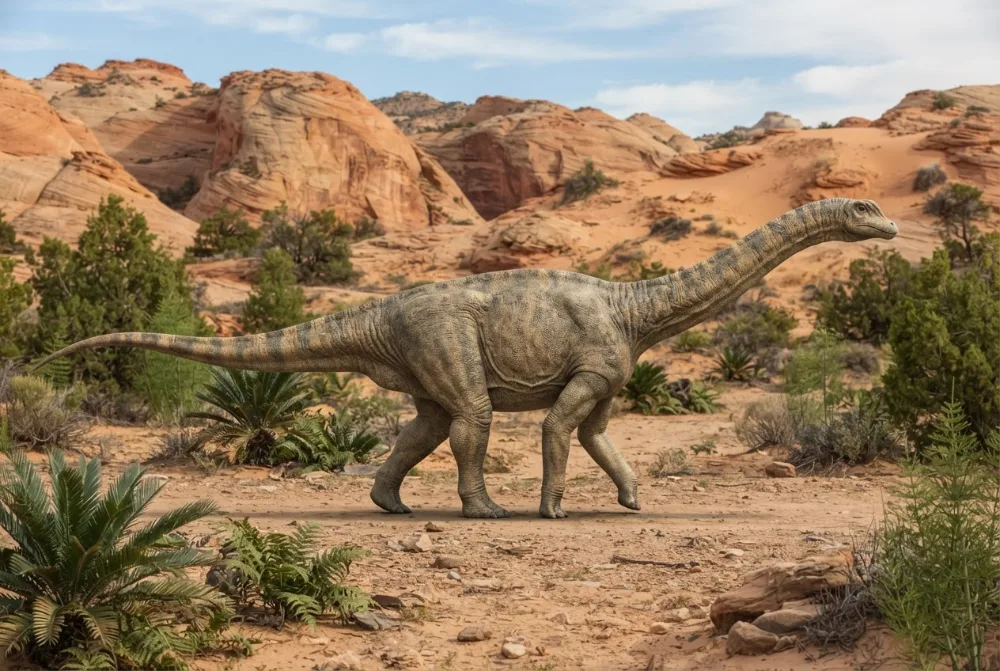
Seitaad was an early long-necked dinosaur that lived about 190 million years ago. It was a plant-eater that walked on two legs and could also use all fours. This dinosaur is one of the most complete fossils ever found in the Navajo Sandstone of Utah.31
Azalaki na bomoi ntango nini?
Azalaki monene boni?
Azalaki molai boni?
Azalaki molai boni na likolo?
Azalaki kilo boni?
 molai lokola bambwa 4 zolo kino mokila🍌molai lokola matoko 25 oyo balandani🍉kilo lokola bapasteke 18🧸kilo lokola bana 5 ya eteyelo ya bana mike🎒kilo lokola bana 3 ya kelasi🏃akokaki kopota metele 100 na sekonde 8,8 (moto oyo aleki mbangu asalelaka 9,6)
Seitaad azalaki monene boni soki tokokanisi na YO?
Kaka matematiki na navigatere na yo. Eloko moko te ebombami to etindami esika moko.
Azalaki na mbangu boni?


Makambo ya kosepelisa
Seitaad's name comes from a Navajo legend about a sand monster that buried its victims in dunes.1
The only known fossil of Seitaad was found at the base of a collapsed sand dune, which may have buried the animal after it died.1
Seitaad is one of the few early sauropodomorph dinosaurs known from North America.1
The species name ruessi honors Everett Ruess, a young artist and explorer who disappeared in southern Utah in 1934.1
Seitaad had a plate-like bone on its shoulder blade that helped support its arm.1
This dinosaur lived during the Early Jurassic period, when the climate was warm and deserts covered much of the area.1
Mituna oyo batunaka mingi na ntina na Seitaad
?How big was Seitaad?
About 3 to 4.5 metres long and 1 metre tall at the hips. It weighed around 70 to 90 kilograms, about the size of a large human.2
?What did Seitaad eat?
Seitaad ate plants. It had leaf-shaped teeth and a small head, just like its later giant relatives the sauropods.2
?Could Seitaad walk on two legs?
Yes, Seitaad could walk on two legs or on all fours. It had a long neck and tail, and a large curved claw on its thumb.2
?When did Seitaad live?
Seitaad lived during the Early Jurassic Period, about 183 to 190 million years ago. That is millions of years before the famous giant sauropods like Diplodocus.2
Mpo na bayebi ya badino
- Nkombo ya siansi
- Seitaad
- Nkombo epesamaki na
- Sertich and Loewen 20103
- Lisanga
- Nkingo milai
- Libota / klade
- Sauropodiformes3
- Klasifikasio
- Sauropodomorpha3
- Mbula ya mabanga
- mbula milio 193 kino 175 (Pliensbachian / Toarcian)3
- Milongo ya mabanga
- Navajo Sandstone3
- Bikolo
- Amerika3
- Bafosile oyo ekomami
- 1 na The Paleobiology Database3
- Ntango bamonaki yango
- Seitaad was named by scientists Joseph Sertich and Michael Loewen in 2010. The partial skeleton was found in the Navajo Sandstone of southern Utah, near a cliff dwelling called Eagle's Nest.31
- Naino bazali kowelana
- Scientists are not sure exactly how Seitaad is related to other early sauropodomorphs, because its fossils do not give a clear family tree.1
Esika makambo euti
- pone.0009789 1..17 (journals.plos.org)
- New Dinosaur from Utah’s Red Rocks – UNews Archive (archive.unews.utah.edu)
- Seitaad in The Paleobiology Database (CC BY 4.0): mbula, bisika, milongo ya mabanga, klasifikasio.
Likambo nyonso na lokasa oyo ezali na nimero oyo elakisi liziba na yango. Soki tosali libunga, limbisa biso, tozali bato balingaka badino, zulunalo ya siansi te. Yebisa biso na [email protected] mpe tokobongisa yango.
 Rex azali na nzala! Dino Wiki ezali mosala ya tata moko mpo na mwana na ye ya mobali oyo alingaka badino, ofele, piblisite te mpe batrakere te. Bato bakolo bakoki kopesa Rex biskwi mpo na kosalisa ete etikala na internet.Leisa Rex
 Brachiosaurus
 Diplodocus
 Brontosaurus
 Argentinosaurus
 Camarasaurus
 Morosaurus
 Dilophosaurus
 Stenopterygius
 Dorygnathus
 Scutellosaurus
 Sinosaurus
 Temnodontosaurus