 Ozali dino nini? Kwizi
 Etumba ya badino
 Mbangu ya badino
 Masano mike ya badino
 Albumu ya bastika
 Bilisti TOP ya badino
 Kamwisa ngai!
Triceratops
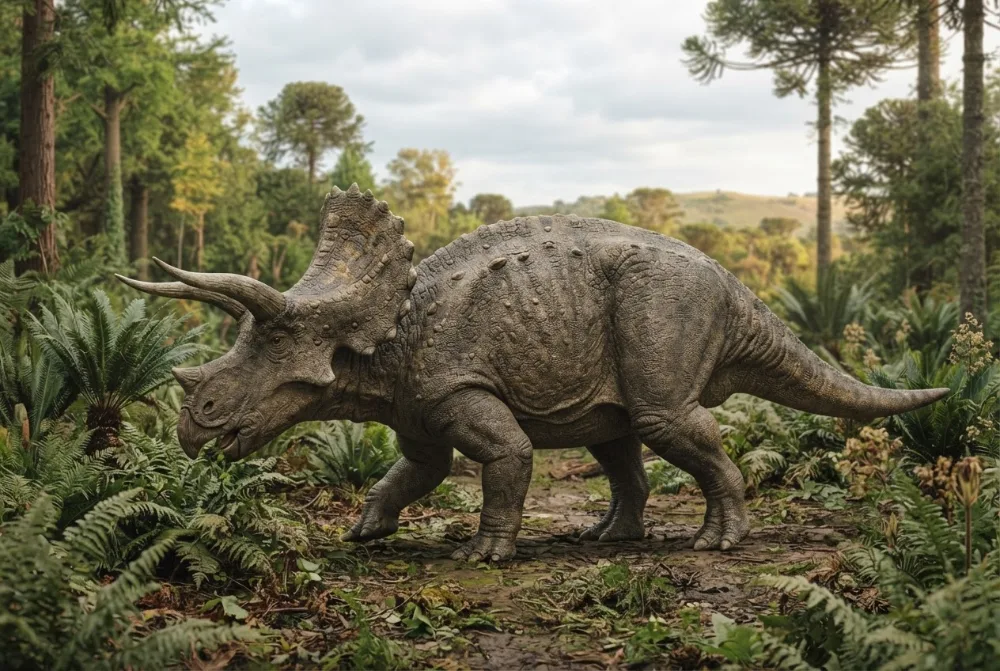
Triceratops was a huge plant-eater with a big frill on its head and three horns. It lived at the very end of the age of dinosaurs, about 66 million years ago. It was one of the last horned dinosaurs to walk the Earth.1
Azalaki na bomoi ntango nini?
Azalaki monene boni?
Azalaki molai boni?
Azalaki molai boni na likolo?
Azalaki kilo boni?

 molai lokola bamotuka 2 oyo batelemi na molongo🍌molai lokola matoko 50 oyo balandanikilo lokola bamotuka 8🍉kilo lokola bapasteke 2400🎒kilo lokola bakelasi 15 mobimba ya bana🐻❄️kilo lokola ba-urs ya pembe 27🏃akokaki kopota metele 100 na sekonde 12 (moto oyo aleki mbangu asalelaka 9,6)
Triceratops azalaki monene boni soki tokokanisi na YO?
Kaka matematiki na navigatere na yo. Eloko moko te ebombami to etindami esika moko.
Azalaki na mbangu boni?


Makambo ya kosepelisa
Triceratops had a huge frill made of solid bone at the back of its skull, which may have been used to attract mates or scare off rivals.1
Its name means 'three-horned face' because it had two long brow horns and a smaller horn on its nose.1
Triceratops lived right up to the mass extinction that killed the non-bird dinosaurs, about 66 million years ago.1
Fossils of Triceratops have been found in huge bonebeds, with many individuals together, suggesting they may have lived in herds.1
Triceratops had a strong beak like a parrot's, which it used to bite off tough plants.1
Some scientists think Triceratops could have fought predators like Tyrannosaurus rex using its sharp horns.1
Mituna oyo batunaka mingi na ntina na Triceratops
?How big was Triceratops?
Triceratops was about 8 to 9 metres (26 to 30 feet) long and weighed between 6 and 10 tonnes (13,000 to 22,000 pounds). That is roughly as long as a school bus and as heavy as a large elephant.12
?What did Triceratops eat?
Triceratops was a plant-eater that ate low-growing plants like ferns, cycads and palms. It used its sharp, parrot-like beak to snip off tough leaves and had up to 800 teeth to grind them up.23
?Did Triceratops live in herds?
Most Triceratops fossils are found alone, so scientists think they usually lived alone. However, a few young Triceratops were found together, which suggests they might have stayed in small groups sometimes.23
?Could Triceratops fight T. rex?
Yes, Triceratops probably fought Tyrannosaurus rex. One fossil shows a Triceratops horn that was bitten by a T. rex and then healed, proving these dinosaurs really did battle.21
?Why did Triceratops have a frill?
The frill may have helped protect its neck, but it was not always enough since T. rex bite marks have been found on frills. It was also used to attract mates and help Triceratops recognize each other.23
?How fast could Triceratops run?
Up to about 30 km/h (19 mph) for a short dash, about as fast as a fast human runner. This is an estimate: nobody knows for sure. Triceratops was very heavy and walked on four legs, but its legs were strong, a bit like a rhino's.1
?When did Triceratops go extinct?
Triceratops died out about 66 million years ago, at the same time as the big mass extinction that killed all non-bird dinosaurs. It was one of the last horned dinosaurs alive.21
?Where was Triceratops found?
Triceratops fossils have been found in western North America, especially in the United States (Wyoming, Montana, Colorado, South Dakota) and in Canada (Alberta and Saskatchewan).23
?How many horns did Triceratops have?
Triceratops had three horns: two long ones above its eyes, each up to 1 metre (3.3 feet) long, and a shorter one on its nose. Its name means 'three-horned face'.24
?Was Triceratops bigger than T. rex?
Triceratops was generally smaller than T. rex. Triceratops was about 8 to 9 metres long, while T. rex could reach over 12 metres in length.1
Mobuki masapo
Lisapo: Triceratops was a slow, clumsy animal that could barely move.
Solo: Triceratops was actually quite fast for its size, able to run at speeds of up to 30 km/h (about 20 mph) on its strong legs.1
Mpo na bayebi ya badino
- Nkombo ya siansi
- Triceratops
- Nkombo epesamaki na
- Marsh 18895
- Lisanga
- Badino na maseke
- Libota / klade
- Ceratopsidae5
- Klasifikasio
- Ornithischia > Ceratopsia > Ceratopsidae5
- Mbula ya mabanga
- mbula milio 84 kino 66 (Campanian / Maastrichtian)5
- Milongo ya mabanga
- Lance, Hell Creek, Frenchman5
- Bikolo
- Amerika, Kanada5
- Bafosile oyo ekomami
- 166 na The Paleobiology Database5
- Bayebi ye mpe na nkombo
- Diceratops, Diceratus, Nedoceratops, Sterrholophus (bankombo ya kala oyo sikoyo batangaka lokola nyama moko)5
- Ntango bamonaki yango
- Triceratops was named by paleontologist Othniel Charles Marsh in 1889, based on fossils found in Wyoming, USA.5
- Naino bazali kowelana
- Scientists still debate whether some fossils belong to Triceratops or to a separate, related dinosaur called Torosaurus.1
Esika makambo euti
- Triceratops (en.wikipedia.org)
- Triceratops | Natural History Museum (nhm.ac.uk)
- Triceratops | The Canadian Encyclopedia (thecanadianencyclopedia.ca)
- Triceratops summary | Britannica (britannica.com)
- Triceratops in The Paleobiology Database (CC BY 4.0): mbula, bisika, milongo ya mabanga, klasifikasio.
Likambo nyonso na lokasa oyo ezali na nimero oyo elakisi liziba na yango. Soki tosali libunga, limbisa biso, tozali bato balingaka badino, zulunalo ya siansi te. Yebisa biso na [email protected] mpe tokobongisa yango.
 Rex azali na nzala! Dino Wiki ezali mosala ya tata moko mpo na mwana na ye ya mobali oyo alingaka badino, ofele, piblisite te mpe batrakere te. Bato bakolo bakoki kopesa Rex biskwi mpo na kosalisa ete etikala na internet.Leisa Rex
 Protoceratops
 Ojoceratops
 Tatankaceratops
 Psittacosaurus
 Centrosaurus
 Chasmosaurus
 Tyrannosaurus
 Velociraptor
 Spinosaurus
 Ankylosaurus
 Parasaurolophus
 Pteranodon