 Ozali dino nini? Kwizi
 Etumba ya badino
 Mbangu ya badino
 Masano mike ya badino
 Albumu ya bastika
 Bilisti TOP ya badino
 Kamwisa ngai!
Tyrannosaurus
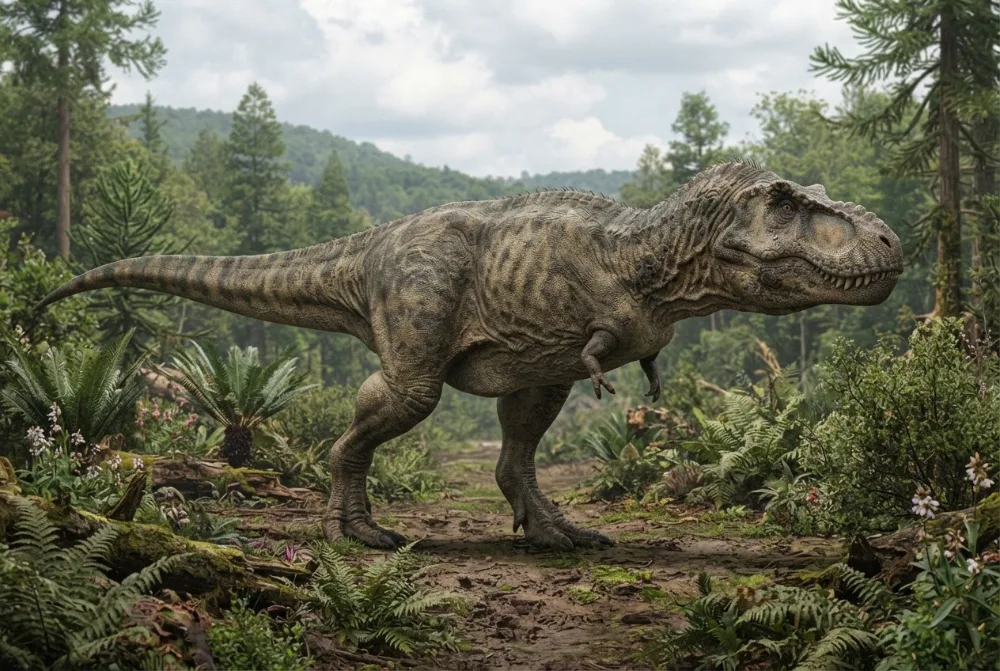
Tyrannosaurus rex was one of the biggest meat-eating dinosaurs that ever lived. It stomped across western North America about 69 to 66 million years ago, at the very end of the Age of Dinosaurs. With its huge skull, powerful legs, and tiny arms, it was the king of its prehistoric world.1
Azalaki na bomoi ntango nini?
Azalaki monene boni?
Azalaki molai boni?
Azalaki molai boni na likolo?
Azalaki kilo boni?
 molai lokola bamotuka 3 oyo batelemi na molongo🍌molai lokola matoko 72 oyo balandani
 kilo lokola banzoku 1,5🍉kilo lokola bapasteke 1800🎒kilo lokola bakelasi 11 mobimba ya bana🐻❄️kilo lokola ba-urs ya pembe 20🏃akokaki kopota metele 100 na sekonde 15 (moto oyo aleki mbangu asalelaka 9,6)
Tyrannosaurus azalaki monene boni soki tokokanisi na YO?
Kaka matematiki na navigatere na yo. Eloko moko te ebombami to etindami esika moko.
Azalaki na mbangu boni?


Makambo ya kosepelisa
Tyrannosaurus had the most powerful bite of any land animal ever, with a force of 35,000 to 57,000 newtons in its back teeth.1
Its arms were very short but surprisingly strong, with two clawed fingers on each hand.1
The first Tyrannosaurus rex fossil was a tooth found in Colorado in 1874, but the animal wasn't named until 1905.1
A set of footprints from Wyoming shows that a young Tyrannosaurus walked at a speed of about 2.8 to 5 miles per hour.1
Tyrannosaurus lived on an island continent called Laramidia, which was separated by a shallow sea from the eastern part of North America.1
Mituna oyo batunaka mingi na ntina na Tyrannosaurus
?How big was Tyrannosaurus?
About 12 to 13 metres (40 to 43 feet) long, 3.7 to 4 metres (12 to 13 feet) tall at the hip, and weighed up to 8.8 tonnes (9.7 tons).13
?What did Tyrannosaurus eat?
It was a meat-eater that hunted large dinosaurs like Edmontosaurus and Triceratops, and probably also scavenged. Its powerful jaws and serrated teeth could crush bone.43
?How fast could Tyrannosaurus run?
Up to about 24 km/h (15 mph), about as fast as a grown-up riding a bike. T. rex was too heavy to really run like a horse, so most scientists think it moved with a big, fast power walk. That was still fast enough to catch other large dinosaurs.43
?Why were Tyrannosaurus arms so small?
Nobody knows for sure. One idea is that as its head grew bigger, the arms got shorter to keep the dinosaur balanced. They were still very strong and had two claws.43
?When did Tyrannosaurus live?
It lived about 69 to 66 million years ago, at the very end of the Cretaceous Period, just before the dinosaurs went extinct.14
?Where did Tyrannosaurus live?
It lived in western North America, on an island continent called Laramidia. Fossils have been found in the United States (like Montana and Wyoming) and Canada.14
?Was Tyrannosaurus the biggest meat-eating dinosaur?
It was one of the largest land predators ever, but some other dinosaurs like Giganotosaurus and Spinosaurus were similar in size. T. rex was the biggest predator in its own time and place.41
?Did Tyrannosaurus have feathers?
Some scientists think young T. rex may have had a light covering of feathers, but adults probably had mostly scaly skin. No direct fossil feathers have been found on T. rex.1
?How strong was Tyrannosaurus bite?
It had the most powerful bite of any land animal ever, with a force of 35,000 to 57,000 newtons in its back teeth. That is a very strong bite.1
Mobuki masapo
Lisapo: Tyrannosaurus rex was just a slow scavenger that only ate dead animals.
Solo: Most paleontologists now agree that T. rex was an active predator that hunted live prey, though it also scavenged when it had the chance.1
Mpo na bayebi ya badino
- Nkombo ya siansi
- Tyrannosaurus
- Nkombo epesamaki na
- Osborn 19055
- Lisanga
- Batiranozore
- Libota / klade
- Tyrannosauridae5
- Klasifikasio
- Theropoda > Tyrannosauroidea > Tyrannosauridae5
- Mbula ya mabanga
- mbula milio 84 kino 66 (Campanian / Maastrichtian)5
- Milongo ya mabanga
- Hell Creek, Lance, Denver5
- Bikolo
- Amerika, Kanada, Rusi, Meksike, Sina5
- Bafosile oyo ekomami
- 87 na The Paleobiology Database5
- Bayebi ye mpe na nkombo
- Dinotyrannus, Dynamosaurus, Manospondylus, Stygivenator (bankombo ya kala oyo sikoyo batangaka lokola nyama moko)5
- Ntango bamonaki yango
- Barnum Brown of the American Museum of Natural History found the first partial skeleton in Wyoming in 1900, and a more complete one in Montana in 1902. Henry Fairfield Osborn named it Tyrannosaurus rex in 1905.12
- Naino bazali kowelana
- Scientists still debate whether some smaller tyrannosaur fossils belong to a separate genus called Nanotyrannus or are just young Tyrannosaurus rex.1
Esika makambo euti
- Tyrannosaurus (en.wikipedia.org)
- Bulletin of the American Museum of Natural History/Volume 21/Tyrannosaurus and Other Cretaceous Carnivorous Dinosaurs - Wikisource, the free online library (en.wikisource.org)
- Dinosaur - Tyrannosaurus rex - The Australian Museum (australian.museum)
- si.edu (si.edu)
- Tyrannosaurus in The Paleobiology Database (CC BY 4.0): mbula, bisika, milongo ya mabanga, klasifikasio.
Likambo nyonso na lokasa oyo ezali na nimero oyo elakisi liziba na yango. Soki tosali libunga, limbisa biso, tozali bato balingaka badino, zulunalo ya siansi te. Yebisa biso na [email protected] mpe tokobongisa yango.
 Rex azali na nzala! Dino Wiki ezali mosala ya tata moko mpo na mwana na ye ya mobali oyo alingaka badino, ofele, piblisite te mpe batrakere te. Bato bakolo bakoki kopesa Rex biskwi mpo na kosalisa ete etikala na internet.Leisa Rex
 Tarbosaurus
 Albertosaurus
 Daspletosaurus
 Gorgosaurus
 Alectrosaurus
 Dryptosaurus
 Triceratops
 Velociraptor
 Spinosaurus
 Ankylosaurus
 Parasaurolophus
 Pteranodon