 Ozali dino nini? Kwizi
 Etumba ya badino
 Mbangu ya badino
 Masano mike ya badino
 Albumu ya bastika
 Bilisti TOP ya badino
 Kamwisa ngai!
Azalaki na bomoi ntango nini?

Azalaki monene boni?
Azalaki molai boni?
Azalaki molai boni na likolo?
kokanisa
Azalaki kilo boni?
 molai lokola bapusu 4 ya ndako zolo kino mokila🍌molai lokola matoko 11 oyo balandani🍌kilo lokola matoko 120🏃akokaki kopota metele 100 na sekonde 10 (moto oyo aleki mbangu asalelaka 9,6)
Yuanyanglong azalaki monene boni soki tokokanisi na YO?
Kaka matematiki na navigatere na yo. Eloko moko te ebombami to etindami esika moko.
Azalaki na mbangu boni?


Makambo ya kosepelisa
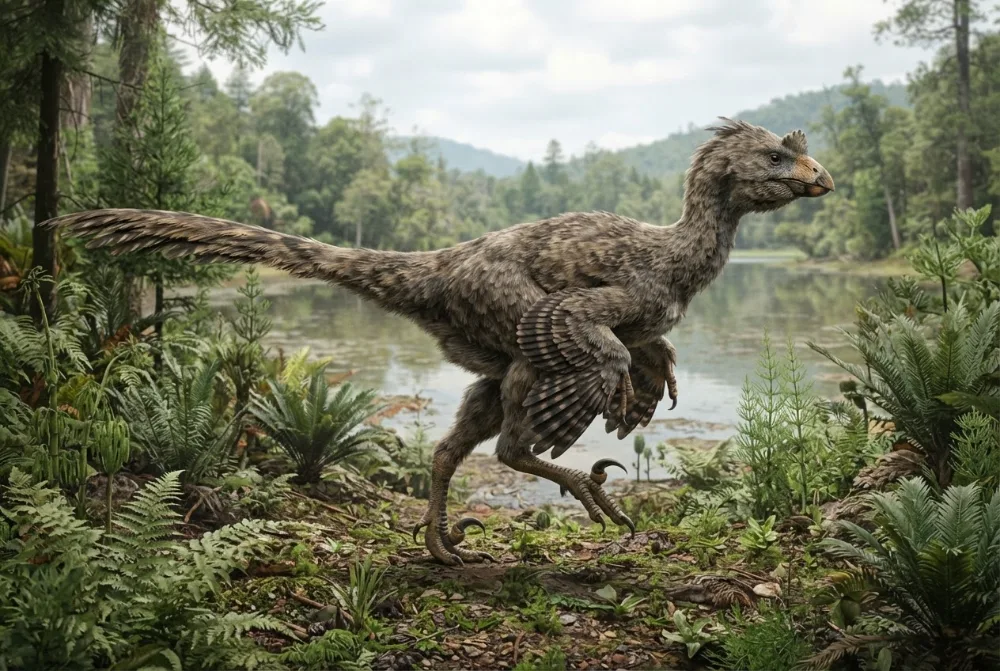
Yuanyanglong is the first Early Cretaceous oviraptorosaur named from the Gobi Desert region, while other Gobi relatives come from later rocks.1
The name Yuanyanglong comes from the Mandarin word for lovebirds, because the two fossil skeletons were found together on the same block.1
The species name bainian means 'a hundred years' in Chinese, celebrating 100 years since the first oviraptorosaurs were named in 1924.1
Scientists found two partial skeletons, one with a poorly preserved skull and the other with parts of the hips, legs, and arms.1
Yuanyanglong is a basal oviraptorosaur, meaning it branched off early in the group's family tree, before many other oviraptorosaurs.1
Mituna oyo batunaka mingi na ntina na Yuanyanglong
?How big was Yuanyanglong?
It was a relatively small dinosaur, though its exact size is not given in the sources. It is described as a 'smaller' oviraptorosaur based on the two partial skeletons found.3
?What did Yuanyanglong eat?
It was an omnivore, meaning it ate both plants and small animals. Scientists found gastroliths (stomach stones) in its body cavity, which helped it grind up food.43
?Could Yuanyanglong run fast?
It had long legs and narrow feet, which usually help with running, but its hip bone had a very short area for leg muscles to attach. Scientists think it was probably not a fast runner and may have been better at wading in water like a modern wading bird.3
?Why was it called Yuanyanglong?
The name means 'lovebird dragon' in Chinese, because the two fossil skeletons were found lying together on the same rock block, like a pair of lovebirds.1
Mpo na bayebi ya badino
- Nkombo ya siansi
- Yuanyanglong
- Nkombo epesamaki na
- Hao et al. 20254
- Lisanga
- Badino ya nsala ya kokamwa
- Libota / klade
- Oviraptorosauria4
- Klasifikasio
- Theropoda > Oviraptorosauria4
- Mbula ya mabanga
- mbula milio 121 kino 100 (Aptian / Albian)4
- Milongo ya mabanga
- Miaogou4
- Bikolo
- Sina4
- Bafosile oyo ekomami
- 1 na The Paleobiology Database4
- Ntango bamonaki yango
- The fossils were discovered in 2021 in the Miaogou Formation in Inner Mongolia, China. In 2024, Hao and colleagues announced the new genus and species Yuanyanglong bainian, and the full description was published in 2025.1
- Naino bazali kowelana
- Scientists are still debating exactly where Yuanyanglong sits on the oviraptorosaur family tree, since its skeleton is incomplete.1
Esika makambo euti
- Yuanyanglong (en.wikipedia.org)
- Yuanyanglong bainian | Dinosaur Database by DinoAnimals.com (dinoanimals.com)
- 内蒙古发现窃蛋龙类恐龙新属种——百年鸳鸯龙----中国科学院古脊椎动物与古人类研究所 (ivpp.ac.cn)
- Yuanyanglong in The Paleobiology Database (CC BY 4.0): mbula, bisika, milongo ya mabanga, klasifikasio.
Likambo nyonso na lokasa oyo ezali na nimero oyo elakisi liziba na yango. Soki tosali libunga, limbisa biso, tozali bato balingaka badino, zulunalo ya siansi te. Yebisa biso na [email protected] mpe tokobongisa yango.
 Rex azali na nzala! Dino Wiki ezali mosala ya tata moko mpo na mwana na ye ya mobali oyo alingaka badino, ofele, piblisite te mpe batrakere te. Bato bakolo bakoki kopesa Rex biskwi mpo na kosalisa ete etikala na internet.Leisa Rex
 Therizinosaurus
 Oviraptor
 Chirostenotes
 Citipes
 Leptorhynchos
 Avimimus
 Stegosaurus
 Iguanodon
 Archaeopteryx
 Giganotosaurus
 Microraptor
 Deinonychus