 Kwizi ya Ndiwe dino uti?
 Nkhondo ya madino
 Mpikisano wa madino
 Masewera ang'onoang'ono a madino
 Chimbale cha zomata
 Mindandanda ya TOP ya madino
 Ndidabwitse!
Ankakhala liti?

Anali wamkulu bwanji?
Anali wautali bwanji?
Msinkhu wake unali wautali bwanji?
kuyerekeza
 wautali ngati agalu 4 otsatizana mphuno ndi mchira🍌wautali ngati nthochi 23 zotsatizana🏃akanatha kuthamanga mamita 100 m'masekondi 5.8 (munthu waliwiro kwambiri amafunika 9.6)
Afromimus anali wamkulu bwanji poyerekeza ndi IWEYO?
Ndi masamu chabe mu msakatuli wako. Palibe chimene chimasungidwa kapena kutumizidwa kwina kulikonse.
Anali ndi liwiro lotani?


Mfundo zosangalatsa
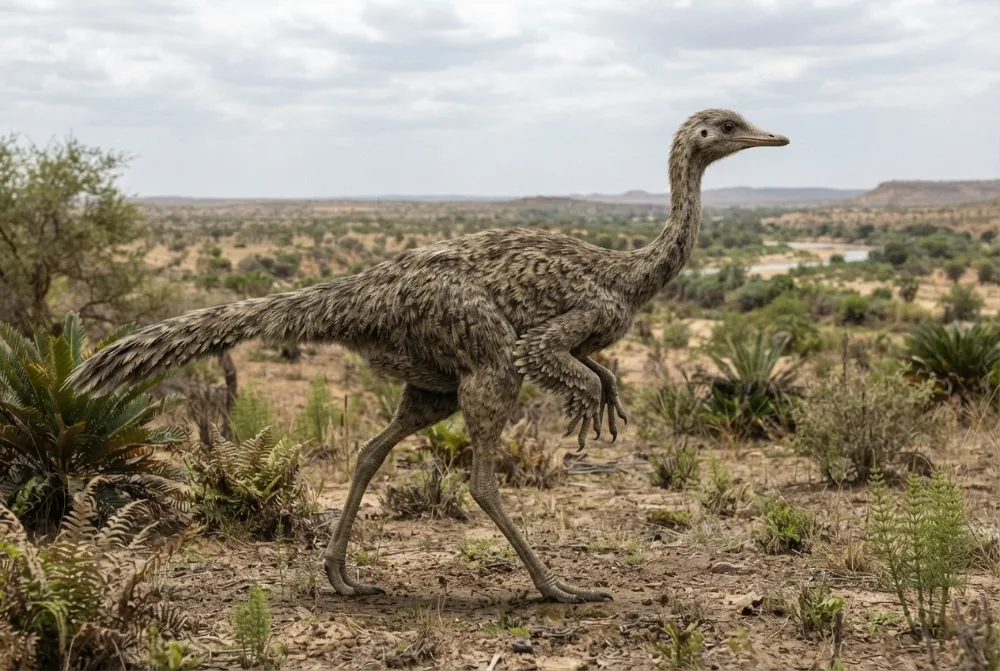
Afromimus is one of the oldest ornithomimosaurs found in Africa, showing that these ostrich-like dinosaurs lived on southern continents early in their evolution.2
The only known skeleton of Afromimus includes tail bones, chevrons, and parts of the right hind leg.2
Its tail vertebrae have broad, peanut-shaped joints that helped the tail bend and flex.2
Afromimus lived about 113 to 100 million years ago, during the Albian age of the Early Cretaceous.1
The name Afromimus means 'African mimic', because it looks like other ornithomimosaurs but comes from Africa.1
Scientists think Afromimus was a ground-dwelling dinosaur that laid eggs.1
Mafunso ofunsidwa kwambiri okhudza Afromimus
?How big was Afromimus?
About 4.14 metres long, based on its tibia length and its classification as a noasaurid. It was half the size of Gallimimus and twice the size of Shenzhousaurus.4
?What did Afromimus eat?
Scientists are not sure, but its toothless beak suggests it may have eaten plants, small animals, or eggs. No direct evidence of its diet has been found.4
?Is Afromimus a dinosaur?
Yes, Afromimus is a theropod dinosaur. It was originally thought to be an ornithomimosaur, but later studies suggest it was a ceratosaurian related to abelisauroids.4
?When did Afromimus live?
Afromimus lived during the Early Cretaceous, about 113 to 100 million years ago. That is the Albian age.4
?Could Afromimus run fast?
Probably yes. It had long legs and a light body, like modern ostriches, so it was likely a fast runner. No exact speed has been calculated.4
?Where was Afromimus found?
Its only skeleton was found in the Ténéré Desert of Niger, Africa. It was discovered in 1997 at a place called Gadoufaoua.4
Kwa akatswiri a madino
- Dzina la sayansi
- Afromimus
- Anapatsidwa dzina ndi
- Sereno 20175
- Gulu
- Madino a nthiwatiwa
- Banja / kladi
- Ornithomimosauria5
- Magawidwe a sayansi
- Theropoda > Ornithomimosauria5
- Zaka za miyala
- zaka 113 mpaka 100 miliyoni (Albian)5
- Mapangidwe a miyala
- Elrhaz5
- Mayiko
- Nijeri5
- Zolemba za mafosili
- 1 mu The Paleobiology Database5
- Kupezeka
- Afromimus was named by paleontologist Paul Sereno in 2017, based on a fragmentary skeleton found in the El Rhaz Formation of Niger.12
- Akukambiranabe
- Scientists are not sure exactly how big Afromimus was, because only a partial skeleton has been found.2
Kumene mfundo zimachokera
- PBDB Taxon (paleobiodb.org)
- Early Cretaceous Ornithomimosaurs (Dinosauria: Coelurosauria) from Africa (exa.ai)
- Afromimus (Wikipedia) (Wikipedia)
- Afromimus - Wikipedia (en-wp.org)
- Afromimus in The Paleobiology Database (CC BY 4.0): zaka, malo, mapangidwe a miyala, magawidwe a sayansi.
Mfundo iliyonse patsamba lino ili ndi nambala yosonyeza kumene yachokera. Ngati talakwitsa kanthu, pepa, ndife okonda madino, osati magazini ya sayansi. Tiuze pa [email protected] ndipo tikonza.
 Rex ali ndi njala! Dino Wiki ndi ntchito ya bambo kwa mwana wawo wamwamuna wokonda madainoso, yaulere popanda zotsatsa ndi zokazonda. Akuluakulu angadyetse Rex zokhwasula-khwasula kuti tsambali lipitirize kupezeka pa intaneti.Dyetsa Rex
 Gallimimus
 Ornithomimus
 Struthiomimus
 Deinocheirus
 Dromiceiomimus
 Archaeornithomimus
 Stegosaurus
 Iguanodon
 Archaeopteryx
 Giganotosaurus
 Microraptor
 Deinonychus