 Kwizi ya Ndiwe dino uti?
 Nkhondo ya madino
 Mpikisano wa madino
 Masewera ang'onoang'ono a madino
 Chimbale cha zomata
 Mindandanda ya TOP ya madino
 Ndidabwitse!
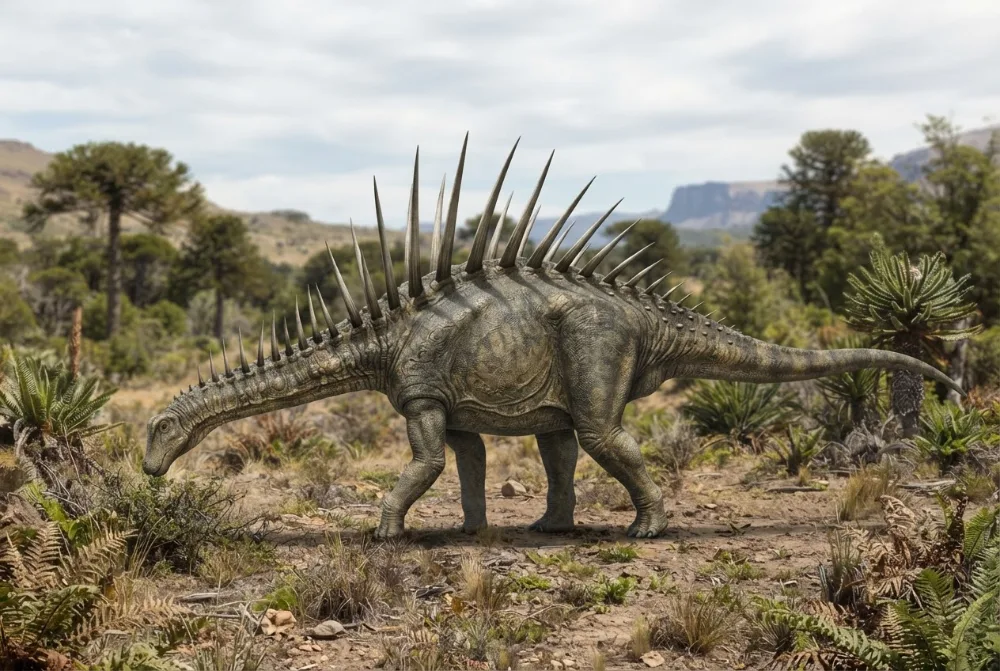
Amargasaurus
Amargasaurus was a sauropod with a very unusual back. It had long, sharp spines sticking up from its neck and back, like a row of spikes. Scientists think these spikes might have been used for defense or to impress other Amargasaurus.1
Ankakhala liti?
Anali wamkulu bwanji?
Anali wautali bwanji?
Msinkhu wake unali wautali bwanji?
Ankalemera bwanji?
 wautali ngati magalimoto 3 oimikidwa pamzere🍌wautali ngati nthochi 72 zotsatizana
 wolemera ngati agalu 200🍉wolemera ngati mavwende 800🎒wolemera ngati makalasi athunthu a ana a sukulu 5🐻❄️wolemera ngati zimbalangondo zoyera 9🏃akanatha kuthamanga mamita 100 m'masekondi 17 (munthu waliwiro kwambiri amafunika 9.6)
Amargasaurus anali wamkulu bwanji poyerekeza ndi IWEYO?
Ndi masamu chabe mu msakatuli wako. Palibe chimene chimasungidwa kapena kutumizidwa kwina kulikonse.
Anali ndi liwiro lotani?


Mfundo zosangalatsa
Amargasaurus had very long, sharp spines on its neck and back vertebrae. These spines were much longer than those of its relative Dicraeosaurus.1
The spines on its neck were so long that they probably stuck out like a sail or a row of spikes. Scientists think they could have been used for defense or to show off to other Amargasaurus.1
Amargasaurus was a dicraeosaurid, a family of sauropods with shorter necks than other long-necked dinosaurs. Its closest relatives include Dicraeosaurus and Bajadasaurus.6
The only known skeleton of Amargasaurus is mostly complete. It includes the back of the skull, most of the backbone, and parts of the legs and hips.1
Amargasaurus lived about 125 to 121 million years ago, during the Early Cretaceous period. That is about 15 to 20 million years after its African relative Dicraeosaurus.61
Scientists think Amargasaurus could not rear up on its hind legs like some other sauropods. Its legs were built for slow, steady walking, not speed.1
Mafunso ofunsidwa kwambiri okhudza Amargasaurus
?How big was Amargasaurus?
Amargasaurus was about 9 to 13 metres long and weighed around 2.5 to 4 metric tons. That is small for a sauropod.25
?What did Amargasaurus eat?
Amargasaurus was a herbivore that ate tough plants. It had pencil-like teeth for grinding and chewing.52
?When did Amargasaurus live?
Amargasaurus lived during the Early Cretaceous period, about 130 to 120 million years ago.25
?Where was Amargasaurus found?
Amargasaurus was found in Argentina, in the La Amarga Formation of Neuquén Province. The only known skeleton was discovered in 1984.25
?Why did Amargasaurus have spines?
Scientists think the spines might have been used for display, combat, or defense. They could have supported a sail or been covered in horn.23
?Was Amargasaurus a dinosaur?
Yes, Amargasaurus was a dinosaur. It was a sauropod, a type of long-necked plant-eating dinosaur.25
?How fast could Amargasaurus run?
Scientists think Amargasaurus could not run fast. Its legs were built for slow, steady walking, not speed.2
?Is Amargasaurus bigger than T. rex?
Amargasaurus was longer than T. rex, reaching 9 to 13 metres, but it was much lighter, weighing only 2.5 to 4 metric tons.2
Kwa akatswiri a madino
- Dzina la sayansi
- Amargasaurus
- Anapatsidwa dzina ndi
- Bonaparte 19846
- Gulu
- Makosi atali
- Banja / kladi
- Dicraeosauridae6
- Magawidwe a sayansi
- Sauropodomorpha > Sauropoda > Diplodocoidea6
- Zaka za miyala
- zaka 126 mpaka 121 miliyoni (Barremian)6
- Mapangidwe a miyala
- La Amarga6
- Mayiko
- Argentina6
- Zolemba za mafosili
- 2 mu The Paleobiology Database6
- Kupezeka
- Amargasaurus was named by Argentine paleontologist José Bonaparte in 1984. The skeleton was found in the La Amarga Formation in Neuquén Province, Argentina.61
- Akukambiranabe
- Scientists are not sure exactly what the long spines on Amargasaurus's neck were used for. They might have been for defense, to attract mates, or to help control body temperature.1
Kumene mfundo zimachokera
- p (naturalhistory.si.edu)
- Amargasaurus (en.wikipedia.org)
- Amargasaurus | Western Australian Museum (museum.wa.gov.au)
- Giants and Bizarres: Body Size of Some Southern South American Cretaceous Dinosaurs (miketaylor.org.uk)
- Amargasaurus | Natural History Museum (nhm.ac.uk)
- Amargasaurus in The Paleobiology Database (CC BY 4.0): zaka, malo, mapangidwe a miyala, magawidwe a sayansi.
Mfundo iliyonse patsamba lino ili ndi nambala yosonyeza kumene yachokera. Ngati talakwitsa kanthu, pepa, ndife okonda madino, osati magazini ya sayansi. Tiuze pa [email protected] ndipo tikonza.
 Rex ali ndi njala! Dino Wiki ndi ntchito ya bambo kwa mwana wawo wamwamuna wokonda madainoso, yaulere popanda zotsatsa ndi zokazonda. Akuluakulu angadyetse Rex zokhwasula-khwasula kuti tsambali lipitirize kupezeka pa intaneti.Dyetsa Rex
 Brachiosaurus
 Diplodocus
 Brontosaurus
 Argentinosaurus
 Camarasaurus
 Morosaurus
 Stegosaurus
 Iguanodon
 Archaeopteryx
 Giganotosaurus
 Microraptor
 Deinonychus