 Kwizi ya Ndiwe dino uti?
 Nkhondo ya madino
 Mpikisano wa madino
 Masewera ang'onoang'ono a madino
 Chimbale cha zomata
 Mindandanda ya TOP ya madino
 Ndidabwitse!
Amygdalodon
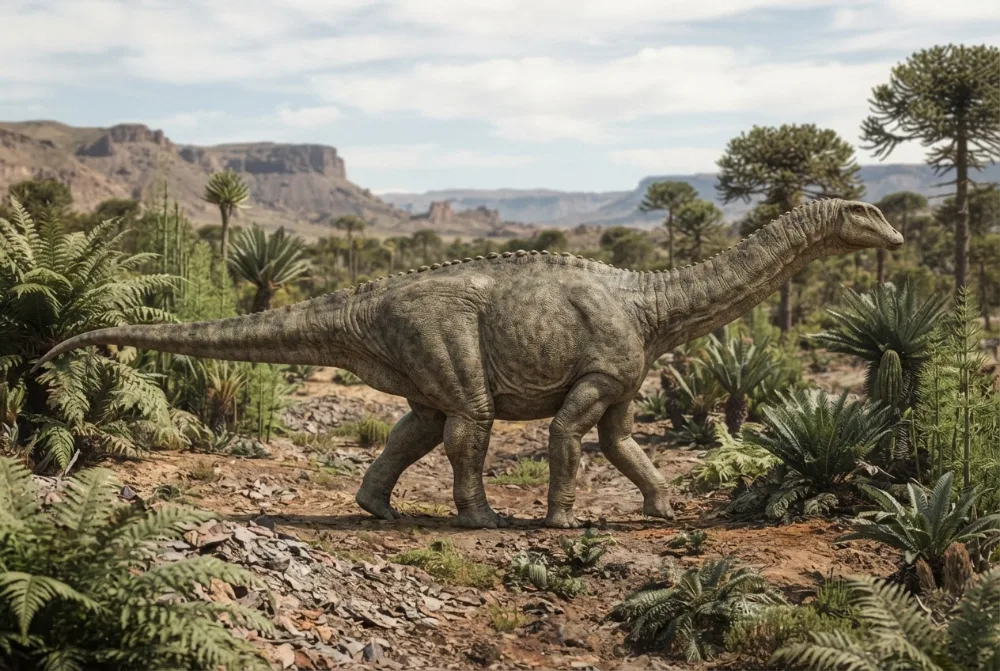
Amygdalodon was a huge, long-necked plant-eater that lived in Argentina during the Early Jurassic, about 180 million years ago. It was one of the very first sauropod dinosaurs ever found in South America, and scientists only know it from a single partial skeleton.12
Ankakhala liti?
Anali wamkulu bwanji?
Anali wautali bwanji?
Msinkhu wake unali wautali bwanji?
Ankalemera bwanji?
 wautali ngati magalimoto 3 oimikidwa pamzere🍌wautali ngati nthochi 83 zotsatizana
 wolemera pafupifupi ngati njovu🍉wolemera ngati mavwende 1000🎒wolemera ngati makalasi athunthu a ana a sukulu 6🐻❄️wolemera ngati zimbalangondo zoyera 11🏃akanatha kuthamanga mamita 100 m'masekondi 19 (munthu waliwiro kwambiri amafunika 9.6)
Amygdalodon anali wamkulu bwanji poyerekeza ndi IWEYO?
Ndi masamu chabe mu msakatuli wako. Palibe chimene chimasungidwa kapena kutumizidwa kwina kulikonse.
Anali ndi liwiro lotani?


Mfundo zosangalatsa
It was discovered in 1936 after a local scientist mentioned finding bones of a large reptile, and Dr. Tomás Suero went to look for more.1
The only known fossils include some vertebrae, ribs, teeth, and parts of the pelvis and shoulder blade.1
Amygdalodon lived about 180 to 172 million years ago, during the Toarcian stage of the Jurassic.1
It was a quadruped, meaning it walked on all four legs, like other sauropods.1
Scientists think Amygdalodon was a basal sauropod, meaning it was an early relative of the giant long-necked dinosaurs that came later.1
Some studies suggest it might be closely related to the Asian dinosaur Gongxianosaurus.1
Mafunso ofunsidwa kwambiri okhudza Amygdalodon
?How big was Amygdalodon?
Amygdalodon was about 12 metres (39 feet) long and 4 metres (13 feet) tall, and weighed over 5 tonnes (5.5 short tons). Estimates vary, with some sources suggesting a length of 15 metres (49 feet).12
?What did Amygdalodon eat?
Amygdalodon was a plant-eater, or herbivore. Its almond-shaped teeth show early signs of adapting for bulk feeding, which later sauropods used to eat lots of plants.12
Kwa akatswiri a madino
- Dzina la sayansi
- Amygdalodon
- Anapatsidwa dzina ndi
- Cabrera 19473
- Gulu
- Makosi atali
- Banja / kladi
- Gravisauria3
- Magawidwe a sayansi
- Sauropodomorpha > Sauropoda3
- Zaka za miyala
- zaka 193 mpaka 183 miliyoni (Pliensbachian / Toarcian)3
- Mapangidwe a miyala
- Cerro Carnerero3
- Mayiko
- Argentina3
- Zolemba za mafosili
- 1 mu The Paleobiology Database3
- Kupezeka
- Amygdalodon was named by Argentine paleontologist Ángel Cabrera in 1947, based on fossils found in 1936 by Dr. Tomás Suero in Chubut, Argentina.12
- Akukambiranabe
- Scientists are still debating exactly where Amygdalodon fits in the sauropod family tree, with some placing it as a very early sauropod and others as a more advanced eusauropod.1
Kumene mfundo zimachokera
- Amygdalodon (en.wikipedia.org)
- Amygdalodon | Natural History Museum (nhm.ac.uk)
- Amygdalodon in The Paleobiology Database (CC BY 4.0): zaka, malo, mapangidwe a miyala, magawidwe a sayansi.
Mfundo iliyonse patsamba lino ili ndi nambala yosonyeza kumene yachokera. Ngati talakwitsa kanthu, pepa, ndife okonda madino, osati magazini ya sayansi. Tiuze pa [email protected] ndipo tikonza.
 Rex ali ndi njala! Dino Wiki ndi ntchito ya bambo kwa mwana wawo wamwamuna wokonda madainoso, yaulere popanda zotsatsa ndi zokazonda. Akuluakulu angadyetse Rex zokhwasula-khwasula kuti tsambali lipitirize kupezeka pa intaneti.Dyetsa Rex
 Brachiosaurus
 Diplodocus
 Brontosaurus
 Argentinosaurus
 Camarasaurus
 Morosaurus
 Dilophosaurus
 Stenopterygius
 Dorygnathus
 Scutellosaurus
 Sinosaurus
 Temnodontosaurus