 Kwizi ya Ndiwe dino uti?
 Nkhondo ya madino
 Mpikisano wa madino
 Masewera ang'onoang'ono a madino
 Chimbale cha zomata
 Mindandanda ya TOP ya madino
 Ndidabwitse!
Dorygnathus
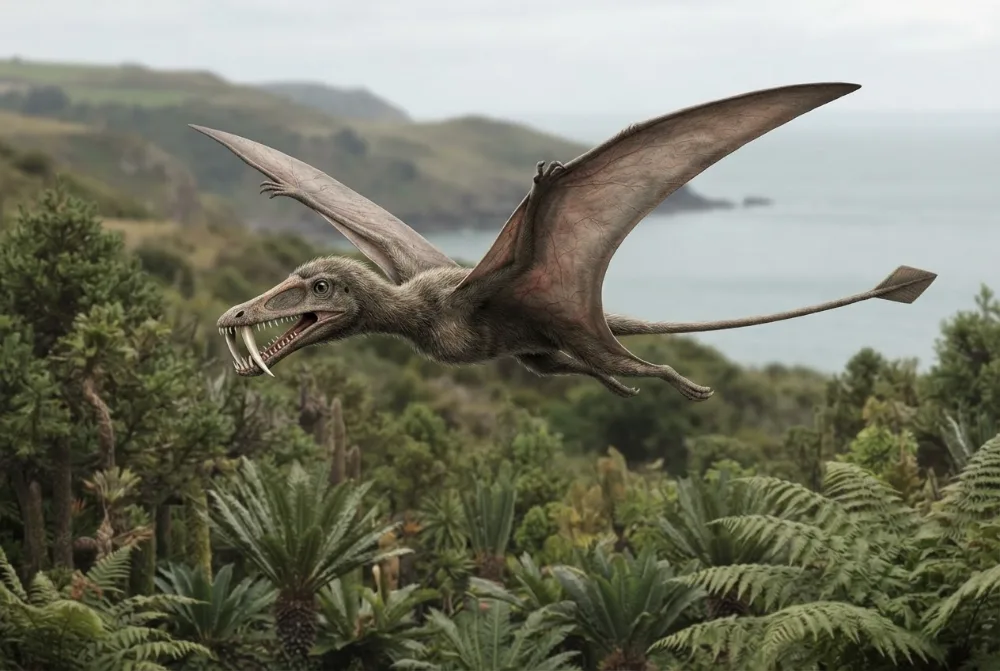
Dorygnathus was a flying reptile that lived during the Early Jurassic, about 180 million years ago. It had a short wingspan of around 1.5 metres (4.9 feet) and a long tail. Its most striking feature was its mouth full of large, curved fangs at the front and smaller teeth at the back.1
Ankakhala liti?
Anali wamkulu bwanji?
Mapiko ake anali otambalala bwanji?
 wautali ngati amphaka a pakhomo 3 otsatizana mphuno ndi mchira⚽akanatha kuuluka kudutsa bwalo lonse la mpira m'masekondi 8.4
Dorygnathus anali wamkulu bwanji poyerekeza ndi IWEYO?
Ndi masamu chabe mu msakatuli wako. Palibe chimene chimasungidwa kapena kutumizidwa kwina kulikonse.
Anali ndi liwiro lotani?


Mfundo zosangalatsa
Dorygnathus had different kinds of teeth: four large fangs in the upper jaw and three or four in the lower jaw at the front, with smaller, straighter teeth behind. This is called heterodonty and is rare in modern reptiles.1
The fifth toe on its hind feet was unusually long and pointed sideways. Scientists think it may have supported a membrane, like the one on its wings.1
Dorygnathus was a close relative of the later pterosaur Rhamphorhynchus, and lived at the same time as another pterosaur called Campylognathoides in Germany.1
Over 50 specimens of Dorygnathus have been found, many in slate quarries. The best fossils are kept at the State Museum of Natural History Stuttgart in Germany.1
Some Dorygnathus teeth show wear from eating hard food like crustaceans or mollusks, not just fish.1
The smallest known Dorygnathus had a wingspan of 60 centimetres (2 feet). Scientists think very young juveniles could not fly far over the open sea.1
Mafunso ofunsidwa kwambiri okhudza Dorygnathus
?How big was Dorygnathus?
Dorygnathus had a wingspan of about 1.5 metres (4.9 feet), though some large individuals reached 1.7 metres (5.6 feet).12
?What did Dorygnathus eat?
Dorygnathus ate small fish, as shown by fossilised stomach contents. Some teeth also show wear from eating hard food like crustaceans or mollusks.13
?Could Dorygnathus fly?
Yes, Dorygnathus was a flying reptile. It had wings made of skin and other membranes, and its flight muscles attached to a small triangular breastbone.1
?Is Dorygnathus a dinosaur?
No, Dorygnathus was a pterosaur, a flying reptile that lived during the age of dinosaurs, but it was not a dinosaur.1
Kwa akatswiri a madino
- Dzina la sayansi
- Dorygnathus
- Anapatsidwa dzina ndi
- Wagner 18604
- Gulu
- Zokwawa zouluka
- Banja / kladi
- Rhamphorhynchidae4
- Magawidwe a sayansi
- Pterosauria > Rhamphorhynchidae4
- Zaka za miyala
- zaka 184 mpaka 183 miliyoni (Toarcian)4
- Mapangidwe a miyala
- Posidonia Shale, Posidonienschiefer, Marne de Flize4
- Mayiko
- Jeremani, Falansa4
- Zolemba za mafosili
- 37 mu The Paleobiology Database4
- Kupezeka
- The first fossils of Dorygnathus were found near Banz, Bavaria, Germany, and were described in 1830 by Carl Theodori as Ornithocephalus banthensis. In 1860, Johann Andreas Wagner gave it the name Dorygnathus, meaning 'spear jaw'.1
- Akukambiranabe
- Scientists still debate whether Dorygnathus walked on two legs or four. Some think it could walk on two legs because of its long tail, but most now believe all pterosaurs walked on all fours.1
Kumene mfundo zimachokera
- Dorygnathus (en.wikipedia.org)
- The Early Jurassic Pterosaur Dorygnathus Banthensis (Theodori, 1830) | The Palaeontological Association (palass.org)
- Press | State Museum of Natural History Stuttgart (naturkundemuseum-bw.de)
- Dorygnathus in The Paleobiology Database (CC BY 4.0): zaka, malo, mapangidwe a miyala, magawidwe a sayansi.
Mfundo iliyonse patsamba lino ili ndi nambala yosonyeza kumene yachokera. Ngati talakwitsa kanthu, pepa, ndife okonda madino, osati magazini ya sayansi. Tiuze pa [email protected] ndipo tikonza.
 Rex ali ndi njala! Dino Wiki ndi ntchito ya bambo kwa mwana wawo wamwamuna wokonda madainoso, yaulere popanda zotsatsa ndi zokazonda. Akuluakulu angadyetse Rex zokhwasula-khwasula kuti tsambali lipitirize kupezeka pa intaneti.Dyetsa Rex
 Pteranodon
 Quetzalcoatlus
 Rhamphorhynchus
 Anhanguera
 Pterodactylus
 Eudimorphodon
 Dilophosaurus
 Stenopterygius
 Lufengosaurus
 Scutellosaurus
 Yunnanosaurus
 Sinosaurus