 Kwizi ya Ndiwe dino uti?
 Nkhondo ya madino
 Mpikisano wa madino
 Masewera ang'onoang'ono a madino
 Chimbale cha zomata
 Mindandanda ya TOP ya madino
 Ndidabwitse!
Anurognathus
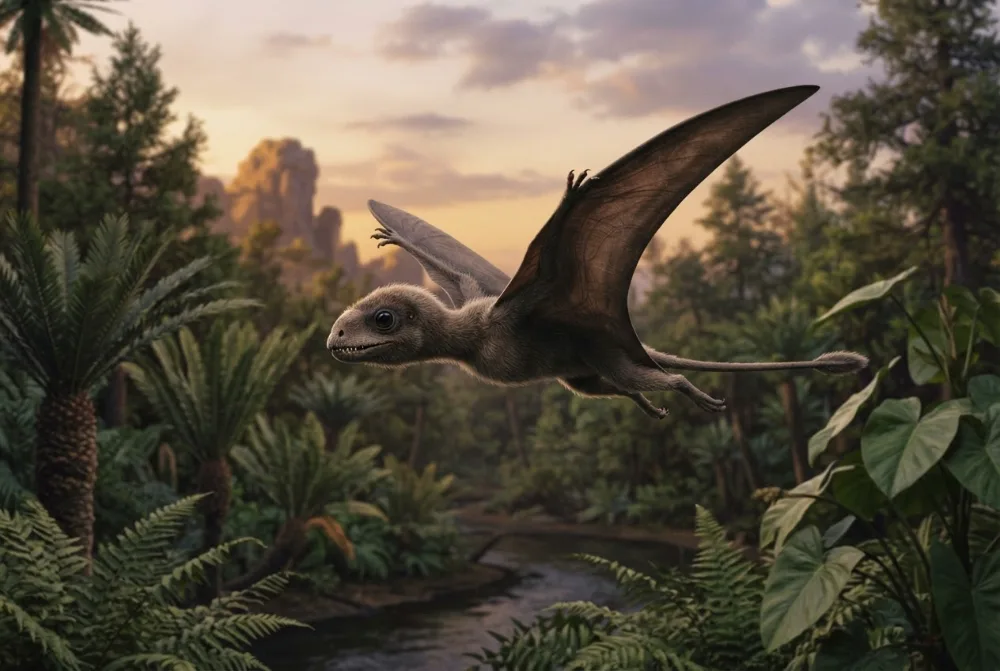
Anurognathus was a tiny pterosaur that lived in the Late Jurassic. It had a very short, wide head and big eyes, like a little flying frog. It probably hunted insects at dusk.12
Ankakhala liti?
Anali wamkulu bwanji?
Anali wautali bwanji?
Ankalemera bwanji?
Anurognathus anali wamkulu bwanji poyerekeza ndi IWEYO?
Ndi masamu chabe mu msakatuli wako. Palibe chimene chimasungidwa kapena kutumizidwa kwina kulikonse.
Anali ndi liwiro lotani?


Mfundo zosangalatsa
Anurognathus had a very short tail, unlike most early pterosaurs. This made it more maneuverable when hunting insects.1
Its skull was wider than it was long, and its eyes were huge. This helped it see well in dim light.12
Anurognathus weighed only about 40 grams (1.4 ounces), as light as a small bird.1
Scientists think Anurognathus had bristles around its mouth, like a fringe, to help catch insects.12
Only two fossils of Anurognathus have been found, both in Germany. One is a juvenile.1
Mafunso ofunsidwa kwambiri okhudza Anurognathus
?How big was Anurognathus?
Anurognathus was tiny, with a wingspan of about 35 cm (14 in) and a weight of only 40 grams (1.4 oz), as light as a small bird.1
?What did Anurognathus eat?
It ate insects. Its pin-like teeth and small mouth were perfect for catching tiny bugs about 11 mm long.1
?Could Anurognathus fly?
Yes, it was a pterosaur and could fly. It had short, broad wings and probably flew slowly and maneuvered well to catch insects at dusk.1
?Did Anurognathus have feathers?
No, it did not have feathers. It had a fuzzy coat of hair-like fibers called pycnofibers, and possibly bristles around its mouth.1
?When did Anurognathus live?
Anurognathus lived during the Late Jurassic period, about 150 to 148 million years ago.1
?Why did Anurognathus have big eyes?
Its huge eyes helped it see well in dim light, so it could hunt insects at dusk or in the dark.1
?Is Anurognathus a dinosaur?
No, Anurognathus is a pterosaur, a flying reptile that is not a dinosaur.1
?How many fossils of Anurognathus have been found?
Only two fossils have been found, both in Germany. One is a juvenile, and the other is a subadult.1
Wothetsa nthano zabodza
Nthano: Some people think Anurognathus was a dinosaur.
Zoona: Anurognathus was a pterosaur, a flying reptile that is not a dinosaur.4
Kwa akatswiri a madino
- Dzina la sayansi
- Anurognathus
- Anapatsidwa dzina ndi
- Döderlein 19234
- Gulu
- Zokwawa zouluka
- Banja / kladi
- Anurognathidae4
- Magawidwe a sayansi
- Pterosauria4
- Zaka za miyala
- zaka 149 mpaka 145 miliyoni (Tithonian)4
- Mapangidwe a miyala
- Solnhofener Plattenkalk4
- Mayiko
- Jeremani4
- Zolemba za mafosili
- 1 mu The Paleobiology Database4
- Kupezeka
- Anurognathus was named by Ludwig Döderlein in 1923. He bought the first fossil from a collector in 1922. It was found in the Solnhofen limestone of Germany.1
- Akukambiranabe
- Scientists still debate whether Anurognathus was a fast flyer that surprised its prey, or a slow, maneuverable hunter like a nightjar.1
Kumene mfundo zimachokera
- Anurognathus (en.wikipedia.org)
- A second specimen of the pterosaurAnurognathus ammoni | PalZ | Springer Nature Link (link.springer.com)
- PaleoCodex :: Anurognathus (paleocodex.com)
- Anurognathus in The Paleobiology Database (CC BY 4.0): zaka, malo, mapangidwe a miyala, magawidwe a sayansi.
Mfundo iliyonse patsamba lino ili ndi nambala yosonyeza kumene yachokera. Ngati talakwitsa kanthu, pepa, ndife okonda madino, osati magazini ya sayansi. Tiuze pa [email protected] ndipo tikonza.
 Rex ali ndi njala! Dino Wiki ndi ntchito ya bambo kwa mwana wawo wamwamuna wokonda madainoso, yaulere popanda zotsatsa ndi zokazonda. Akuluakulu angadyetse Rex zokhwasula-khwasula kuti tsambali lipitirize kupezeka pa intaneti.Dyetsa Rex
 Pteranodon
 Quetzalcoatlus
 Dorygnathus
 Rhamphorhynchus
 Anhanguera
 Pterodactylus
 Brachiosaurus
 Diplodocus
 Allosaurus
 Brontosaurus
 Compsognathus
 Camarasaurus