 Kwizi ya Ndiwe dino uti?
 Nkhondo ya madino
 Mpikisano wa madino
 Masewera ang'onoang'ono a madino
 Chimbale cha zomata
 Mindandanda ya TOP ya madino
 Ndidabwitse!
Bagualia
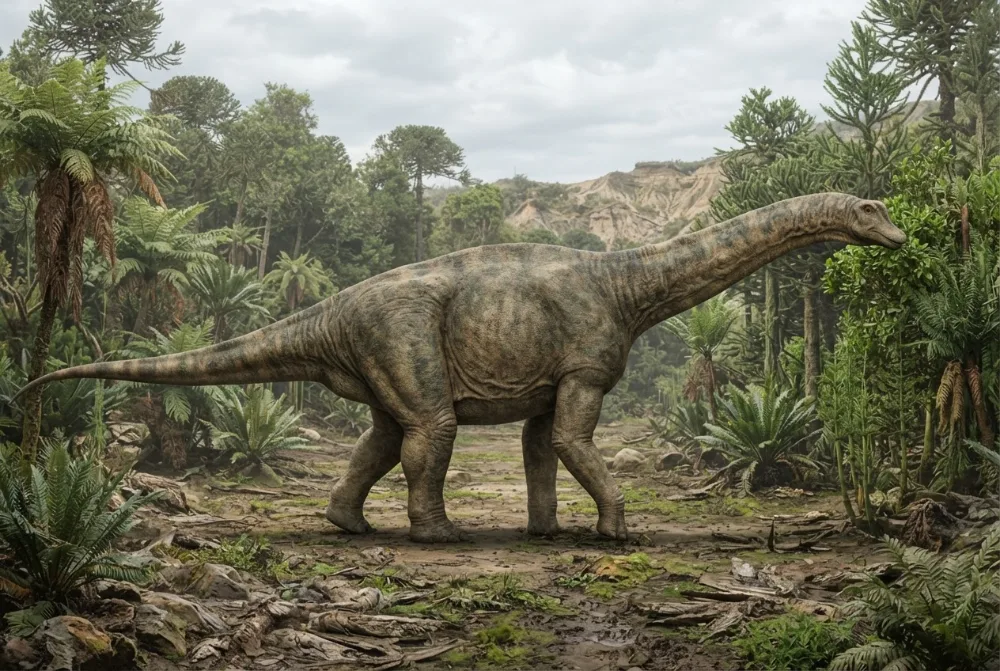
Bagualia was an early long-necked dinosaur that lived about 180 million years ago. It is one of the oldest known true sauropods, the group that later included giants like Brachiosaurus. Bagualia had a deep skull and big spoon-shaped teeth for eating tough plants.21
Ankakhala liti?
Anali wamkulu bwanji?
Anali wautali bwanji?
Msinkhu wake unali wautali bwanji?
kuyerekeza
Ankalemera bwanji?
 wautali ngati magalimoto 2.5 oimikidwa pamzere🍌wautali ngati nthochi 67 zotsatizana
 wolemera ngati njovu 1.5🍉wolemera ngati mavwende 2000🎒wolemera ngati makalasi athunthu a ana a sukulu 12🐻❄️wolemera ngati zimbalangondo zoyera 22🏃akanatha kuthamanga mamita 100 m'masekondi 24 (munthu waliwiro kwambiri amafunika 9.6)
Bagualia anali wamkulu bwanji poyerekeza ndi IWEYO?
Ndi masamu chabe mu msakatuli wako. Palibe chimene chimasungidwa kapena kutumizidwa kwina kulikonse.
Anali ndi liwiro lotani?


Mfundo zosangalatsa
Bagualia lived during a time of major climate change, when a huge volcanic event warmed the Earth and many other plant-eating dinosaurs died out.2
The holotype specimen includes the back half of a skull and the first seven neck bones, all still connected together.2
Scientists found remains of at least three Bagualia individuals at the same site, all about the same size.2
Bagualia had a short, deep snout and large nostrils that were set far back on its skull, like later sauropods.2
Mafunso ofunsidwa kwambiri okhudza Bagualia
?How big was Bagualia?
Scientists estimate Bagualia weighed over 10 tonnes, making it one of the first truly giant sauropods. Its exact length is not known, but it had a long neck and a large body.5
?What did Bagualia eat?
Bagualia ate tough plants like conifers. Its spoon-shaped teeth had very thick enamel, about seven times thicker than other plant-eaters, to help shear leaves.1
?When did Bagualia live?
Bagualia lived about 179 million years ago, during the Early Jurassic period. That makes it one of the oldest known true sauropods.15
?Where was Bagualia found?
Bagualia fossils were found in Bagual Canyon in Chubut, Argentina. The remains were discovered in 2007 and 2009 by scientists from the Museo Paleontológico Egidio Feruglio.1
Kwa akatswiri a madino
- Dzina la sayansi
- Bagualia
- Anapatsidwa dzina ndi
- Pol et al. 20206
- Gulu
- Makosi atali
- Banja / kladi
- Eusauropoda6
- Magawidwe a sayansi
- Sauropodomorpha > Sauropoda6
- Zaka za miyala
- zaka 183 mpaka 180 miliyoni (Toarcian)6
- Mapangidwe a miyala
- Cañadón Asfalto6
- Mayiko
- Argentina6
- Zolemba za mafosili
- 1 mu The Paleobiology Database6
- Kupezeka
- Bagualia was named in 2020 by Diego Pol and colleagues. The fossils were found in the Cañadón Asfalto Formation in Chubut, Argentina, at a site called Bagual Canyon.12
- Akukambiranabe
- Scientists are still debating exactly how Bagualia is related to other early sauropods and how quickly the group evolved after the Toarcian warming event.2
Kumene mfundo zimachokera
- Bagualia (en.wikipedia.org)
- Extinction of herbivorous dinosaurs linked to Early Jurassic global warming event (royalsocietypublishing.org)
- PBDB Taxon (paleobiodb.org)
- Nuevos hallazgos sobre Bagualia alba, un dinosaurio saurópodo qu (iipg.conicet.gov.ar)
- Axial skeleton of Bagualia (palaeo-electronica.org)
- Bagualia in The Paleobiology Database (CC BY 4.0): zaka, malo, mapangidwe a miyala, magawidwe a sayansi.
Mfundo iliyonse patsamba lino ili ndi nambala yosonyeza kumene yachokera. Ngati talakwitsa kanthu, pepa, ndife okonda madino, osati magazini ya sayansi. Tiuze pa [email protected] ndipo tikonza.
 Rex ali ndi njala! Dino Wiki ndi ntchito ya bambo kwa mwana wawo wamwamuna wokonda madainoso, yaulere popanda zotsatsa ndi zokazonda. Akuluakulu angadyetse Rex zokhwasula-khwasula kuti tsambali lipitirize kupezeka pa intaneti.Dyetsa Rex
 Brachiosaurus
 Diplodocus
 Brontosaurus
 Argentinosaurus
 Camarasaurus
 Morosaurus
 Dilophosaurus
 Stenopterygius
 Dorygnathus
 Scutellosaurus
 Sinosaurus
 Temnodontosaurus