 Kwizi ya Ndiwe dino uti?
 Nkhondo ya madino
 Mpikisano wa madino
 Masewera ang'onoang'ono a madino
 Chimbale cha zomata
 Mindandanda ya TOP ya madino
 Ndidabwitse!
Bohaiornis
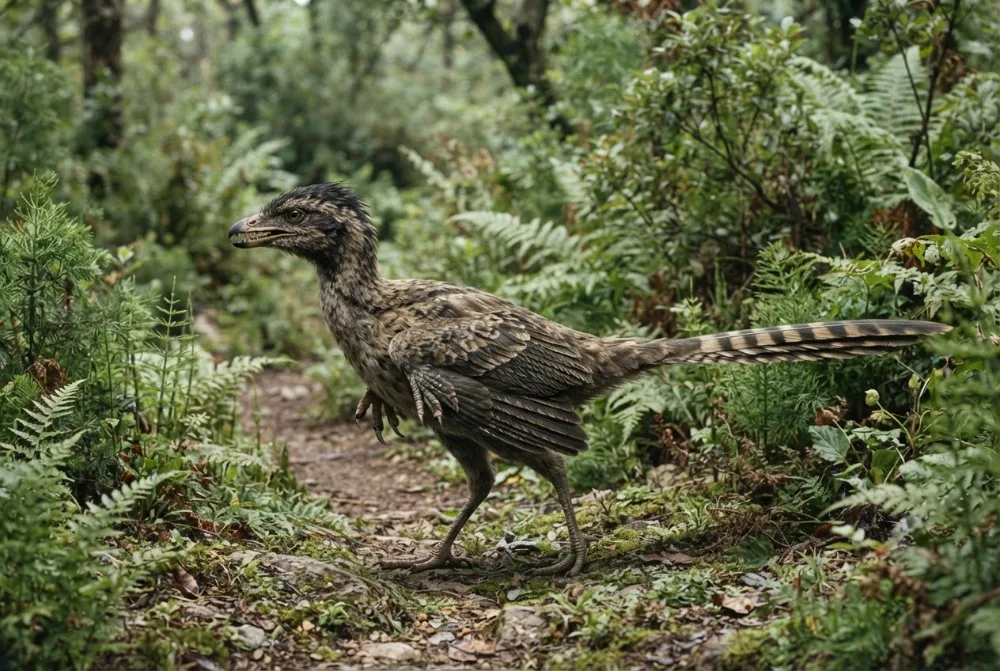
Bohaiornis was a feathered dinosaur that lived about 120 million years ago in what is now China. It was a bird-like predator with sharp teeth and long tail feathers. Scientists found a nearly complete skeleton that shows it was a fast, ground-dwelling hunter.15
Ankakhala liti?
Anali wamkulu bwanji?
Ankalemera bwanji?
Bohaiornis anali wamkulu bwanji poyerekeza ndi IWEYO?
Ndi masamu chabe mu msakatuli wako. Palibe chimene chimasungidwa kapena kutumizidwa kwina kulikonse.
Anali ndi liwiro lotani?


Mfundo zosangalatsa
Bohaiornis had two long, ribbon-like feathers on its tail, not a fan of short feathers like many other birds.1
It was much larger than its close relative Eoenantiornis, which lived a bit earlier.1
The first skeleton found was almost complete, with all its bones still connected.2
Scientists once thought it had stones in its belly to help grind food, but those turned out to be mineral lumps that formed after death.1
Bohaiornis had a broad snout, which is unusual for early birds that ate meat.1
It lived during the Early Cretaceous, about 120 million years ago.1
Mafunso ofunsidwa kwambiri okhudza Bohaiornis
?How big was Bohaiornis?
Scientists do not give an exact size, but it was much larger than its close relative Eoenantiornis, and a second, even larger specimen has been found.14
?What did Bohaiornis eat?
It was probably a meat-eater, maybe a raptorial predator. Scientists once thought it had stomach stones to help grind food, but those turned out to be mineral lumps that formed after death.14
?Did Bohaiornis have feathers?
Yes. The first skeleton found had two long, ribbon-like feathers attached to its tail.1
?When did Bohaiornis live?
It lived during the Early Cretaceous, about 120 million years ago, in what is now China.1
Wothetsa nthano zabodza
Nthano: People might think Bohaiornis ate plants because it had stones in its stomach.
Zoona: The stones were actually mineral concretions that formed after the animal died, and Bohaiornis was a meat-eater.1
Kwa akatswiri a madino
- Dzina la sayansi
- Bohaiornis
- Anapatsidwa dzina ndi
- Hu et al. 20115
- Gulu
- Mbalame zoyambirira
- Banja / kladi
- Bohaiornithidae5
- Magawidwe a sayansi
- Theropoda > Avialae5
- Zaka za miyala
- zaka 121 mpaka 113 miliyoni (Aptian)5
- Mapangidwe a miyala
- Jiufotang5
- Mayiko
- China5
- Zolemba za mafosili
- 2 mu The Paleobiology Database5
- Kupezeka
- Bohaiornis was named by Dongyu Hu, Li Li, Lianhaim Hou, and Xing Xu in 2011. They described a nearly complete skeleton from the Yixian Formation in China.21
- Akukambiranabe
- Scientists still debate what exactly Bohaiornis ate, because its stomach contents are not clear.1
Kumene mfundo zimachokera
- Bohaiornis (en.wikipedia.org)
- A new enantiornithine bird from the Lower Cretaceous of western L...: Ingenta Connect (ingentaconnect.com)
- Synthetic analysis of trophic diversity and evolution in Enantiornithes with new insights from Bohaiornithidae (pmc.ncbi.nlm.nih.gov)
- A new specimen of large-bodied basal Enantiornithine Bohaiornis from the Early Cretaceous of China and the inference of feeding ecology in Mesozoic birds | Journal of Paleontology | Cambridge Core (cambridge.org)
- Bohaiornis in The Paleobiology Database (CC BY 4.0): zaka, malo, mapangidwe a miyala, magawidwe a sayansi.
Mfundo iliyonse patsamba lino ili ndi nambala yosonyeza kumene yachokera. Ngati talakwitsa kanthu, pepa, ndife okonda madino, osati magazini ya sayansi. Tiuze pa [email protected] ndipo tikonza.
 Rex ali ndi njala! Dino Wiki ndi ntchito ya bambo kwa mwana wawo wamwamuna wokonda madainoso, yaulere popanda zotsatsa ndi zokazonda. Akuluakulu angadyetse Rex zokhwasula-khwasula kuti tsambali lipitirize kupezeka pa intaneti.Dyetsa Rex
 Archaeopteryx
 Hesperornis
 Ichthyornis
 Baptornis
 Jurapteryx
 Gobipteryx
 Stegosaurus
 Iguanodon
 Giganotosaurus
 Microraptor
 Deinonychus
 Baryonyx