 Kwizi ya Ndiwe dino uti?
 Nkhondo ya madino
 Mpikisano wa madino
 Masewera ang'onoang'ono a madino
 Chimbale cha zomata
 Mindandanda ya TOP ya madino
 Ndidabwitse!
Borealopelta
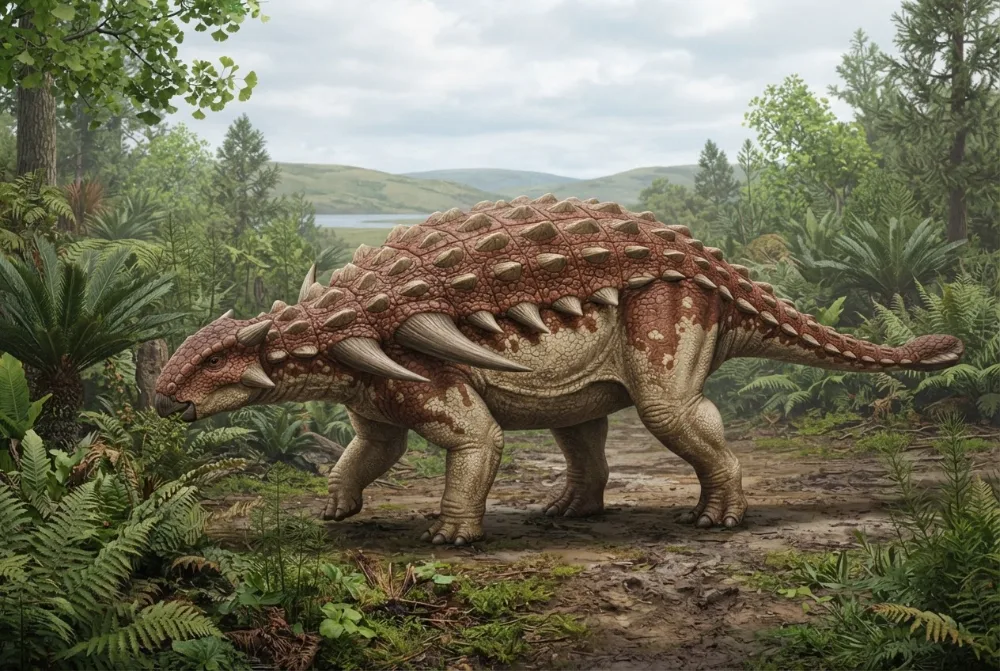
Borealopelta was a heavily armoured dinosaur that looked like a living tank. It had huge spikes on its shoulders and a body covered in bony plates and scales. Scientists even know what colour it was: reddish-brown on top and lighter underneath, like a deer today.1
Ankakhala liti?
Anali wamkulu bwanji?
Anali wautali bwanji?
Msinkhu wake unali wautali bwanji?
Ankalemera bwanji?
 wautali ngati agalu 6 otsatizana mphuno ndi mchira🍌wautali ngati nthochi 31 zotsatizana🍉wolemera ngati mavwende 260🧸wolemera ngati ana a sukulu ya mkaka 68🎒wolemera ngati ana a sukulu 41🐻❄️wolemera ngati zimbalangondo zoyera 3🏃akanatha kuthamanga mamita 100 m'masekondi 21 (munthu waliwiro kwambiri amafunika 9.6)
Borealopelta anali wamkulu bwanji poyerekeza ndi IWEYO?
Ndi masamu chabe mu msakatuli wako. Palibe chimene chimasungidwa kapena kutumizidwa kwina kulikonse.
Anali ndi liwiro lotani?


Mfundo zosangalatsa
Borealopelta is one of the best-preserved armoured dinosaurs ever found. Its fossil includes skin, scales, and even the horn sheaths on its spikes.1
This dinosaur had countershading: its back was reddish-brown and its belly was lighter. This helped it hide from predators.1
The largest spikes on its shoulders were probably used for display, not just defence. They were lighter in colour and covered in a thick horn sheath.1
Borealopelta weighed over 1,300 kilograms, as much as a small rhinoceros. Despite its size and armour, it still needed camouflage from big meat-eating dinosaurs.2
It lived about 121 to 113 million years ago during the Early Cretaceous period, in what is now Alberta, Canada.5
The fossil was found in an oil sands mine. It was so well preserved that scientists could study the melanin in its skin to figure out its colour.1
Borealopelta had more than 20 small bony plates on its snout and a large hexagonal plate on its forehead.1
Mafunso ofunsidwa kwambiri okhudza Borealopelta
?How big was Borealopelta?
About 5.5 metres long and weighed 1.3 metric tons.4
?What did Borealopelta eat?
It ate plants, especially ferns. Its last meal was mostly ferns, and it also swallowed a little bit of charcoal from a wildfire.4
?Did Borealopelta have a tail club?
No, it had a straight tail without a club, unlike some other armoured dinosaurs.4
?Why did Borealopelta have spikes?
The big shoulder spikes were probably used for display to attract mates or scare rivals, but they could also help defend against predators.41
?Was Borealopelta camouflaged?
Yes, it had countershading: a reddish-brown back and a lighter belly, which helped it hide from predators.41
?When did Borealopelta live?
It lived about 110 to 112 million years ago during the Early Cretaceous period.4
?Where was Borealopelta found?
It was discovered in an oil sands mine near Fort McMurray, Alberta, Canada.4
?How well preserved is Borealopelta?
It is one of the best-preserved armoured dinosaurs ever found, with skin, scales, horn sheaths, and even stomach contents still intact.41
?Could Borealopelta swim?
It probably could not swim well. Its body was found in ancient sea sediments, so it likely drowned and sank after being washed out to sea.4
Wothetsa nthano zabodza
Nthano: Many people think all armoured dinosaurs were slow and clumsy.
Zoona: Borealopelta was heavily armoured but its legs were built for walking and it could probably move quickly when needed. Its camouflage shows it was an active prey animal.1
Kwa akatswiri a madino
- Dzina la sayansi
- Borealopelta
- Anapatsidwa dzina ndi
- Brown et al. 20175
- Gulu
- Madino a zishango
- Banja / kladi
- Nodosauridae5
- Magawidwe a sayansi
- Ornithischia > Ankylosauria > Nodosauridae > Thyreophora5
- Zaka za miyala
- zaka 121 mpaka 113 miliyoni (Aptian)5
- Mapangidwe a miyala
- Clearwater5
- Mayiko
- Kanada5
- Zolemba za mafosili
- 1 mu The Paleobiology Database5
- Kupezeka
- Borealopelta was discovered in 2011 at the Suncor Millennium Mine in Alberta, Canada, by miners removing overburden. It was named by Caleb Brown and colleagues in 2017.15
- Akukambiranabe
- Scientists are not sure exactly how many different kinds of nodosaurids existed, and whether Borealopelta's shoulder spikes were mainly for fighting rivals or scaring predators.1
Kumene mfundo zimachokera
- An Exceptionally Preserved Three-Dimensional Armored Dinosaur Reveals Insights into Coloration and Cretaceous Predator-Prey Dynamics: Current Biology (cell.com)
- An Exceptionally Preserved Three-Dimensional Armored Dinosaur Reveals Insights into Coloration and Cretaceous Predator-Prey Dynamics (pubmed.ncbi.nlm.nih.gov)
- BOREALOPELTA - DinoChecker dinosaur archive (dinochecker.com)
- Borealopelta (en.wikipedia.org)
- Borealopelta in The Paleobiology Database (CC BY 4.0): zaka, malo, mapangidwe a miyala, magawidwe a sayansi.
Mfundo iliyonse patsamba lino ili ndi nambala yosonyeza kumene yachokera. Ngati talakwitsa kanthu, pepa, ndife okonda madino, osati magazini ya sayansi. Tiuze pa [email protected] ndipo tikonza.
 Rex ali ndi njala! Dino Wiki ndi ntchito ya bambo kwa mwana wawo wamwamuna wokonda madainoso, yaulere popanda zotsatsa ndi zokazonda. Akuluakulu angadyetse Rex zokhwasula-khwasula kuti tsambali lipitirize kupezeka pa intaneti.Dyetsa Rex
 Ankylosaurus
 Sauropelta
 Pinacosaurus
 Scutellosaurus
 Struthiosaurus
 Euoplocephalus
 Stegosaurus
 Iguanodon
 Archaeopteryx
 Giganotosaurus
 Microraptor
 Deinonychus