 Kwizi ya Ndiwe dino uti?
 Nkhondo ya madino
 Mpikisano wa madino
 Masewera ang'onoang'ono a madino
 Chimbale cha zomata
 Mindandanda ya TOP ya madino
 Ndidabwitse!
Camptodontus
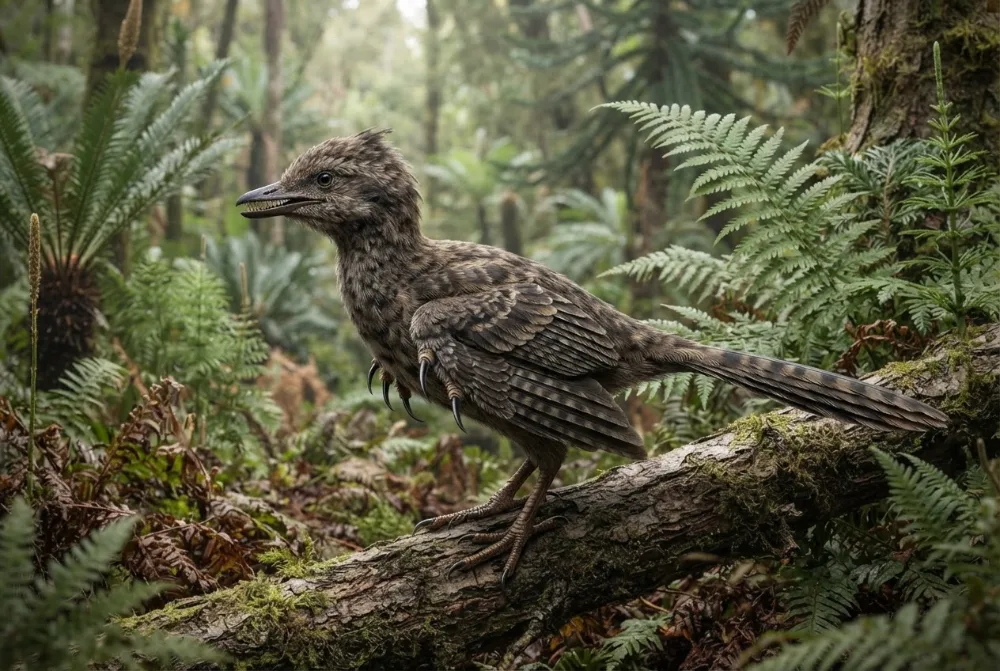
Camptodontornis was a small, toothed bird that lived during the Early Cretaceous. It had strong jaws and curved teeth, which helped it catch and eat prey. This bird was an enantiornithine, a group of early birds that went extinct with the dinosaurs.2
Ankakhala liti?
Anali ndi liwiro lotani?


Mfundo zosangalatsa
Camptodontornis was originally named Camptodontus, but that name was already used for a beetle, so scientists had to give it a new name in 2019.1
This bird had a Y-shaped furcula, which is the wishbone that helps birds fly.2
Its teeth were strongly curved backward, which helped it hold onto slippery prey.2
Camptodontornis belongs to the family Longipterygidae, a group of early birds with long snouts.2
The only known fossil of Camptodontornis is a nearly complete skeleton found in the Jiufotang Formation of China.3
It lived about 121 to 113 million years ago, during the Aptian age of the Early Cretaceous.3
Kwa akatswiri a madino
- Dzina la sayansi
- Camptodontus
- Anapatsidwa dzina ndi
- Li et al. 20103
- Gulu
- Mbalame zoyambirira
- Banja / kladi
- Longipterygidae3
- Magawidwe a sayansi
- Theropoda > Avialae3
- Zaka za miyala
- zaka 121 mpaka 113 miliyoni (Aptian)3
- Zolemba za mafosili
- 1 mu The Paleobiology Database3
- Kupezeka
- Camptodontornis was first described in 2010 by Li Li and colleagues based on a skeleton from Liaoning, China. It was originally called Camptodontus, but that name was already taken by a beetle, so in 2019 it was renamed Camptodontornis.12
- Akukambiranabe
- Scientists are still debating exactly how Camptodontornis is related to other enantiornithine birds.2
Kumene mfundo zimachokera
- Camptodontornis gen. nov., a replacement name for the bird genus Camptodontus Li, Gong, Zhang, Yang, and Hou, 2010, a junior homonym of Camptodontus Dejean, 1826 | Zootaxa (biotaxa.org)
- A NEW ENANTIORNITHINE BIRD(AVES) FROM THE EARLY CRETACEOUS OF LIAONING,CHINA--《Acta Palaeontologica Sinica》2010年04期 (web.archive.org)
- Camptodontus in The Paleobiology Database (CC BY 4.0): zaka, malo, mapangidwe a miyala, magawidwe a sayansi.
Mfundo iliyonse patsamba lino ili ndi nambala yosonyeza kumene yachokera. Ngati talakwitsa kanthu, pepa, ndife okonda madino, osati magazini ya sayansi. Tiuze pa [email protected] ndipo tikonza.
 Rex ali ndi njala! Dino Wiki ndi ntchito ya bambo kwa mwana wawo wamwamuna wokonda madainoso, yaulere popanda zotsatsa ndi zokazonda. Akuluakulu angadyetse Rex zokhwasula-khwasula kuti tsambali lipitirize kupezeka pa intaneti.Dyetsa Rex
 Archaeopteryx
 Hesperornis
 Ichthyornis
 Baptornis
 Jurapteryx
 Gobipteryx
 Stegosaurus
 Iguanodon
 Giganotosaurus
 Microraptor
 Deinonychus
 Baryonyx