 Kwizi ya Ndiwe dino uti?
 Nkhondo ya madino
 Mpikisano wa madino
 Masewera ang'onoang'ono a madino
 Chimbale cha zomata
 Mindandanda ya TOP ya madino
 Ndidabwitse!
Ankakhala liti?

Anali wamkulu bwanji?
Anali wautali bwanji?
Msinkhu wake unali wautali bwanji?
kuyerekeza
Ankalemera bwanji?
 wautali ngati magalimoto 2 oimikidwa pamzere🍌wautali ngati nthochi 50 zotsatizana
 wolemera pafupifupi ngati njovu🍉wolemera ngati mavwende 1000🎒wolemera ngati makalasi athunthu a ana a sukulu 6🐻❄️wolemera ngati zimbalangondo zoyera 11🏃akanatha kuthamanga mamita 100 m'masekondi 30 (munthu waliwiro kwambiri amafunika 9.6)
Cedarpelta anali wamkulu bwanji poyerekeza ndi IWEYO?
Ndi masamu chabe mu msakatuli wako. Palibe chimene chimasungidwa kapena kutumizidwa kwina kulikonse.
Anali ndi liwiro lotani?


Mfundo zosangalatsa
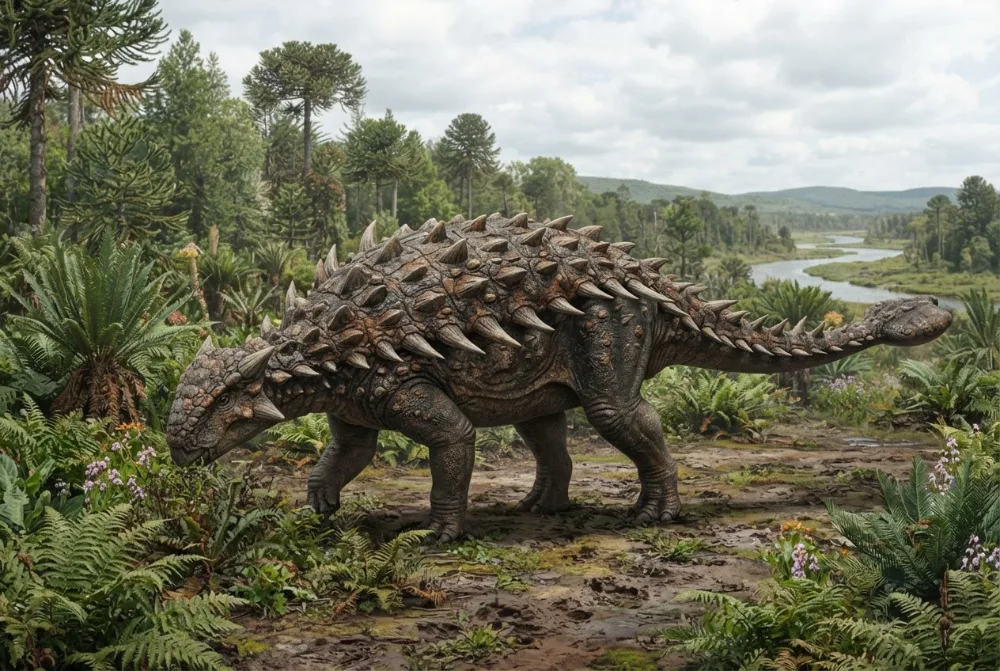
Cedarpelta is one of the few ankylosaurs whose skull bones are not completely fused together, which let scientists study each bone separately.2
One of its skulls was found disarticulated, meaning the bones were scattered, a first for an ankylosaur skull.2
Its skull was about 60 centimetres (24 inches) long, and it had 18 teeth in its upper jaw.2
Cedarpelta lived about 98 to 93 million years ago, during the Late Cretaceous period.2
The name Cedarpelta comes from the Cedar Mountain Formation and the Greek word 'pelte', meaning small shield.2
Fossils of Cedarpelta were found alongside those of a brachiosaurid, an iguanodontian, a turtle, a pterosaur, and another armoured dinosaur called Peloroplites.2
Mafunso ofunsidwa kwambiri okhudza Cedarpelta
?How big was Cedarpelta?
Estimates vary. It was about 7 metres (23 feet) long and weighed about 5 tonnes (11,023 lbs), though some scientists think it could reach 9 metres.2
?What did Cedarpelta eat?
Cedarpelta was a plant-eating dinosaur, so it ate plants like ferns and leaves.1
?Did Cedarpelta have a tail club?
There is no evidence of a tail club in Cedarpelta, even though it is an ankylosaurid.3
?When did Cedarpelta live?
Cedarpelta lived during the Late Cretaceous, about 98 to 93 million years ago.2
Wothetsa nthano zabodza
Nthano: Some people think all armoured dinosaurs had a tail club, but Cedarpelta may not have had one.
Zoona: Cedarpelta is a basal ankylosaurid, and scientists are not sure if it had a tail club like later ankylosaurs.2
Kwa akatswiri a madino
- Dzina la sayansi
- Cedarpelta
- Anapatsidwa dzina ndi
- Carpenter et al. 20014
- Gulu
- Madino a zishango
- Banja / kladi
- Ankylosauridae4
- Magawidwe a sayansi
- Ornithischia > Ankylosauria > Ankylosauridae > Thyreophora4
- Zaka za miyala
- zaka 121 mpaka 100 miliyoni (Aptian / Albian)4
- Mapangidwe a miyala
- Cedar Mountain4
- Mayiko
- Amereka4
- Zolemba za mafosili
- 3 mu The Paleobiology Database4
- Kupezeka
- Cedarpelta was discovered by Evan Hall and Sue Ann Bilbey near the Price River in Utah, and was named in 2001 by Kenneth Carpenter, James Kirkland, Don Burge, and John Bird.2
- Akukambiranabe
- Scientists debate whether Cedarpelta was an ankylosaurid or a nodosaurid, and some think it might be the earliest known ankylosaurid.2
Kumene mfundo zimachokera
- Cedarpelta | Natural History Museum (nhm.ac.uk)
- Cedarpelta (en.wikipedia.org)
- Utah's Prehistoric Tanks: The Ankylosaurs - Utah Geological Survey (geology.utah.gov)
- Cedarpelta in The Paleobiology Database (CC BY 4.0): zaka, malo, mapangidwe a miyala, magawidwe a sayansi.
Mfundo iliyonse patsamba lino ili ndi nambala yosonyeza kumene yachokera. Ngati talakwitsa kanthu, pepa, ndife okonda madino, osati magazini ya sayansi. Tiuze pa [email protected] ndipo tikonza.
 Rex ali ndi njala! Dino Wiki ndi ntchito ya bambo kwa mwana wawo wamwamuna wokonda madainoso, yaulere popanda zotsatsa ndi zokazonda. Akuluakulu angadyetse Rex zokhwasula-khwasula kuti tsambali lipitirize kupezeka pa intaneti.Dyetsa Rex
 Ankylosaurus
 Sauropelta
 Pinacosaurus
 Scutellosaurus
 Struthiosaurus
 Euoplocephalus
 Stegosaurus
 Iguanodon
 Archaeopteryx
 Giganotosaurus
 Microraptor
 Deinonychus