 Kwizi ya Ndiwe dino uti?
 Nkhondo ya madino
 Mpikisano wa madino
 Masewera ang'onoang'ono a madino
 Chimbale cha zomata
 Mindandanda ya TOP ya madino
 Ndidabwitse!
Ankakhala liti?

Anali wamkulu bwanji?
Anali wautali bwanji?
Msinkhu wake unali wautali bwanji?
Ankalemera bwanji?
 wautali ngati magalimoto 2 oimikidwa pamzere🍌wautali ngati nthochi 50 zotsatizana
 wolemera ngati agalu 100🍉wolemera ngati mavwende 400🎒wolemera ngati makalasi athunthu a ana a sukulu 2.5🐻❄️wolemera ngati zimbalangondo zoyera 4🏃akanatha kuthamanga mamita 100 m'masekondi 13 (munthu waliwiro kwambiri amafunika 9.6)
Ceratosuchops anali wamkulu bwanji poyerekeza ndi IWEYO?
Ndi masamu chabe mu msakatuli wako. Palibe chimene chimasungidwa kapena kutumizidwa kwina kulikonse.
Anali ndi liwiro lotani?


Mfundo zosangalatsa
Ceratosuchops was named in 2021, making it a very recently discovered dinosaur.2
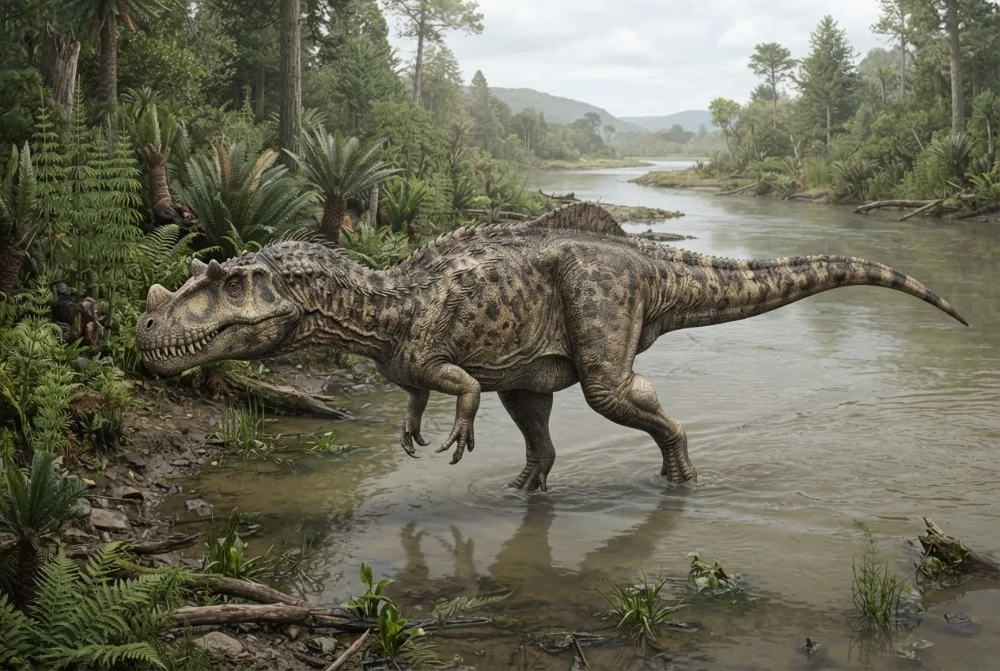
Its name means 'horned crocodile face' because of the bumpy horns above its eyes and its long, crocodile-like snout.1
It lived about 125 to 121 million years ago during the Early Cretaceous period.2
Ceratosuchops belonged to a group of spinosaurid dinosaurs that often had crocodile-like skulls and may have eaten fish.1
Its fossils were found on the Isle of Wight, a famous place for dinosaur discoveries in England.1
Scientists think Ceratosuchops lived near rivers and hunted like a modern heron, wading in shallow water to catch prey.1
Mafunso ofunsidwa kwambiri okhudza Ceratosuchops
?How big was Ceratosuchops?
About 9 metres (30 feet) long, with a skull about 1 metre (3.3 feet) long.3
?What did Ceratosuchops eat?
It ate fish, small turtles, young crocodiles, baby dinosaurs, and mammals.4
?When was Ceratosuchops discovered?
It was named in 2021, based on fossils found between 2013 and 2017.4
?Why does Ceratosuchops have horns?
The bony bumps above its eyes might have been used for signalling to other animals or for fighting.4
?Is Ceratosuchops a dinosaur?
Yes, it is a theropod dinosaur in the spinosaurid group.4
Kwa akatswiri a madino
- Dzina la sayansi
- Ceratosuchops
- Anapatsidwa dzina ndi
- Barker et al. 20216
- Gulu
- Maspinosauri
- Banja / kladi
- Spinosauridae6
- Magawidwe a sayansi
- Theropoda > Spinosauridae6
- Zaka za miyala
- zaka 126 mpaka 121 miliyoni (Barremian)6
- Mapangidwe a miyala
- Wessex6
- Mayiko
- United Kingdom6
- Zolemba za mafosili
- 1 mu The Paleobiology Database6
- Kupezeka
- Ceratosuchops was named by Barker and colleagues in 2021 based on fossils found on the Isle of Wight, England, between 2013 and 2017.1
- Akukambiranabe
- Scientists are not sure exactly how big Ceratosuchops grew, because only a few skull bones have been found so far.2
Kumene mfundo zimachokera
- New spinosaurids from the Wessex Formation (Early Cretaceous, UK) and the European origins of Spinosauridae (pmc.ncbi.nlm.nih.gov)
- PBDB Taxon (paleobiodb.org)
- Two New Species Of Large Predatory Dinosaur Discovered On Isle of Wight | University of Southampton (southampton.ac.uk)
- Ceratosuchops (en.wikipedia.org)
- New spinosaurids from the Wessex Formation (Early Cretaceous, UK) and the European origins of Spinosauridae | Scientific Reports (nature.com)
- Ceratosuchops in The Paleobiology Database (CC BY 4.0): zaka, malo, mapangidwe a miyala, magawidwe a sayansi.
Mfundo iliyonse patsamba lino ili ndi nambala yosonyeza kumene yachokera. Ngati talakwitsa kanthu, pepa, ndife okonda madino, osati magazini ya sayansi. Tiuze pa [email protected] ndipo tikonza.
 Rex ali ndi njala! Dino Wiki ndi ntchito ya bambo kwa mwana wawo wamwamuna wokonda madainoso, yaulere popanda zotsatsa ndi zokazonda. Akuluakulu angadyetse Rex zokhwasula-khwasula kuti tsambali lipitirize kupezeka pa intaneti.Dyetsa Rex
 Spinosaurus
 Baryonyx
 Suchomimus
 Angaturama
 Camarillasaurus
 Iberospinus
 Stegosaurus
 Iguanodon
 Archaeopteryx
 Giganotosaurus
 Microraptor
 Deinonychus