 Kwizi ya Ndiwe dino uti?
 Nkhondo ya madino
 Mpikisano wa madino
 Masewera ang'onoang'ono a madino
 Chimbale cha zomata
 Mindandanda ya TOP ya madino
 Ndidabwitse!
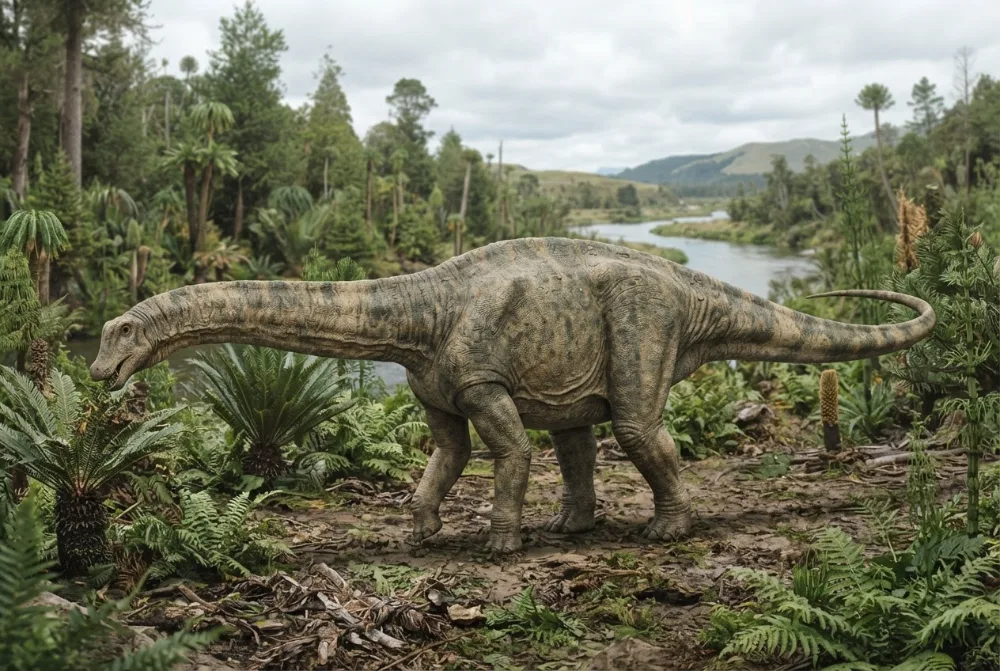
Chinshakiangosaurus
Chinshakiangosaurus was a huge, long-necked plant-eater that lived in China during the Early Jurassic. It is one of the earliest sauropods, the group that includes giants like Brachiosaurus and Diplodocus.1
Ankakhala liti?
Anali wamkulu bwanji?
Anali wautali bwanji?
Msinkhu wake unali wautali bwanji?
kuyerekeza
 wautali ngati magalimoto 3 oimikidwa pamzere🍌wautali ngati nthochi 72 zotsatizana🏃akanatha kuthamanga mamita 100 m'masekondi 20 (munthu waliwiro kwambiri amafunika 9.6)
Chinshakiangosaurus anali wamkulu bwanji poyerekeza ndi IWEYO?
Ndi masamu chabe mu msakatuli wako. Palibe chimene chimasungidwa kapena kutumizidwa kwina kulikonse.
Anali ndi liwiro lotani?


Mfundo zosangalatsa
Chinshakiangosaurus is one of the few early sauropods with preserved skull bones, which helps scientists understand how sauropods evolved.1
Its lower jaw was curved into a U-shape, like later sauropods, but unlike the V-shaped jaws of earlier prosauropods.1
Scientists think Chinshakiangosaurus may have had fleshy cheeks, a feature that helped it hold food while chewing.12
The only known fossil includes a left lower jaw, neck and back vertebrae, shoulder blades, hip bones, and hind legs.1
The name was first used in 1975 but was not properly described until 1992, so for many years it was just a name without a description.1
Chinshakiangosaurus lived about 200 million years ago, during the Hettangian stage of the Early Jurassic.3
Mafunso ofunsidwa kwambiri okhudza Chinshakiangosaurus
?How big was Chinshakiangosaurus?
About 12 to 13 meters long. That is roughly the length of a large city bus.12
?What did Chinshakiangosaurus eat?
It was an herbivore (plant-eater). Its broad U-shaped snout and blunt teeth helped it eat large amounts of leaves and other plants.1
?Did Chinshakiangosaurus have feathers?
There is no evidence that Chinshakiangosaurus had feathers. Sauropods like this one are not known to have feathers.1
Kwa akatswiri a madino
- Dzina la sayansi
- Chinshakiangosaurus
- Anapatsidwa dzina ndi
- Yeh 19753
- Gulu
- Makosi atali
- Banja / kladi
- Sauropoda3
- Magawidwe a sayansi
- Sauropodomorpha > Sauropoda3
- Zaka za miyala
- zaka 201 mpaka 200 miliyoni (Hettangian)3
- Mapangidwe a miyala
- Fengjiahe3
- Mayiko
- China3
- Zolemba za mafosili
- 1 mu The Paleobiology Database3
- Kupezeka
- The fossils were found in 1970 by Zhao Xijin and his team in Yongren County, Yunnan, China. The name was first used by Yeh in 1975, but the official description was published by Dong Zhiming in 1992.1
- Akukambiranabe
- Scientists are not sure exactly how Chinshakiangosaurus is related to other early sauropods, because most of its skeleton has not been studied in detail yet.1
Kumene mfundo zimachokera
- Chinshakiangosaurus (en.wikipedia.org)
- A re-evaluation of Chinshakiangosaurus chunghoensis Ye ... (ivpp.cas.cn)
- Chinshakiangosaurus in The Paleobiology Database (CC BY 4.0): zaka, malo, mapangidwe a miyala, magawidwe a sayansi.
Mfundo iliyonse patsamba lino ili ndi nambala yosonyeza kumene yachokera. Ngati talakwitsa kanthu, pepa, ndife okonda madino, osati magazini ya sayansi. Tiuze pa [email protected] ndipo tikonza.
 Rex ali ndi njala! Dino Wiki ndi ntchito ya bambo kwa mwana wawo wamwamuna wokonda madainoso, yaulere popanda zotsatsa ndi zokazonda. Akuluakulu angadyetse Rex zokhwasula-khwasula kuti tsambali lipitirize kupezeka pa intaneti.Dyetsa Rex
 Brachiosaurus
 Diplodocus
 Brontosaurus
 Argentinosaurus
 Camarasaurus
 Morosaurus
 Dilophosaurus
 Stenopterygius
 Dorygnathus
 Scutellosaurus
 Sinosaurus
 Temnodontosaurus