 Kwizi ya Ndiwe dino uti?
 Nkhondo ya madino
 Mpikisano wa madino
 Masewera ang'onoang'ono a madino
 Chimbale cha zomata
 Mindandanda ya TOP ya madino
 Ndidabwitse!
Dearc
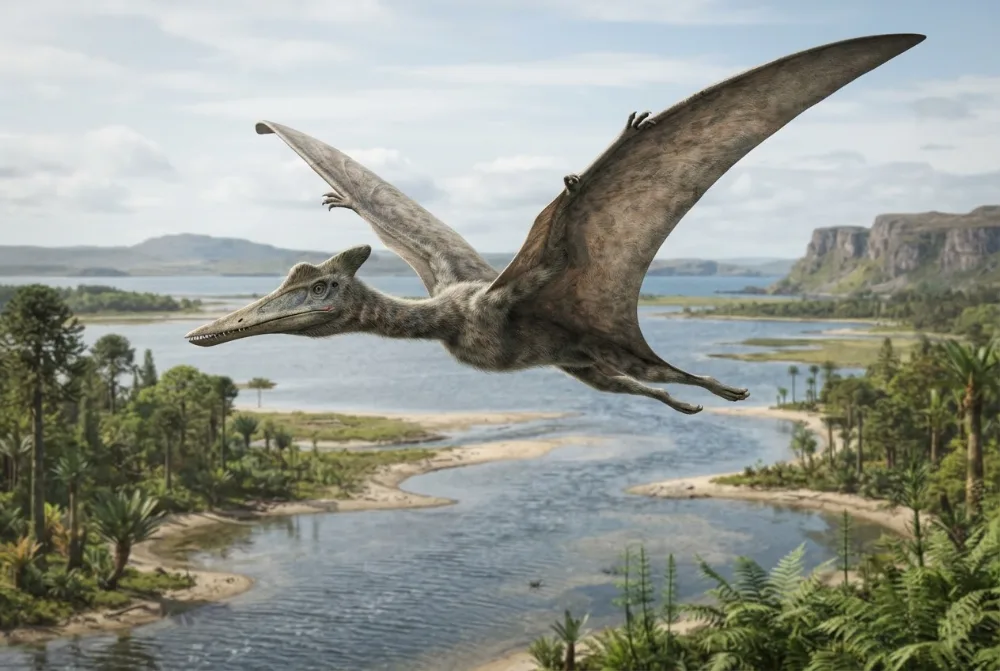
Dearc was a flying reptile that lived in the Middle Jurassic, about 167 million years ago. It was one of the biggest flying animals of its time, with wings as wide as a small car! It soared over the lagoons of what is now Scotland.1
Ankakhala liti?
Anali wamkulu bwanji?
Mapiko ake anali otambalala bwanji?
 mapiko otambalala ngati njinga 1.5 pamzere⚽akanatha kuuluka kudutsa bwalo lonse la mpira m'masekondi 7.3
Dearc anali wamkulu bwanji poyerekeza ndi IWEYO?
Ndi masamu chabe mu msakatuli wako. Palibe chimene chimasungidwa kapena kutumizidwa kwina kulikonse.
Anali ndi liwiro lotani?


Mfundo zosangalatsa
Dearc was not fully grown when it died. It was a juvenile or subadult, still actively growing, so adults might have been even bigger.13
Its wingspan was about 2.5 to 3 metres (8 to 10 feet), as wide as a wandering albatross, the largest flying bird today.1
Before Dearc was discovered, scientists thought pterosaurs stayed small until the Cretaceous period. Dearc shows they got big much earlier.13
The fossil was found at Brothers' Point on the Isle of Skye in 2017, during a National Geographic-funded field trip.1
Its name comes from Scottish Gaelic and means both 'winged reptile' and 'reptile from Skye', because Skye is called the 'winged isle'.1
Dearc had a long, low skull and a slender upper arm bone, which helped it fly.1
Mafunso ofunsidwa kwambiri okhudza Dearc
?How big was Dearc?
Dearc had a wingspan of about 2.5 to 3 metres, as wide as a wandering albatross, the largest flying bird today. It was not fully grown when it died, so adults might have been even bigger.34
?When did Dearc live?
Dearc lived in the Middle Jurassic, about 167 million years ago.3
?Where was Dearc found?
The fossil was found at Brothers' Point on the Isle of Skye in Scotland in 2017.3
?What did Dearc eat?
Dearc had two types of teeth: long fangs at the front and peg-like teeth further back, which suggests it ate fish or other small animals.3
?Is Dearc a dinosaur?
No, Dearc is a pterosaur, a flying reptile, not a dinosaur.3
Kwa akatswiri a madino
- Dzina la sayansi
- Dearc
- Anapatsidwa dzina ndi
- Jagielska et al. 20226
- Gulu
- Zokwawa zouluka
- Banja / kladi
- Rhamphorhynchidae6
- Magawidwe a sayansi
- Pterosauria > Rhamphorhynchidae6
- Zaka za miyala
- zaka 168 mpaka 165 miliyoni (Bathonian)6
- Mapangidwe a miyala
- Lealt Shale6
- Mayiko
- United Kingdom6
- Zolemba za mafosili
- 1 mu The Paleobiology Database6
- Kupezeka
- The first Dearc fossil was discovered on May 23, 2017, at Brothers' Point on the Isle of Skye, Scotland, by a team led by Stephen Brusatte. It was named Dearc sgiathanach by Jagielska and colleagues in 2022.1
- Akukambiranabe
- Scientists are not sure exactly how big Dearc could grow, because the only known fossil is from a young animal that was still growing.1
Kumene mfundo zimachokera
- A skeleton from the Middle Jurassic of Scotland illuminates an earlier origin of large pterosaurs: Current Biology (cell.com)
- PBDB Taxon (paleobiodb.org)
- Dearc (en.wikipedia.org)
- Report A skeleton from the Middle Jurassic of Scotland illuminates an earlier origin of large pterosaurs (sciencedirect.com)
- Jurassic Dearc | Nature Ecology & Evolution (nature.com)
- Dearc in The Paleobiology Database (CC BY 4.0): zaka, malo, mapangidwe a miyala, magawidwe a sayansi.
Mfundo iliyonse patsamba lino ili ndi nambala yosonyeza kumene yachokera. Ngati talakwitsa kanthu, pepa, ndife okonda madino, osati magazini ya sayansi. Tiuze pa [email protected] ndipo tikonza.
 Rex ali ndi njala! Dino Wiki ndi ntchito ya bambo kwa mwana wawo wamwamuna wokonda madainoso, yaulere popanda zotsatsa ndi zokazonda. Akuluakulu angadyetse Rex zokhwasula-khwasula kuti tsambali lipitirize kupezeka pa intaneti.Dyetsa Rex
 Pteranodon
 Quetzalcoatlus
 Dorygnathus
 Rhamphorhynchus
 Anhanguera
 Pterodactylus
 Ichthyosaurus
 Khudiakovia
 Ophthalmosaurus
 Peloneustes
 Gongbusaurus
 Shunosaurus