 Kwizi ya Ndiwe dino uti?
 Nkhondo ya madino
 Mpikisano wa madino
 Masewera ang'onoang'ono a madino
 Chimbale cha zomata
 Mindandanda ya TOP ya madino
 Ndidabwitse!
Ankakhala liti?

Anali wamkulu bwanji?
Anali wautali bwanji?
Msinkhu wake unali wautali bwanji?
 wautali ngati magalimoto 3 oimikidwa pamzere🍌wautali ngati nthochi 72 zotsatizana🏃akanatha kuthamanga mamita 100 m'masekondi 20 (munthu waliwiro kwambiri amafunika 9.6)
Yunnanosaurus anali wamkulu bwanji poyerekeza ndi IWEYO?
Ndi masamu chabe mu msakatuli wako. Palibe chimene chimasungidwa kapena kutumizidwa kwina kulikonse.
Anali ndi liwiro lotani?


Mfundo zosangalatsa
Yunnanosaurus had more than sixty spoon-shaped teeth that were self-sharpening because they wore against each other as the animal fed.1
Its teeth were advanced for an early sauropodomorph and looked like those of later giant sauropods, but scientists think this similarity evolved separately.1
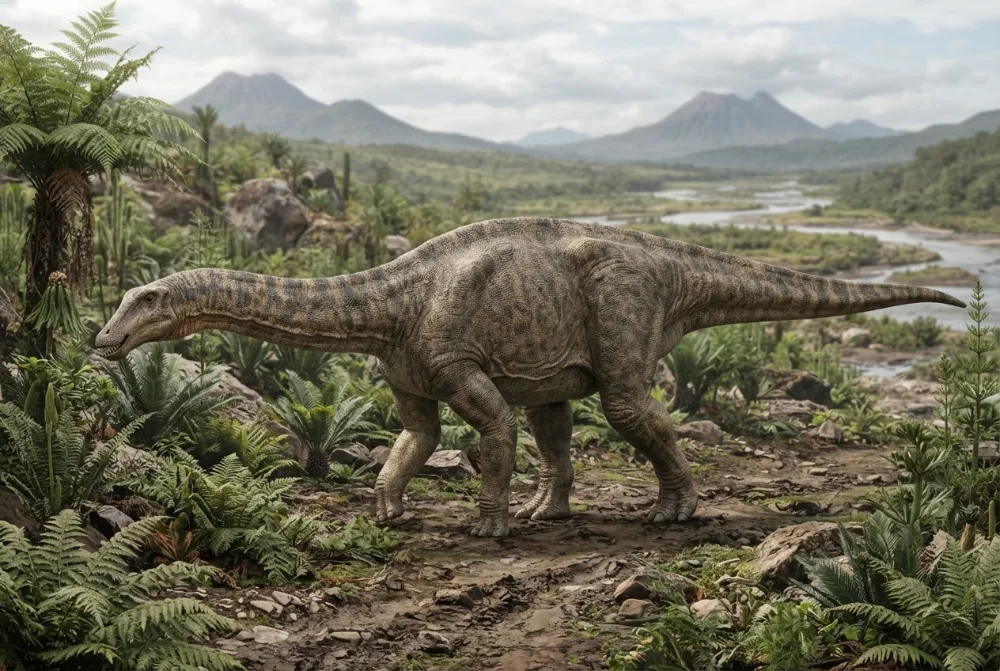
The largest species, Yunnanosaurus youngi, reached about 13 metres (42 feet) long, as big as a school bus.1
The first fossils were discovered by Chinese paleontologist Yang Zhongjian (also known as C. C. Young) in the early 1940s.1
Yunnanosaurus lived between about 201 and 183 million years ago, during the Early Jurassic Period.12
It could walk on two legs or on all fours, making it a versatile mover through its ancient environment.1
Mafunso ofunsidwa kwambiri okhudza Yunnanosaurus
?How big was Yunnanosaurus?
The smallest species, Y. huangi, was about 7 metres (23 feet) long, while the largest, Y. youngi, reached about 13 metres (43 feet) long, roughly the size of a school bus.13
?What did Yunnanosaurus eat?
It was a herbivore that ate plants. Its spoon-shaped teeth were self-sharpening, and it fed on softer, less fibrous plants than later giant sauropods.13
?When did Yunnanosaurus live?
Yunnanosaurus lived during the Early Jurassic Period, about 201 to 183 million years ago.13
?Where was Yunnanosaurus found?
Its fossils were found in Yunnan Province, China. The first skeletons were discovered in the Lufeng Formation.1
?Did Yunnanosaurus have feathers?
No known fossils show feathers on Yunnanosaurus. It is not related to feathered dinosaurs like birds.1
?Could Yunnanosaurus walk on two legs?
Yes, it could walk on two legs or on all fours. It was a versatile mover that could switch between bipedal and quadrupedal walking.1
Wothetsa nthano zabodza
Nthano: Yunnanosaurus is often called a prosauropod, meaning it was a direct ancestor of sauropods.
Zoona: Scientists now place Yunnanosaurus in a group called Sauropodiformes, which is closer to true sauropods but not a direct ancestor.1
Kwa akatswiri a madino
- Dzina la sayansi
- Yunnanosaurus
- Anapatsidwa dzina ndi
- Young 19404
- Gulu
- Makosi atali
- Banja / kladi
- Sauropodiformes4
- Magawidwe a sayansi
- Sauropodomorpha4
- Zaka za miyala
- zaka 201 mpaka 184 miliyoni (Hettangian / Pliensbachian)4
- Mapangidwe a miyala
- Lufeng, Fengjiahe4
- Mayiko
- China4
- Zolemba za mafosili
- 17 mu The Paleobiology Database4
- Kupezeka
- Chinese paleontologist C. C. Young (Yang Zhongjian) named Yunnanosaurus in 1942 after finding many skeletons in Yunnan, China. The type species is Yunnanosaurus huangi.1
- Akukambiranabe
- Scientists are not sure whether Yunnanosaurus robustus is a separate species or just a larger individual of Yunnanosaurus huangi.1
Kumene mfundo zimachokera
- Yunnanosaurus (en.wikipedia.org)
- PBDB Taxon (paleobiodb.org)
- Yunnanosaurus | Natural History Museum (nhm.ac.uk)
- Yunnanosaurus in The Paleobiology Database (CC BY 4.0): zaka, malo, mapangidwe a miyala, magawidwe a sayansi.
Mfundo iliyonse patsamba lino ili ndi nambala yosonyeza kumene yachokera. Ngati talakwitsa kanthu, pepa, ndife okonda madino, osati magazini ya sayansi. Tiuze pa [email protected] ndipo tikonza.
 Rex ali ndi njala! Dino Wiki ndi ntchito ya bambo kwa mwana wawo wamwamuna wokonda madainoso, yaulere popanda zotsatsa ndi zokazonda. Akuluakulu angadyetse Rex zokhwasula-khwasula kuti tsambali lipitirize kupezeka pa intaneti.Dyetsa Rex
 Brachiosaurus
 Diplodocus
 Brontosaurus
 Argentinosaurus
 Camarasaurus
 Morosaurus
 Dilophosaurus
 Stenopterygius
 Dorygnathus
 Scutellosaurus
 Sinosaurus
 Temnodontosaurus