 Kwizi ya Ndiwe dino uti?
 Nkhondo ya madino
 Mpikisano wa madino
 Masewera ang'onoang'ono a madino
 Chimbale cha zomata
 Mindandanda ya TOP ya madino
 Ndidabwitse!
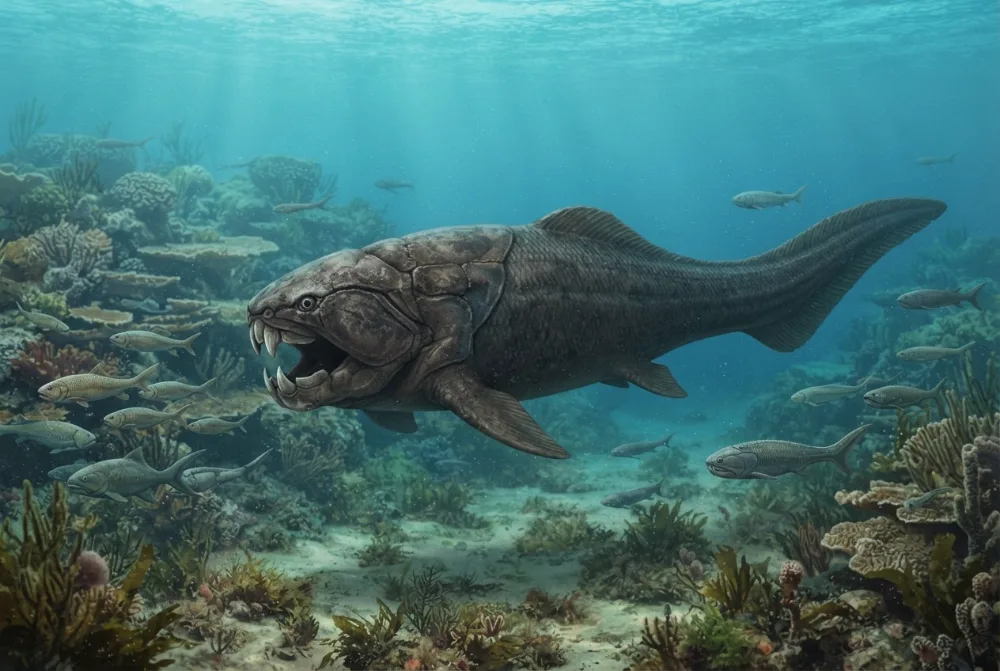
Dunkleosteus
Dunkleosteus was a giant armoured fish that swam in the oceans about 382 to 358 million years ago. It had thick bone plates on its head and front body, and it was one of the first big predators in the sea. It wasn't a dinosaur, but it was super scary!1
Ankakhala liti?
Anali wamkulu bwanji?
Anali wautali bwanji?
Ankalemera bwanji?
 wautali ngati magalimoto 2 oimikidwa pamzere🍌wautali ngati nthochi 56 zotsatizana
 wolemera ngati agalu 200🍉wolemera ngati mavwende 800🎒wolemera ngati makalasi athunthu a ana a sukulu 5🐻❄️wolemera ngati zimbalangondo zoyera 9🏊akanatha kusambira utali wa dziwe lalikulu losambira (50 m) m'masekondi 7.2
Dunkleosteus anali wamkulu bwanji poyerekeza ndi IWEYO?
Ndi masamu chabe mu msakatuli wako. Palibe chimene chimasungidwa kapena kutumizidwa kwina kulikonse.
Anali ndi liwiro lotani?


Mfundo zosangalatsa
Dunkleosteus had a four-bar linkage in its skull that let it open its jaws in just 20 milliseconds, as fast as a blink!1
Its bite force was estimated at up to 7,495 newtons (about 1,685 pounds), which is among the highest of any fish ever.1
Instead of teeth, Dunkleosteus had sharp, blade-like bony plates in its jaws that could cut through armoured prey.1
Fossils of Dunkleosteus are often found with boluses of fish bones, which are the undigested remains of its last meals.1
The armour plates on its head and front body were up to 7.6 cm (3 inches) thick in some places, but thinner elsewhere.1
Dunkleosteus might have been a fast swimmer, not slow as once thought, because it could catch fast fish like Orodus.1
Mafunso ofunsidwa kwambiri okhudza Dunkleosteus
?How big was Dunkleosteus?
The largest known species, Dunkleosteus terrelli, was probably about 3.4 metres (11 feet) long for typical adults, and up to 4.1 metres (13 feet) for exceptionally large individuals. Some older estimates were much bigger, but recent studies suggest these smaller sizes.1
?Did Dunkleosteus have teeth?
No, instead of teeth it had sharp, blade-like bony plates in its jaws that could cut through armoured prey. These blades even sharpened themselves as the fish opened and closed its mouth.13
?What did Dunkleosteus eat?
It ate armoured prey like ammonites and other placoderms, and could even catch fast-swimming fish like Orodus. Fossils show it sometimes regurgitated bones from its last meal.1
?How fast could Dunkleosteus open its mouth?
It could open its jaws in just 20 milliseconds and complete a feeding snap in 50 to 60 milliseconds, which is as fast as a blink. This helped it catch fast prey.4
?Was Dunkleosteus a dinosaur?
No, it was a giant armoured fish that lived in the oceans during the Devonian Period, long before dinosaurs existed. It belonged to a group called placoderms.1
?How strong was Dunkleosteus' bite?
Its bite force was estimated at up to 7,495 newtons, which is among the highest of any fish ever. That is strong enough to puncture armour.14
?Where have Dunkleosteus fossils been found?
Fossils have been found in the United States, Canada, Poland, Belgium, Morocco, and Russia. The largest collection is at the Cleveland Museum of Natural History in Ohio.1
?When did Dunkleosteus live?
It lived during the Late Devonian Period, about 382 to 358 million years ago. That is before the first dinosaurs appeared.1
?Could Dunkleosteus swim fast?
Yes, it might have been a fast swimmer, not slow as once thought. It could catch fast-swimming fish like Orodus, which suggests it was quick.1
?Why did Dunkleosteus have armour?
Its thick bone plates on the head and front body protected it from other predators and helped it hunt armoured prey. The plates were up to 7.6 cm (3 inches) thick in some places.1
Wothetsa nthano zabodza
Nthano: Dunkleosteus was a dinosaur.
Zoona: Dunkleosteus was not a dinosaur. It was a fish, specifically an arthrodire placoderm, and it lived long before the first dinosaurs.1
Kwa akatswiri a madino
- Dzina la sayansi
- Dunkleosteus
- Anapatsidwa dzina ndi
- Newberry 18745
- Gulu
- Ngwazi za kalekale
- Banja / kladi
- Dunkleosteidae5
- Magawidwe a sayansi
- Placodermi > Phlyctaeniiformes > Dunkleosteidae5
- Zaka za miyala
- zaka 388 mpaka 359 miliyoni (Givetian / Famennian)5
- Mapangidwe a miyala
- Ohio Shale, Lost Burro, Tērvete5
- Mayiko
- Amereka, Latvia, Kanada5
- Zolemba za mafosili
- 7 mu The Paleobiology Database5
- Kupezeka
- The first fossils were found in 1867 by Jay Terrell, an amateur paleontologist, near Lake Erie in Ohio, USA. The species was named Dunkleosteus terrelli in 1956, honouring both David Dunkle and Jay Terrell.1
- Akukambiranabe
- Scientists still debate how Dunkleosteus fed. Some think it used suction to gulp prey, but a 2025 study suggests it actively bit and tore prey, and its bite force estimates might need to be revised.1
Kumene mfundo zimachokera
- Dunkleosteus (en.wikipedia.org)
- PBDB Taxon (paleobiodb.org)
- Meet Dunk: Ohio’s Ancient Apex Predator (cmnh.org)
- Feeding mechanics and bite force modelling of the skull of Dunkleosteus terrelli , an ancient apex predator (pmc.ncbi.nlm.nih.gov)
- Dunkleosteus in The Paleobiology Database (CC BY 4.0): zaka, malo, mapangidwe a miyala, magawidwe a sayansi.
Mfundo iliyonse patsamba lino ili ndi nambala yosonyeza kumene yachokera. Ngati talakwitsa kanthu, pepa, ndife okonda madino, osati magazini ya sayansi. Tiuze pa [email protected] ndipo tikonza.
 Rex ali ndi njala! Dino Wiki ndi ntchito ya bambo kwa mwana wawo wamwamuna wokonda madainoso, yaulere popanda zotsatsa ndi zokazonda. Akuluakulu angadyetse Rex zokhwasula-khwasula kuti tsambali lipitirize kupezeka pa intaneti.Dyetsa Rex
 Megalodon
 Sabre-toothed cat
 Dimetrodon
 Woolly mammoth
 Arthropleura
 Helicoprion