 Kwizi ya Ndiwe dino uti?
 Nkhondo ya madino
 Mpikisano wa madino
 Masewera ang'onoang'ono a madino
 Chimbale cha zomata
 Mindandanda ya TOP ya madino
 Ndidabwitse!
Ankakhala liti?

Anali wamkulu bwanji?
Anali wautali bwanji?
Ankalemera bwanji?
Eoalulavis anali wamkulu bwanji poyerekeza ndi IWEYO?
Ndi masamu chabe mu msakatuli wako. Palibe chimene chimasungidwa kapena kutumizidwa kwina kulikonse.
Anali ndi liwiro lotani?


Mfundo zosangalatsa
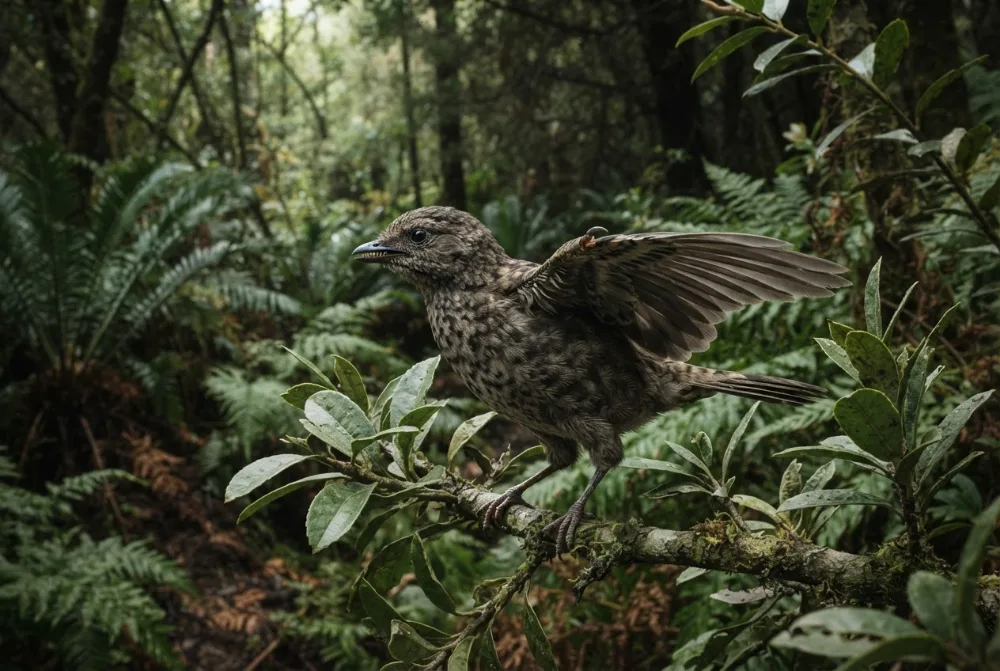
Eoalulavis was about the size of a European goldfinch, weighing only about 45 grams (1.6 ounces).1
Its wingspan, including feathers, was only about 26 centimeters (10 inches), similar to a modern kingfisher.1
The name Eoalulavis means 'dawn alula bird' because it is one of the earliest birds known to have an alula, or 'bastard wing'.1
Scientists found the remains of its last meal inside the fossil: concentrated pieces of crustacean shells.1
Eoalulavis had a very thin, spear-shaped breastbone, unlike the wide breastbones of most early birds.1
It likely flew in a bounding style, flapping hard then tucking its wings to dive, like modern songbirds and woodpeckers.1
The fossil was preserved with feathers and soft tissues because it was buried quickly in a lake with special conditions.1
Mafunso ofunsidwa kwambiri okhudza Eoalulavis
?What did Eoalulavis eat?
It ate small crustaceans. Scientists found pieces of crustacean shells in its fossilized belly, its last meal.1
?How big was Eoalulavis?
It was tiny, about the size of a European goldfinch. It weighed about 45 grams and had a wingspan of about 26 centimeters.1
?Could Eoalulavis fly well?
Yes, it was a good flier. It had an alula for slow, sharp turns and likely used bounding flight, flapping hard then diving with wings folded, like modern songbirds.1
?Is Eoalulavis a dinosaur?
Yes, it is a bird, and birds are a type of dinosaur called avialan dinosaurs. It lived about 125 million years ago.1
Kwa akatswiri a madino
- Dzina la sayansi
- Eoalulavis
- Anapatsidwa dzina ndi
- Sanz et al. 19962
- Gulu
- Mbalame zoyambirira
- Banja / kladi
- Enantiornithes2
- Magawidwe a sayansi
- Theropoda > Avialae2
- Zaka za miyala
- zaka 126 mpaka 121 miliyoni (Barremian)2
- Mapangidwe a miyala
- La Huérguina2
- Mayiko
- Sipeyini2
- Zolemba za mafosili
- 1 mu The Paleobiology Database2
- Kupezeka
- Eoalulavis was named in 1996 by Sanz and colleagues based on a single fossil skeleton found at Las Hoyas in Spain.12
- Akukambiranabe
- Scientists are not sure what its hind legs looked like because no leg bones have been found.1
Kumene mfundo zimachokera
- Eoalulavis (en.wikipedia.org)
- Eoalulavis in The Paleobiology Database (CC BY 4.0): zaka, malo, mapangidwe a miyala, magawidwe a sayansi.
Mfundo iliyonse patsamba lino ili ndi nambala yosonyeza kumene yachokera. Ngati talakwitsa kanthu, pepa, ndife okonda madino, osati magazini ya sayansi. Tiuze pa [email protected] ndipo tikonza.
 Rex ali ndi njala! Dino Wiki ndi ntchito ya bambo kwa mwana wawo wamwamuna wokonda madainoso, yaulere popanda zotsatsa ndi zokazonda. Akuluakulu angadyetse Rex zokhwasula-khwasula kuti tsambali lipitirize kupezeka pa intaneti.Dyetsa Rex
 Archaeopteryx
 Hesperornis
 Ichthyornis
 Baptornis
 Jurapteryx
 Gobipteryx
 Stegosaurus
 Iguanodon
 Giganotosaurus
 Microraptor
 Deinonychus
 Baryonyx