 Kwizi ya Ndiwe dino uti?
 Nkhondo ya madino
 Mpikisano wa madino
 Masewera ang'onoang'ono a madino
 Chimbale cha zomata
 Mindandanda ya TOP ya madino
 Ndidabwitse!
Harpactognathus
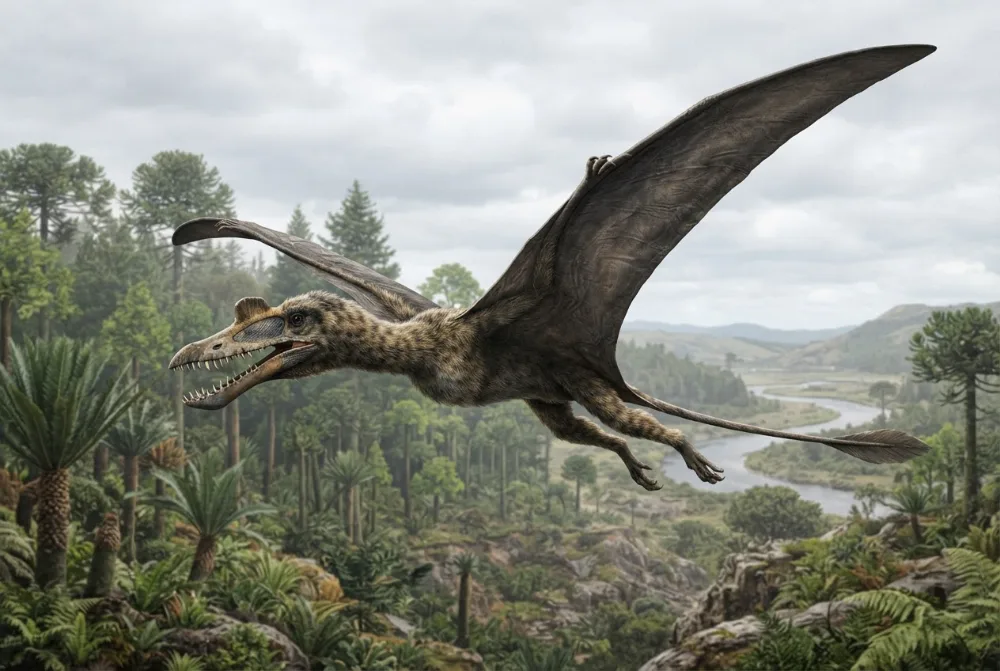
Harpactognathus was a large flying reptile that lived during the Jurassic period. It had a strong, wide beak and sharp teeth for grabbing prey. This pterosaur was one of the biggest of its kind that did not belong to the short-tailed pterodactyl group.1
Ankakhala liti?
Anali wamkulu bwanji?
Mapiko ake anali otambalala bwanji?
 mapiko otambalala ngati njinga 1.5 pamzere⚽akanatha kuuluka kudutsa bwalo lonse la mpira m'masekondi 7.3
Harpactognathus anali wamkulu bwanji poyerekeza ndi IWEYO?
Ndi masamu chabe mu msakatuli wako. Palibe chimene chimasungidwa kapena kutumizidwa kwina kulikonse.
Anali ndi liwiro lotani?


Mfundo zosangalatsa
Harpactognathus is known from only a partial skull and a few other bones, so scientists are still learning about its full appearance.1
It had a crest on the front of its skull that might have been used for display to attract mates or show off to rivals.1
With a wingspan of about 2.5 metres (8.2 feet), Harpactognathus was among the largest non-pterodactyloid pterosaurs.1
Its fossils were found in the Morrison Formation, the same rock layer that contains famous dinosaurs like Stegosaurus and Diplodocus.1
Unlike many other pterosaurs that ate fish, Harpactognathus probably hunted small animals on land near rivers and lakes.1
The name Harpactognathus comes from Greek words meaning 'seizing jaw', which describes its strong, grabbing beak.1
Mafunso ofunsidwa kwambiri okhudza Harpactognathus
?Was Harpactognathus a dinosaur?
No, Harpactognathus was a pterosaur, a flying reptile, not a dinosaur.1
?How big was Harpactognathus?
It had an estimated wingspan of about 2.5 metres (8.2 feet) and a skull length of 280 to 300 millimetres (11 to 12 inches).1
?What did Harpactognathus eat?
It was a terrestrial carnivore that probably hunted small animals on land near rivers and lakes, not fish like many other pterosaurs.1
?Where was Harpactognathus found?
Its fossils were found in the Morrison Formation in Wyoming, USA, the same rock layer as Stegosaurus and Diplodocus.1
?Did Harpactognathus have a crest?
Yes, it had a thin crest on the front of its skull that may have been used for display to attract mates or show off to rivals.1
?When did Harpactognathus live?
It lived during the Kimmeridgian stage of the Late Jurassic period, about 157 to 152 million years ago.1
Wothetsa nthano zabodza
Nthano: Harpactognathus is often thought to be a dinosaur.
Zoona: Harpactognathus was a pterosaur, a flying reptile that is not a dinosaur.1
Kwa akatswiri a madino
- Dzina la sayansi
- Harpactognathus
- Anapatsidwa dzina ndi
- Carpenter et al. 20032
- Gulu
- Zokwawa zouluka
- Banja / kladi
- Lonchognatha2
- Magawidwe a sayansi
- Pterosauria2
- Zaka za miyala
- zaka 152 mpaka 145 miliyoni (Kimmeridgian / Tithonian)2
- Mapangidwe a miyala
- Morrison2
- Mayiko
- Amereka2
- Zolemba za mafosili
- 1 mu The Paleobiology Database2
- Kupezeka
- Harpactognathus was named in 2003 by paleontologist Kenneth Carpenter and his team. The first fossil, a partial snout, was found in 1996 at Bone Cabin Quarry in Wyoming, USA. The species name honors Joe Gentry, a volunteer who helped with fossil preparation.1
- Akukambiranabe
- Scientists are not sure whether Harpactognathus belongs to the scaphognathine or rhamphorhynchine group of pterosaurs, because its fossils are so incomplete.1
Kumene mfundo zimachokera
- Harpactognathus (en.wikipedia.org)
- Harpactognathus in The Paleobiology Database (CC BY 4.0): zaka, malo, mapangidwe a miyala, magawidwe a sayansi.
Mfundo iliyonse patsamba lino ili ndi nambala yosonyeza kumene yachokera. Ngati talakwitsa kanthu, pepa, ndife okonda madino, osati magazini ya sayansi. Tiuze pa [email protected] ndipo tikonza.
 Rex ali ndi njala! Dino Wiki ndi ntchito ya bambo kwa mwana wawo wamwamuna wokonda madainoso, yaulere popanda zotsatsa ndi zokazonda. Akuluakulu angadyetse Rex zokhwasula-khwasula kuti tsambali lipitirize kupezeka pa intaneti.Dyetsa Rex
 Pteranodon
 Quetzalcoatlus
 Dorygnathus
 Rhamphorhynchus
 Anhanguera
 Pterodactylus
 Brachiosaurus
 Diplodocus
 Allosaurus
 Brontosaurus
 Compsognathus
 Camarasaurus